A 3D scanner was more accurate than the techniques it was compared with in 61.1% of reviewed studies. Yet in a validation study of 265 adults, an infrared scan put mean body fat at 18.1%, compared with 22.8% from underwater weighing. The results show why accuracy depends on the task: a digital body model can perform well on one measurement and miss another.
If a model looks precise, why might a shopper still order the wrong size and return it? A model is an estimate, not a copy of the person. Its measurements have limits, and creating it can involve a privacy cost. Those limits matter when judging whether a fit recommendation is useful.
Table of Contents
- What a 3D Body Image Is
- 3D Body Image vs 2D Photos and Avatars
- How 3D Body Images Are Captured
- Where 3D Body Images Are Used in Fashion
- Accuracy Limits and Common Misconceptions
- Privacy, Consent and Body Image Safeguards
- Check a 3D Body Image Tool Before You Trust It
What a 3D Body Image Is
A 3D body image is a digital, three-dimensional model of a real person's body shape, built from scans, photos, or body data.
Say you are helping a colleague pick a coat online. A phone photo of them is a flat picture. You can see colour, a smile, and a rough outline, but you cannot walk around it or read a waist from it. A 3D body image is closer to a sculpture you can turn, measure, and dress. Spin it and the chest still has depth. Measure it and you get a number, not a guess from a silhouette.
What you see in a fitting tool is three layers stacked on that sculpture.
Surface geometry is the outside of the body, stored as a mesh (a net of tiny triangles) or a point cloud (a spray of measured points). Anatomical landmarks are named spots on that surface, such as the shoulder, waist, and hip, so two scans can be compared at the same places. Derived values are the numbers calculated from the surface: circumferences, lengths, and body volume.
The idea is older than phone selfies. In 1973, researchers proposed a light-sectioning technique to study the human body as a three-dimensional object, and reading those captures took heavy manual work, as a review of 3D anthropometry recounts. In the early 1990s, hardware and software produced body scanners that captured a whole body faster and more consistently than tape measurements. The same account describes CAESAR (Civilian American and European Surface Anthropometry Resource), run from April 1998 through early 2000, which scanned adults aged 18 to 65 in standing, full-coverage, and relaxed seated poses so shape and posture could be studied together, not only height, chest, waist, or hip.
A 3D body image is not a photo, a cartoon avatar, or a clinical measurement. It is a measured surface plus the numbers pulled from it, and those numbers are estimates.
If you can tell a colleague that in two sentences, you have the term.
3D Body Image vs 2D Photos and Avatars
A 2D photo shows how a person looks, a 3D body image encodes how a person is shaped, and an avatar is a character that may or may not be based on a real body.
| Feature | 2D photo | 3D body image | Avatar |
|---|---|---|---|
| Shape information | Flat outline and colour | Full surface geometry with depth | Stylised or generic shape |
| Measurements | None without a reference object | Circumferences, lengths, and volumes | Set by the designer or user input |
| Source | Camera photo | Scanner, multi-camera rig, depth sensor, or selfie-based reconstruction | Created by a 3D artist or generated from settings |
| Based on a real person | Yes | Usually yes | Sometimes, often not |
| Privacy exposure | Shows face and full appearance | Body geometry tied to a person | Usually low when not based on a real body |
| Typical use | Product photos and social media | Size recommendation, fit analysis, and try-on | Games, film, virtual characters, and social play |
When an avatar is just a costume
An avatar can be a 3D body image, but only when it is built from a real person's measurements. A generic game character encodes no sizing value. You can dress that character in a jacket and it will look dressed. You cannot ask it whether the jacket's size M matches your chest.
Two catalogue photos of the same shirt on a model show drape, colour, and how the fabric falls on that one body. They do not tell a retailer whether the chest and waist will match the person about to click buy. Only a body model with circumferences lets the store compare the shopper with the garment's size chart.
Use 2D for appearance and marketing. Use a 3D body image for sizing and fit analysis. Use avatars for expression or entertainment. Keep one caveat in view while you choose: even the shaped model is an estimate, and later checks show where that estimate bends.
How 3D Body Images Are Captured
Every method, from a lab booth to a short questionnaire, runs the same four stages. Capture the body. Reconstruct a 3D surface. Detect landmarks and measure. Output a body model with dimensions.
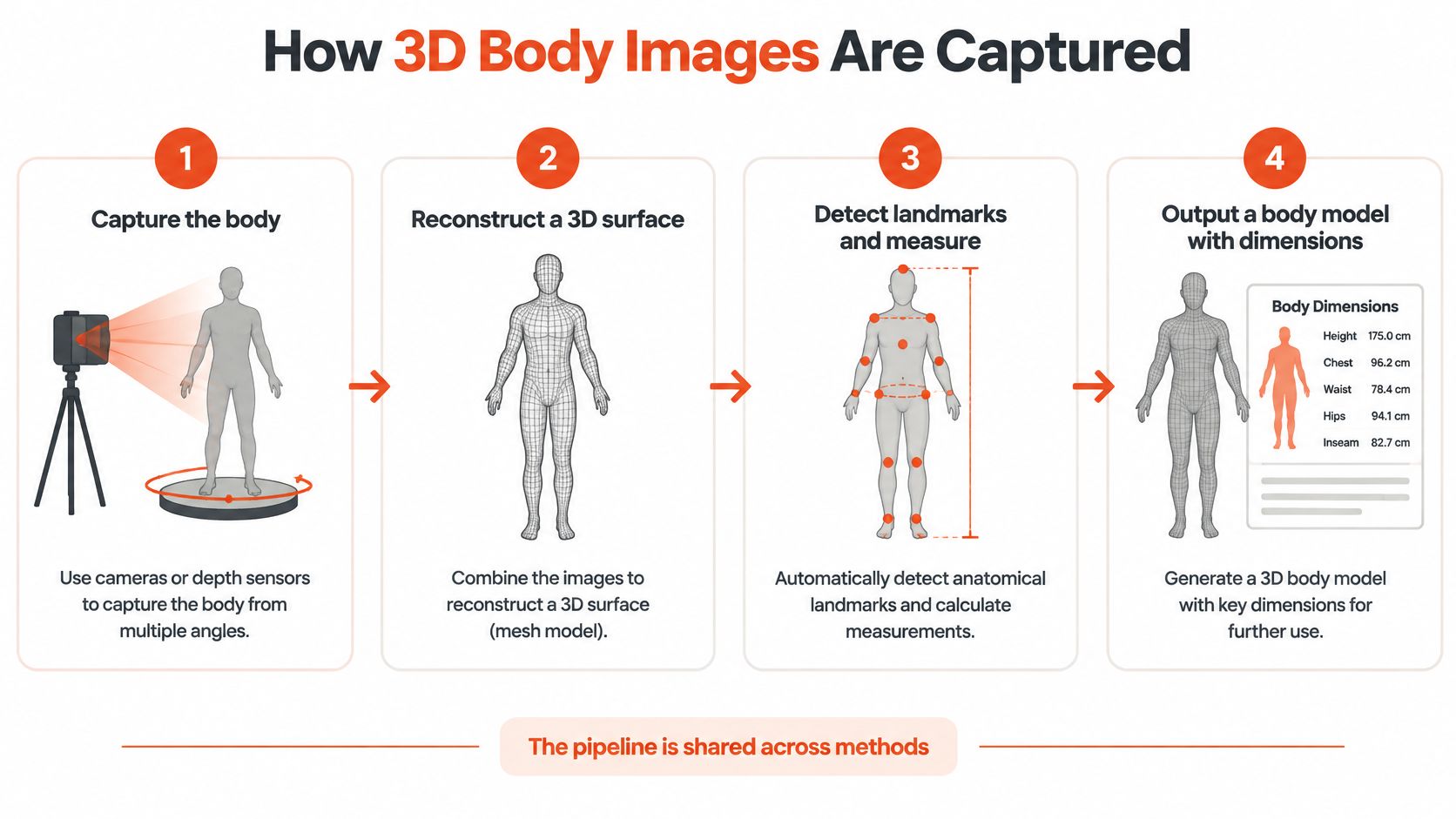
Capture records the outside of the person, either with sensors or with answers the person types. Reconstruction turns that record into a surface with depth. Landmarks and measures mark the shoulder, waist, hip, and similar points, then calculate circumferences, lengths, and volume. Output is the model plus those dimensions, ready for a size chart.
The pipeline is shared. The honesty of each stage is not.
| Method | How it works | Typical accuracy | Shopper effort |
|---|---|---|---|
| Multi-camera or structured-light booth | Projects patterns or uses many cameras to capture the body at once | High in research and survey use | Stand still in a booth or studio |
| Laser or 3D body scanner | Sensors sweep around the body to capture surface geometry | High; validated against tape measures in most studies | Visit a scanner location |
| Depth sensor on a phone or webcam | Uses depth data to build a body mesh | Moderate; lighting and pose change the mesh | Short capture at home |
| Photogrammetry from several photos | Reconstructs shape from overlapping photos taken from several angles | Moderate; clothing and pose change the result | Take several photos |
| Questionnaire-based model | Builds a body model from height, weight, age, and a chosen body-proportion illustration | Estimate only; no direct scan | Answer a few questions |
Why the scan still needs a tape check
Optical scanning captures circumferences, body volumes, and shape variables that line up strongly with tape anthropometry and with reference methods such as DXA and air-displacement plethysmography. A systematic review of 3D scanners found excellent accuracy or reliability in most of the studies it evaluated, and scanners were more accurate than the comparator techniques in 61.1% of those studies.
That is not a blank cheque. Scan-derived measurements can carry systematic bias at anatomical landmarks, so a production pipeline should be checked against tape measurements in the population it will serve, rather than treated as universally equivalent. A booth that is tight on athletic torsos can drift at the hip on other bodies. A phone depth sensor can lose the side of the waist if the room is dim or the arms sit too close to the ribs.
Practical rule: The less surface a method records, the more the model is filled in by assumption. A questionnaire model is an estimate by design.
Home methods ask less of the shopper and reveal less of the surface. If you are matching a result to a brand chart, start from the chart's own measurements, the way a women's clothing size chart for Australia lays out waist, hip, and related dimensions, and only then ask whether the body model measured those same places.
Where 3D Body Images Are Used in Fashion
Maya orders the same jeans size from three brands and sends two pairs back. The waistband on one gapes. The second won't button. The third is fine until she sits. Her "usual size" was never a measurement. It was a memory of the last pair that happened to work.
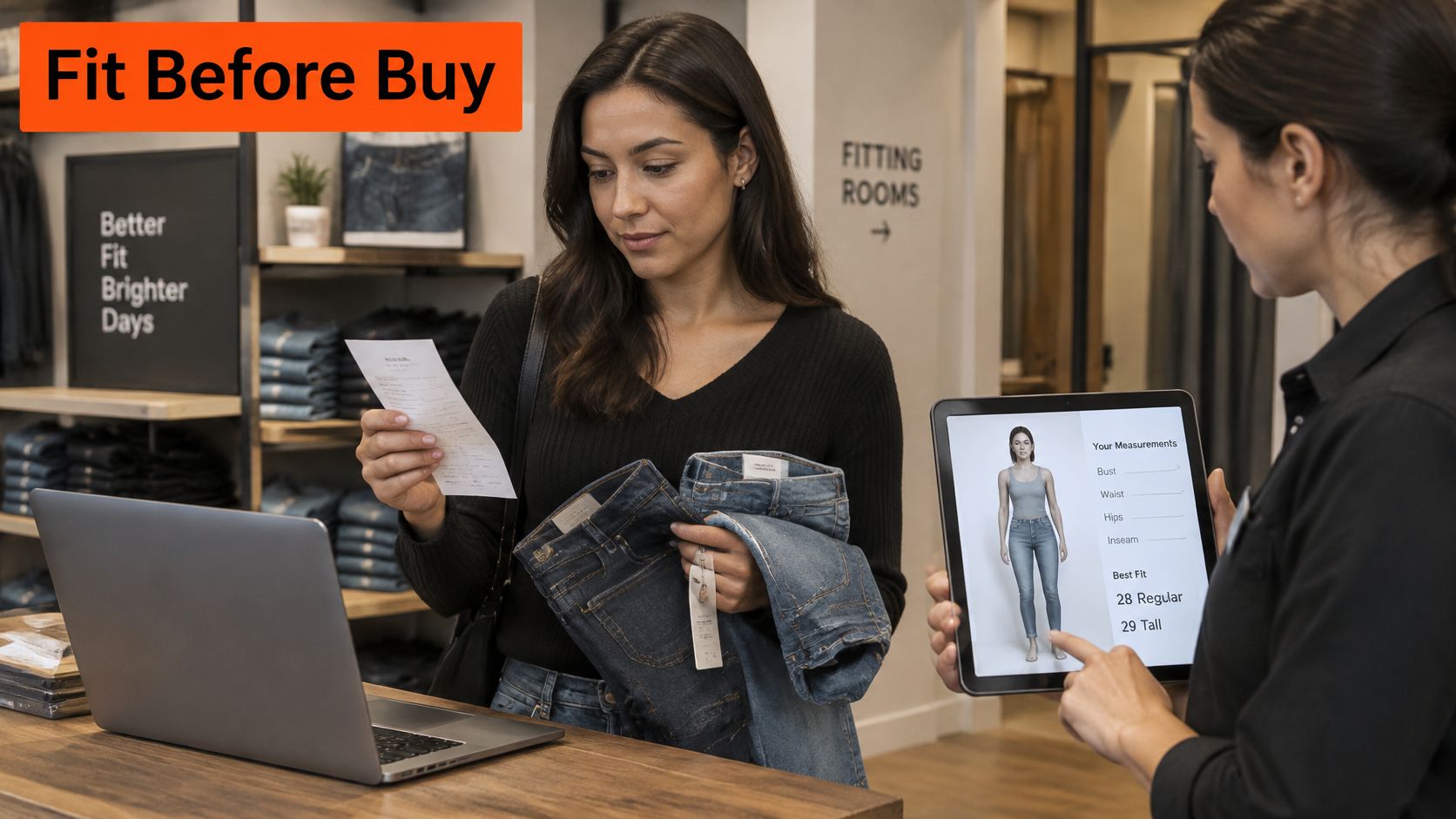
A 3D body image lets the store compare her chest, waist, hip, and inseam with that garment's size chart instead of trusting the guessed label. The model does not pick a vibe. It supplies dimensions. The chart supplies the garment. Fit is the gap between them, including the ease the pattern was cut with.
What teams actually do with the model
Size recommendation on a product page is the shopper-facing use. The store reads the body model, reads the chart for that SKU, and names a size. Brands that publish a clear way to find your clothing size already do half of this job on paper. A body model only helps if it feeds those same measurements.
Virtual try-on places a garment on the body model so the shopper can judge silhouette. It is a picture of a fit hypothesis, not proof the fabric will feel right after an hour of wear.
Pattern and fit development is the designer's use. A digital body lets a pattern maker test a block against many shapes before a sample is cut. Ergonomics and product design use the same surfaces for seats, packs, and tools, because posture changes the surface a tape never holds still.
Sportswear and jerseys care about precise shape. A race singlet and a fashion tee can share a size label and fail in opposite ways, which is why size in fashion is a garment problem, not only a body problem. Body-data analytics then show merchandisers which fits sell and which fits return, so the next cut can move.
The survey behind the average body
CAESAR set the scale for this work by scanning more than 5,000 subjects, with the project completed in 2002. The NIST description of the CAESAR viewer records 3D body surfaces, 73 anthropometric landmarks, and traditional measurements for people aged 18 to 65 in Europe and North America. NIST describes scans with more than 250,000 grid points per body, far beyond a handful of tape dimensions, and the set used more than one posture so standing and sitting could both be studied. About 2,400 of the civilians were from the United States and Canada, and about 2,000 were European.
That scale made it possible to model population variation instead of designing around one "average" body. The same documentation warns that the sample was not fully representative of the U.S. civilian population and must be statistically weighted for population estimates. More than 25 years after collection began, it still had not been superseded by another public dataset of comparable breadth.
Before you trust a use case, name the measurement the decision depends on, and check that the body model captured it. If the decision is inseam and the model only estimated height and weight, you do not have a fit tool yet. You have a guess with a picture attached.
Accuracy Limits and Common Misconceptions
A 3D body image is an estimate, not a perfect copy. Its accuracy depends on how it is captured, which body measurements the system infers, and the assumptions built into its model.
In a validation study of 265 adults, an infrared 3D scanner estimated mean body-fat percentage at 18.1%, compared with 22.8% from hydrostatic weighing, 20.1% from bioelectrical impedance, 19.7% from skinfolds, and 21.2% from girth-based equations. A validation study in the European Journal of Clinical Nutrition found that each difference was statistically significant.
| Method | Mean body fat |
|---|---|
| Infrared 3D scanner | 18.1% |
| Hydrostatic weighing | 22.8% |
| Bioelectrical impedance | 20.1% |
| Skinfolds | 19.7% |
| Girth-based equations | 21.2% |
These averages show that measurement methods can produce different results. They do not establish which method is right for an individual. Surface shape, hidden landmarks, and model assumptions can all affect a scan. For example, a fold of tissue may obscure a landmark, leaving the system to estimate its position.
A body-composition scale also produces an estimate, using a different method and with different limitations. Readers comparing home tools may find general guidance on choosing a body composition scale. A scale reading cannot serve as a definitive check on a 3D scan.
Three ideas that do not hold
- A scan does not guarantee a good fit. One apparel-consumer study reported that 64.8% of participants bought shirts and 50% bought pants in sizes that did not match their 3D body-scan measurements. A University of Arkansas apparel study also describes mismatches between scan measurements and manual production practices. Fit depends on more than body dimensions: preferred ease, length, tightness, and silhouette matter too. In the same work, 77.8% of surveyed consumers said ready-to-wear sizes were not standardized, and 61.2% said they wore different sizes across brands.
- A body image is not a clinical body-composition measurement. The table shows how much estimated body-fat results can vary by method. A selfie-based or questionnaire-based model should be treated as an estimate, not a clinical measurement. For clothing fit, garment dimensions such as chest, waist, hip, and inseam are more directly relevant than an inferred body-fat figure.
- A body-shape match is not a standard size. Brands can use the same size label while making garments with different patterns, ease, and fabric stretch. A model that resembles your shape cannot tell you whether you will prefer that garment's fit.
Test the image against the decision you need to make. If the question is whether a pair of trousers will fit at the waist and inseam, check whether the tool provides information relevant to both. Treat the result as a useful estimate, not a promise.
Privacy, Consent and Body Image Safeguards
What happens to a selfie after a virtual try-on, and how much control does the shopper retain? A 3D body image can include the photo, measurements, inferred body-shape labels, and the generated model. Each may reveal information about a person, so privacy depends on how the tool collects, stores, and uses these inputs.
Research on 3D scanning, summarised in a Humanities and Social Sciences Communications paper, describes information-breach risks associated with extracted measurements and body images. It also reports that privacy concerns can reduce people's willingness to use the technology. A shopper may find a scan reassuring and still feel uneasy seeing their body rendered in detail.
The feeling is part of the decision
A flattering render can still feel like being measured in public. A retail try-on serves a different purpose from a clinical scan used to assess body composition, such as a Telomyx DEXA scan service in Liverpool. The distinction matters: shoppers should understand what information a retail tool collects and what it is used for.
A lifelike image is not automatically a safer or more useful one. A simpler model, or an option that avoids a selfie, may give shoppers more control over how much they share.
Before uploading a photo, look for clear safeguards:
- Retention: How long are the selfie, measurements, and model kept?
- Deletion: Can the shopper delete them directly?
- Consent: Does the tool explain what it will capture before the photo is taken?
- A non-selfie option: Can shoppers use stated body data or choose a model instead?
- Neutral presentation: Does the tool show body variation without scoring or shaming it?
If a tool cannot explain what it collects, how it uses that information, and what the shopper can control, a realistic render alone is not a reason to proceed.
Check a 3D Body Image Tool Before You Trust It
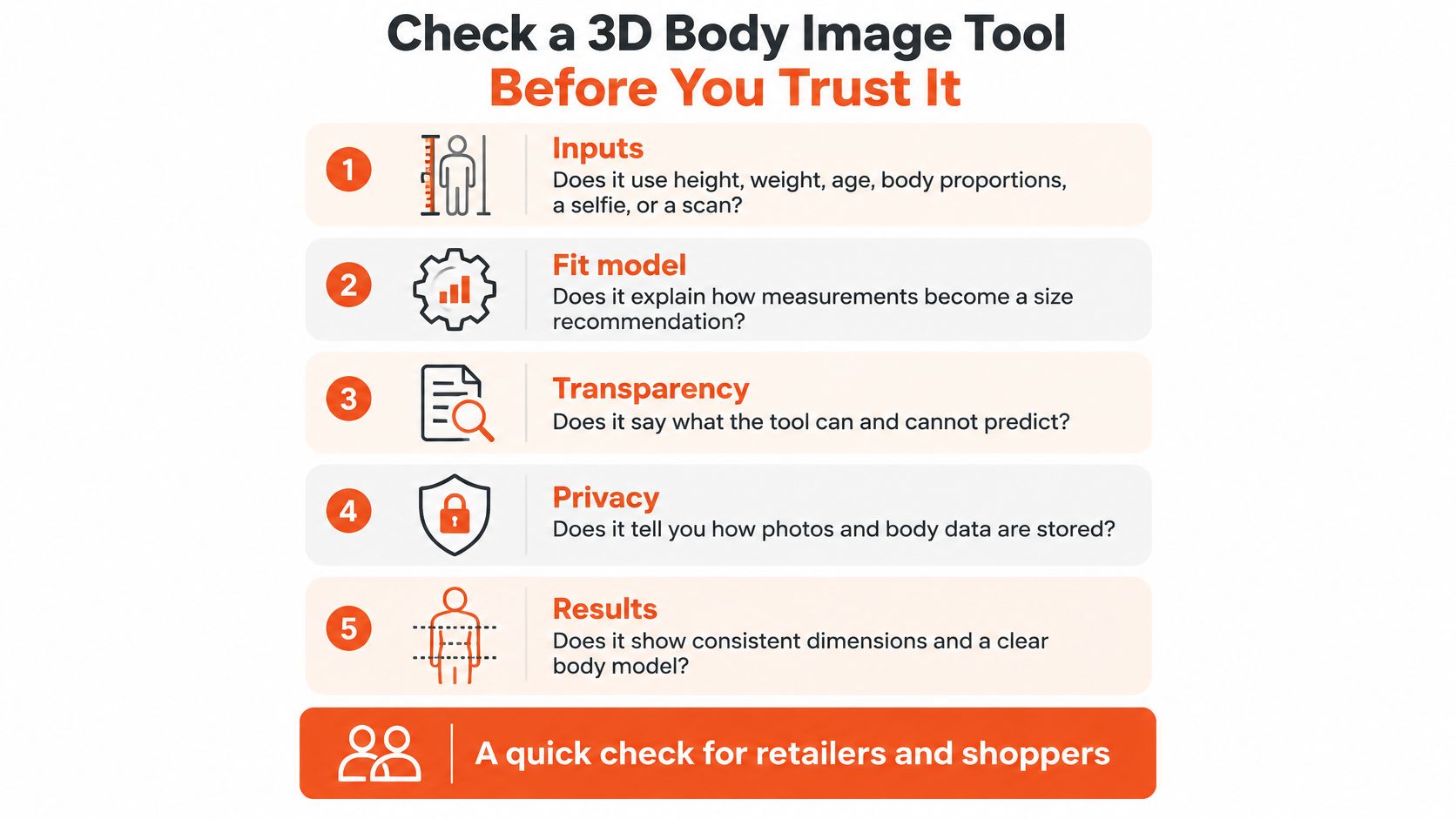
Run this list on any 3D body image or try-on tool, whether you are the shopper or the retailer choosing the vendor.
- Inputs. Check whether the result comes from height, weight, and age plus a body-proportion illustration, from a selfie, or from a chosen body model, and whether the shopper can see which input drove the size.
- Validation. Ask whether those measurements were checked against a tape on bodies like yours, including larger sizes where landmark error grows.
- Garment logic. Confirm the recommendation uses that garment's size chart, ease, and fabric stretch, not body shape alone.
- Explanation. The tool should say why a size was chosen, how confident it is, and what fallback question appears when the capture is unclear.
- Data. You should know where the selfie is processed, how long it is kept, and whether it can be deleted.
- Alternatives. There should be a non-selfie option that still returns a sizing answer.
A tool that hides its inputs cannot be tested. One that skips the garment's own chart is guessing with extra steps. Our shoppers enter height, weight, and age, plus the closest illustration of their proportions, and within seconds of a try-on they see the outfit with a size and fit recommendation for that garment. If you are choosing software for a store, ask how a 3D body model maker turns those inputs into a surface before you trust the label it prints.
Next step: ask for a live demo that walks through the platform on your own products, then test five real garments against a tape measure before you roll the tool out.
Robosize builds a shopper-specific body model for online apparel, renders the garment on that model, and recommends a size for that product rather than a generic label. If you want to see how an estimate like this behaves on your own size charts, visit Robosize and try the fitting flow on a real product page.