The same Australian clothing size can describe very different bodies. That's why a familiar label is only a starting clue, not a fit guarantee. A useful clothing size guide for Australia starts with centimetres, identifies the measurements that matter for the garment, and tells you whether you're comparing your body with a body chart or with the clothing itself.
Table of Contents
- Australian Size Ranges at a Glance
- How to Measure Yourself for Clothing Sizes
- Body Measurements Versus Garment Measurements
- Why the Same AU Size Differs Between Brands
- Extra Measurements That Decide Trousers, Dresses and Tops
- Choosing and Confirming Your Size Online
- Men's, Kids' and International Size Labels
Australian Size Ranges at a Glance
The Bonds size chart places women's AU sizes 8 to 16 across approximate body-measurement ranges of 82–102 cm at the bust, 63–83 cm at the waist and 88–108 cm at the hip. These are reference ranges across the whole size run, not the measurements for a single size.
Bonds reference ranges for AU women's sizes 8 to 16
| Measurement | Where to measure | Range, AU 8–16 (cm) | What shifts the reading |
|---|---|---|---|
| Bust | Fullest point, tape level across the back | 82–102 | Bra band and cup change the reading |
| Waist | Natural waist, narrowest point | 63–83 | Low-rise garments sit below this point |
| Hip | Fullest point of the seat | 88–108 | Stretch fabric changes how the garment fits |
Use this as an orientation, then open the retailer's actual chart. Don't interpolate a missing size or assume that another brand uses the same intervals.
Australia has no current mandatory adult clothing-size standard, and the last adult standard was withdrawn in 2007 because it was outdated, explains CHOICE's guide to clothing-size irregularities. An AU label therefore identifies a retailer's size category, not a nationally fixed set of dimensions.
Read the chart for the garment
A fitted shirt and a loose ceremonial robe need different checks. For specialist clothing, a resource such as Baptism Robes' adult baptism robe size chart is more relevant than transferring your everyday shirt size without checking the garment's own guidance.
Look for clearly named measurements, garment length and any notes about intended looseness. A chart that gives only a letter or number leaves important questions unanswered.
Starting-point test: If your bust, waist and hip all fit one chart row, start there. If they fall into different rows, identify the dimension the garment must accommodate before choosing a size.
For a fitted top, that's often the bust. For trousers or a close-fitting skirt, the seat or hip usually deserves priority.
How to Measure Yourself for Clothing Sizes
Use a soft dressmaker's tape, a mirror and a note on your phone. A rigid ruler won't follow body contours, and measuring over bulky clothing adds material that won't necessarily be under the garment you're buying.
The basic setup matters as much as reading the tape correctly.
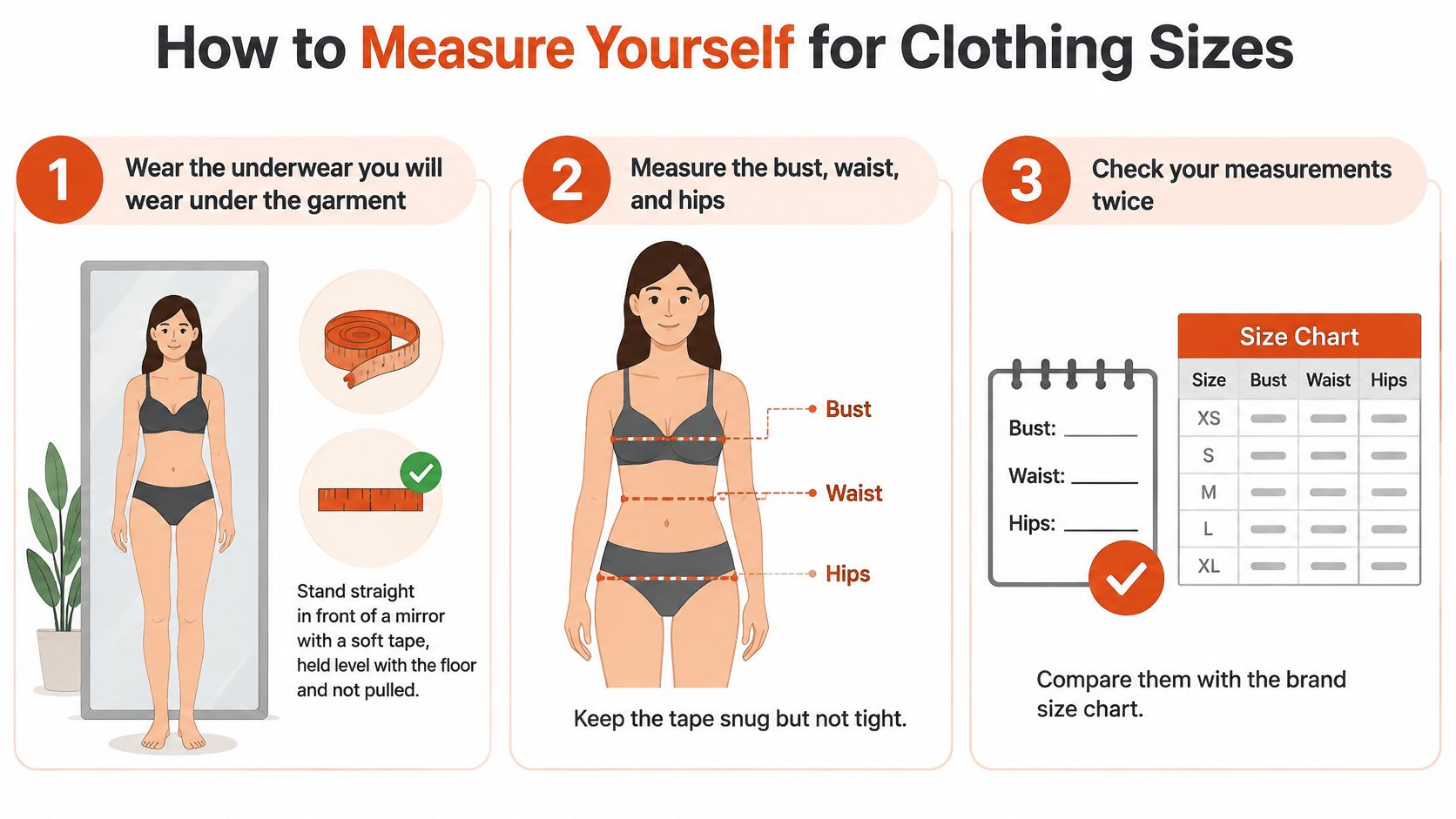
Take the measurements in order
Prepare your underwear and posture. Wear the underwear you'll use beneath the garment, then stand naturally in front of a mirror with your weight balanced. Keep the tape level for circumference measurements, without pulling it tight or lifting your shoulders.
Measure your bust around its fullest point, keeping the tape horizontal across your back. It should touch without compressing breast tissue; measuring in a different bra can change the result enough to affect a fitted bodice.
Find your natural waist, usually at the narrowest part of your torso above the navel, and bend gently sideways to locate the crease if necessary. Breathe normally rather than sucking in your stomach, and don't substitute the waistband position of your favourite jeans.
With your feet together, pass the tape around the fullest part of your seat and hips. Check your side view in the mirror because the tape can ride up at the back or miss the fullest area.
For trousers, record inside leg and check rise separately. Measure the body's inside leg from the crotch towards the ankle, using the retailer's stated endpoint; measure garment rise along an existing pair's crotch seam to the waistband. If the chart requests seated crotch depth, sit upright on a firm chair and measure vertically from your waist to the seat surface, because crotch depth and garment rise aren't interchangeable.
Save the measurements in centimetres, with the landmark name beside each result, then repeat any reading that looks unexpected. A twisted tape can distort the reading, so smooth it flat rather than averaging inconsistent results.
Check length against something you wear
Circumference measurements won't tell you where a hem lands. If the product lists garment length, measure a similar piece you already like, starting at the same point the retailer uses.
Occasion clothing makes this particularly important. Grad Store's explanation of how a graduation gown should fit provides useful context when you're judging an intentionally loose garment rather than a close-fitting outfit.
Finally, keep body measurements and favourite-garment measurements in separate notes. Label the latter with the garment type and whether you measured flat or around its full circumference, so you won't accidentally compare unlike figures.
Body Measurements Versus Garment Measurements
A size chart doesn't automatically describe your body. Body measurements describe the person; garment measurements describe the clothing. Confusing them can make a deliberately roomy garment seem too large or a fitted garment seem suitable when it has no room for movement.
The distinction is easier to understand when you compare the person and the garment separately.
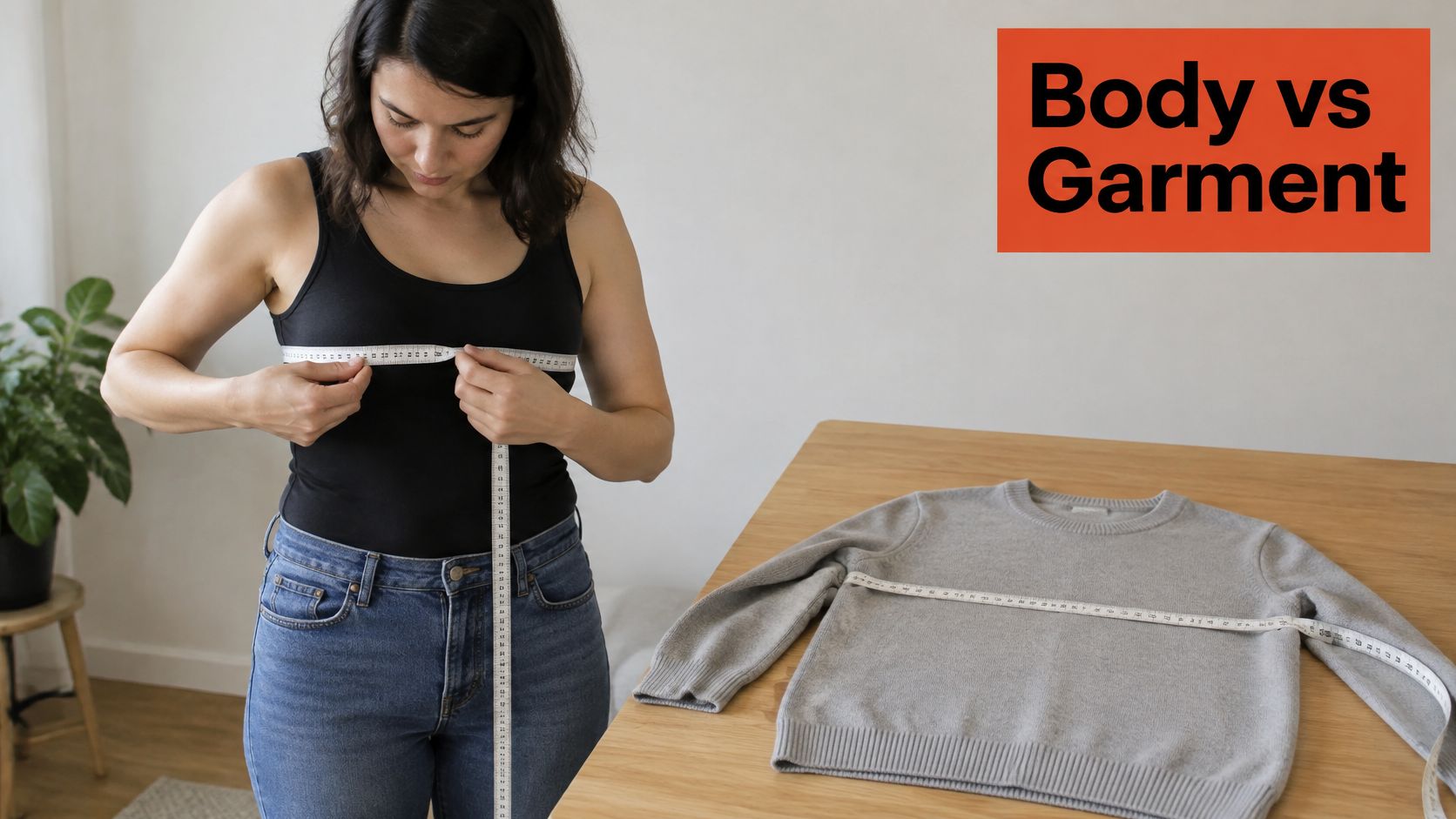
ISO 8559-2 defines clothing size designation around the body measurements of the person the garment is intended to fit. That's a different question from how wide a finished shirt measures when it's laid on a table.
Identify what the chart actually measures
- Read the heading. Look for body measurements, finished garment measurements or a clearly explained equivalent.
- Check the measuring conditions. The instructions should distinguish a snug body reading, a reading over underwear and any allowance already included.
- Read the stretch note. A knitted garment may fit closer than a rigid woven piece without restricting movement.
- Find the ease guidance. Ease is the difference between body dimensions and the garment's intended dimensions.
Say your bust falls within the retailer's body-size interval. You shouldn't then add extra room before selecting that body-chart row, because the designer should already have allowed for the intended fit.
A garment chart requires another approach. Compare its finished bust circumference with your body and the designer's recommended ease, allowing for the intended silhouette and fabric. Don't add seam allowances to a finished-garment measurement.
A visual measuring demonstration can help you check your technique before comparing the results.
Match a body number to a body column. When only garment dimensions are available, use the stated ease or compare with a similar garment that already fits.
If neither is available, request clarification rather than treating equal body and garment circumferences as a safe fit.
Why the Same AU Size Differs Between Brands
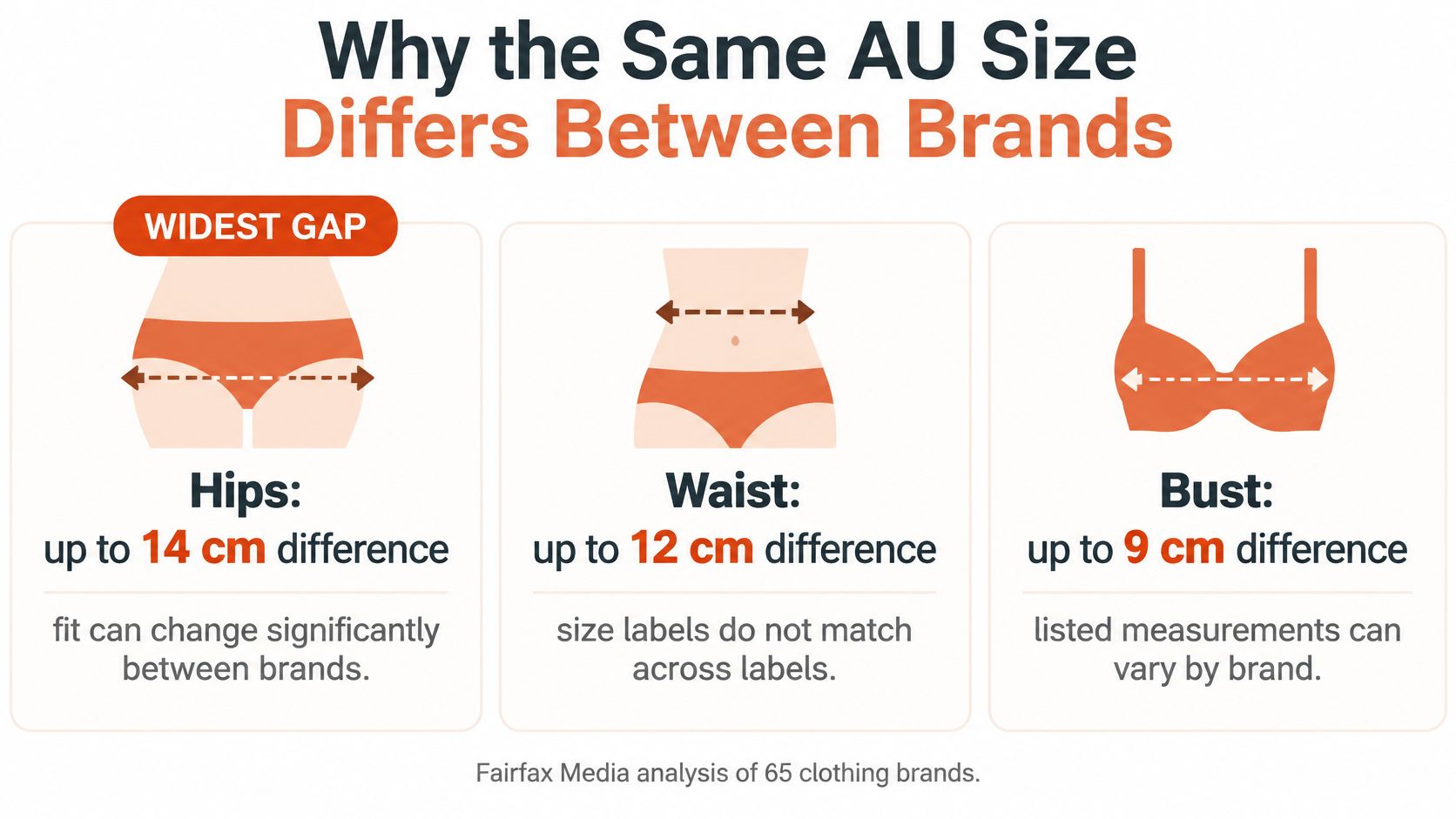
A Fairfax Media analysis of 65 clothing brands, described in Sizing Up Australia, found that listed measurements for the same nominal sizes could differ by up to 9 cm at the bust, 12 cm at the waist and 14 cm at the hips. Those gaps explain why transferring a size label between retailers can fail even when you've measured accurately.
The differences affect distinct parts of the body, not an overall impression that one brand fits generously.
Brands fit different proportions
A brand develops its patterns around a target customer, a fit model and its intended silhouette. Its pattern team then grades those patterns into other sizes, making decisions about how much to change the bust, waist, hip and length.
Those decisions aren't interchangeable. A shopper with a fuller seat may fit one brand comfortably but find another brand tight through the hips despite adequate room at the waist.
Australia's intermittent body-measurement research also helps explain why retailers haven't converged on a universally dependable fit reference. But more population measurements alone wouldn't make a fitted work shirt, relaxed linen shirt and stretch training top fit alike. Designers still need to decide how each garment should sit and move.
Separate brand fit from personal preference
Before deciding that a brand runs small, distinguish the problem you're experiencing.
- Too little room at a specific landmark suggests a dimensional mismatch, such as a tight seat with a loose waistband.
- Enough room but unwanted volume may reflect an intentionally oversized silhouette rather than an incorrect size.
- Correct circumference but poor positioning points towards length or proportion, such as a waist seam sitting too high.
Sizing up can solve insufficient circumference, but it can also create dropped shoulders, excess back fabric or an overly long sleeve. It won't reliably correct a pattern designed for a different torso length.
The useful question isn't whether you're normally a particular AU size. It's whether the retailer's dimensions and the product's cut suit your body and the fit you want. Keep a note of successful brand, style and fabric combinations, not just the label inside them.
Extra Measurements That Decide Trousers, Dresses and Tops
Bust, waist and hip are useful, but they don't describe where your waist sits, how broad your shoulders are or how much length you need through a jumpsuit. Australian garment-measurement training guidance recognises a broader measurement set, including underbust, rise, inside leg, arm length, shoulder breadth, posture and seat prominence.
The practical consequence is straightforward: measure for the garment you're buying, rather than collecting the same basic circumferences for every purchase.
Extra measurements to check by garment type
| Garment | Extra measurements to check | Return signal |
|---|---|---|
| Trousers and jeans | Rise, inside leg, seat | Check crotch pulling, waistband position and leg length |
| Dresses and jumpsuits | Torso length, underbust, shoulder breadth | Check waist-seam position and restriction when sitting |
| Fitted tops and jackets | Shoulder breadth, arm length, back length | Check arm movement, shoulder placement and sleeve length |
| All fashion | Fit or wrong size cited as the primary concern | Identify the fit problem before ordering another size |
Trousers need enough room through the seat and crotch, not merely a waistband that closes. Compare front and back rise with a comfortable pair, and check thigh room if you have fuller thighs or a muscular build. Shortening the hem won't fix a crotch that hangs too low.
Dresses need different checks according to their construction. A fitted bodice may require underbust and shoulder measurements, while a shaped waist seam makes torso length important. A jumpsuit also needs enough vertical length to let you sit without pulling through the crotch or shoulders.
When proportions don't match the chart
Petite and tall shoppers shouldn't judge fit by hem length alone. A petite shopper may need a shorter bodice, while a tall shopper may need a longer rise or lower waist-seam position, even when the overall garment length appears suitable.
For a larger bust-to-waist difference, read the bust and waist requirements separately. Choosing only for the waist can leave the chest restricted; choosing only for the bust can create unwanted waist volume.
Shoulder placement matters most when the design uses a conventional fitted shoulder. A dropped shoulder or the silhouette described in what boxy fit means calls for a different interpretation, because extra width can be intentional.
Fit priority: Check the dimension the garment is built around before choosing the nominal size. If accommodating that dimension makes everything else unsuitable, change the cut rather than forcing the size.
A curvy trouser block, a different bodice shape or a dedicated length option may work better than moving repeatedly up and down the same chart.
Choosing and Confirming Your Size Online
Make the decision while you have the product page, your measurements and a comparable garment in front of you. That's more dependable than choosing from memory and hoping the fabric will compensate.
A single-session buying checklist
Open the exact product's size guide. Confirm that you're viewing the correct category and units, particularly on a multi-brand store where products may use different charts.
Compare your saved measurements landmark by landmark. Don't substitute a low-waist measurement for natural waist or a flat garment width for a body circumference.
Identify the controlling dimension. Prioritise bust for a fitted woven top, seat for trousers and hip for a close-fitting skirt, then check that the other dimensions remain wearable.
Read the fabric and fit notes together. Stretch isn't automatic permission to size down: recovery, lining and the intended silhouette still matter, while a rigid woven garment needs sufficient movement room.
Use reviews to investigate a specific concern. Comments about tight upper arms or a short torso are more useful than an unexplained runs-small verdict, especially when the reviewer describes proportions similar to yours.
Compare with a favourite-fitting garment when finished dimensions are available. Lay it flat without stretching it, measure from the same landmarks and check whether the chart uses flat widths or full circumferences.
Check the return and exchange conditions before paying. Confirm the deadline, return postage, exclusions and whether an exchange is available, because uncertainty becomes more expensive when the fallback is restrictive.
Use recommendation tools without skipping fit checks
Our Robosize sizing tool gives one precise size and fit recommendation for each specific garment. Shoppers enter height, weight, age and the closest illustration of their body proportions; we match each product to the store's own size chart, with unlimited chart uploads available to the retailer.
That product-level approach is useful when your measurements don't all suggest the same label. If you're also considering a different silhouette, separate the sizing decision from the styling ideas in trying a new look.
Post-purchase changes are a separate issue. Mayra's guide to update colors on existing Shopify orders is relevant when a Shopify retailer offers order editing, but don't assume that every store permits changes or that an edit replaces its return policy.
Before ordering, save your measurements, check the product chart and choose for the controlling dimension. If the remaining fit questions are substantial and returns are restrictive, leave the item rather than buying a size you can't reasonably verify.
Men's, Kids' and International Size Labels
The women's reference ranges aren't a men's or children's conversion chart. Start with the retailer's appropriate category, then use the landmarks relevant to that garment rather than transferring a familiar label.
For men's shirts, that may mean chest, collar and sleeve length. For trousers, check whether the waist measurement describes the body, the waistband or a labelled trouser size, and confirm how the retailer measures inside leg.
Children need current measurements
An age bracket is a browsing aid, not proof of fit. Measure the child as they are now, paying particular attention to height, torso length and the garment's intended room for movement.
Buying larger can create useful growing room in some casual clothing. It can also leave sleeves covering hands, waistbands insecure or crotches hanging too low, so don't use extra overall size as a substitute for checking proportions.
Convert dimensions rather than names
International conversions are useful for finding a likely starting point, but they don't resolve differences in retailer fit. A broader explanation of size in fashion helps distinguish a size designation from the dimensions and silhouette behind it.
Before using an overseas chart, check:
- Category and age range. Confirm that the chart covers the shopper and the product you're buying.
- Landmark definitions. Match chest to chest, natural waist to natural waist and garment length to the specified starting point.
- Measurement units. Use the chart's unit switch carefully and avoid mixing converted figures with the original readings.
- Ease and intended fit. Check whether the design is close-fitting, relaxed or deliberately oversized.
When a product presents only a single familiar label, don't let that label overrule its measurements. Treat the product's centimetre table as the authority, and resolve missing dimensions before committing.
Robosize gives online clothing stores garment-specific size recommendations matched to their own size charts, helping shoppers move beyond an AU label alone. Visit Robosize to explore the fitting room and request a live demonstration using your store's sizing needs.