If your fitting room recommends a size 12 to a shopper who normally wears a 16, which of your AI guidelines catches that before she returns the dress?
Most retail teams can't answer, because what they have is a principles document rather than a working control. The document says fairness matters. It doesn't name who checks the error rate, what number counts as a pass, how long a selfie is kept, or where the record lives proving the test ran. That gap is what turns a good guideline into a liability with a nice font.
AI guidelines only do work when they behave like operating evidence. Every control needs a named owner, a threshold set in advance, a retention rule and a record. The rest of this guide builds that system one piece at a time, starting with the document that applies to you.
Table of Contents
- Which AI Guidelines Apply to Your Business
- The Six Principles Behind Every AI Guideline
- Who Owns AI Decisions in Your Organization
- Privacy and Consumer Control for Body and Photo Data
- Testing Models for Accuracy and Fairness Before Launch
- Sector Rules for Retail and Sizing Tools
- How to Build a Minimum Viable AI Guideline Program
- Audit One Sizing Tool Against These Guidelines This Quarter
Which AI Guidelines Apply to Your Business
Two documents travel under the name "AI guidelines," and the first mistake is treating them as interchangeable. A voluntary framework describes good practice and leaves the penalty box empty. Binding law gives a regulator powers, deadlines and duties. A sizing team that files a voluntary checklist as if it were compliance proof creates comfort without cover; a team that ignores a binding tier because the model seems harmless creates the opposite problem.
The usual starting point is the NIST AI Risk Management Framework, published on January 26, 2023. It was built for organizations that design, develop, deploy or use AI systems, and it stays voluntary, non-sector-specific and use-case-agnostic so a ten-person brand and a national chain can adapt the same structure. Its operating model has four functions, Govern, Map, Measure and Manage, covering accountability, context and impact assessment, testing and evaluation, and ongoing risk treatment. A resource center followed to support implementation.
| Framework | Status | Who It Applies To | Core Requirement |
|---|---|---|---|
| NIST AI Risk Management Framework 1.0 | Voluntary | Any organization that designs, develops, deploys or uses AI | Govern, Map, Measure and Manage, with records for each function |
| EU AI Act | Binding law, in force | Providers and deployers serving EU customers | Risk-based obligations; higher-risk duties phase in over the following years |
| OECD AI Principles | Non-binding intergovernmental principles | Governments and organizations adopting AI | Human-centred values, transparency, reliability and accountability |
Where the Frameworks Sit Against the Law
The EU AI Act is the binding counterweight. It sorts systems by risk tier and attaches duties to each tier, so the question becomes "which tier is this system in." For a sizing recommender, that means checking whether the feature stays inside retail advice or drifts toward uses the law treats more strictly.
Below the law sits ISO/IEC 42001, a certifiable management standard for an AI management system. Its value is auditability: an external reviewer can ask for the owner, the test threshold, the retention rule and the log that proves the control ran. The OECD AI Principles sit at the widest layer: non-binding intergovernmental expectations around human-centred values, transparency, reliability and accountability that many national rules echo.
Three Questions That Decide Which Rows Apply
Run every AI feature through these before reading another framework.
- Where are your customers? A brand headquartered outside Europe still owes EU obligations when it serves European shoppers, so market coverage matters more than the address on the invoice.
- Which sector are you in? Apparel sizing sits in a different position from credit, hiring or medical triage, and the same model moved into one of those areas changes its tier.
- Do you build or buy? Building puts design duties on you. Buying puts vendor due diligence and contract terms on you; obligations do not vanish because someone else trained the model.
Answer those three in writing and keep the note beside the control record. When a feature or market changes, the original reasoning shows whether the tier changed or only the packaging did.
The Six Principles Behind Every AI Guideline
Fire-safety rules apply to every building, yet no inspector accepts a promise that the builder cares about fire safety. The builder shows sprinkler plans, clearance distances and signed inspection records. AI guidelines work the same way: the principles are shared across frameworks, and the proof is local to your storefront.
Almost every framework in the table above, plus the national rules that followed, reduces to six principles. Read them as a set. Weakness in one shifts pressure onto the others, and a technical win in accuracy doesn't fix a failure in consent.
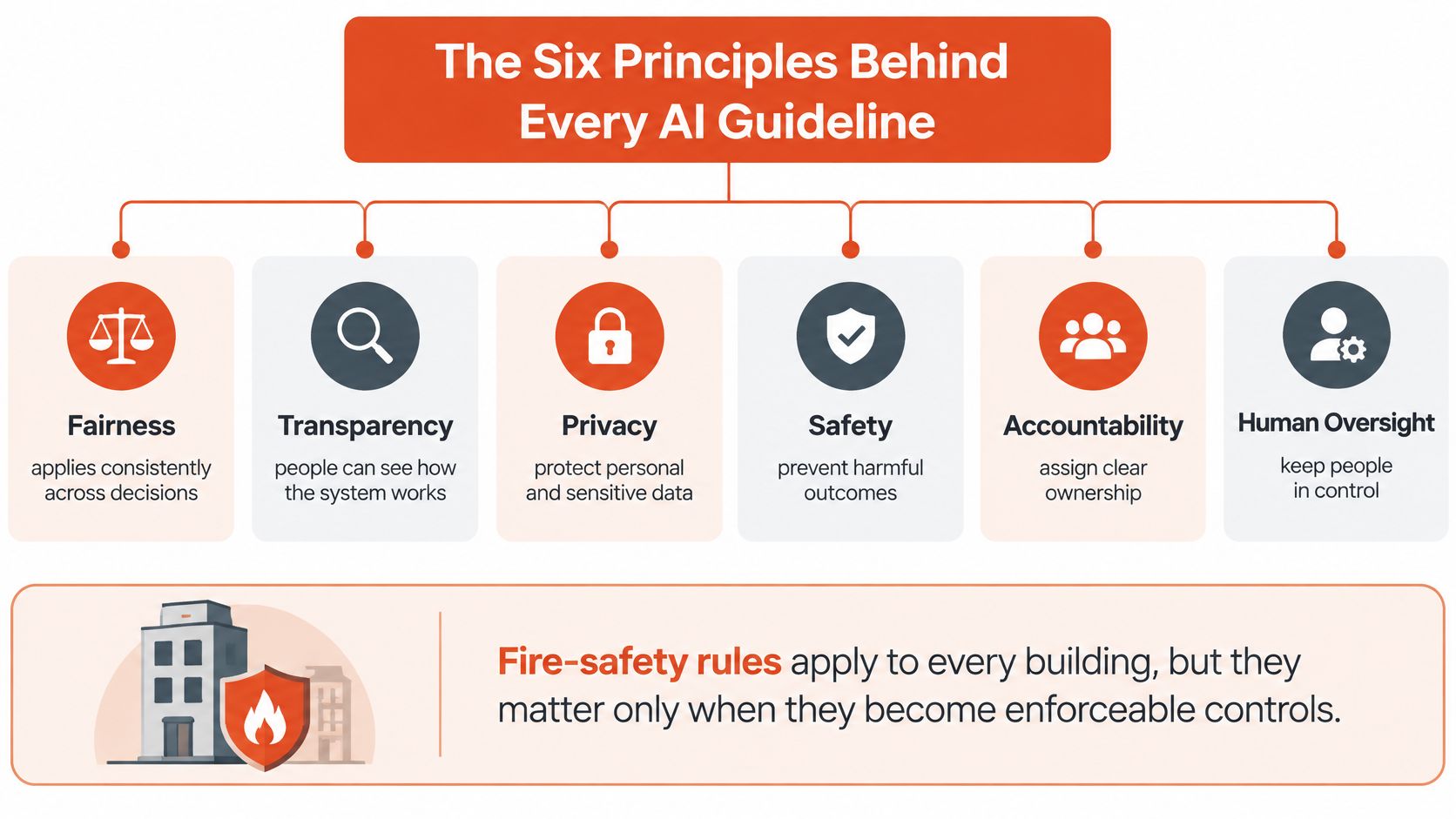
Accountability means a named person answers for each system, not a committee. If a size recommender misfires on petite frames, someone's calendar has the review on it. Transparency means shoppers know when AI is sizing them and what it used. A recommendation shown with a short note such as "based on your height, weight, age and body proportions" clears that bar far better than a footer link nobody opens.
Fairness means error rates are comparable across body types, skin tones, ages and disabilities. The test isn't whether the average error looks good, it's whether one group carries most of the misses. Privacy means you collect only what the recommendation needs and keep it briefly. A tool that stores selfies indefinitely to improve a model is making a data decision under a fit-and-sizing label.
From Principle to Control
Safety and reliability cover what happens when inputs arrive broken: a cropped photo, loose clothing, low light, or a shopper who types a height in centimeters into a field expecting inches. A system that is dependable fails into a safe path, like a questionnaire-based estimate, instead of confidently returning nonsense.
Human oversight means a person can review, correct or override a recommendation. At minimum, a merchandiser can pull a broken garment mapping and a support agent can see why a size was suggested.
A principle is a promise. A control is the proof, and the rest of this guide shows how to produce that proof.
Who Owns AI Decisions in Your Organization
When a size recommendation misses, the question that decides how fast you fix it isn't technical. It's whose name is on the system.
Ambition is rarely the missing ingredient. In 2024, 97% of the 117 AI leaders surveyed by Domino Data Lab and Revelate said their organizations had set goals for responsible AI, while 48% said they lacked sufficient resources to implement governance frameworks, according to the Revelate 2024 responsible AI survey. Goals without owners is exactly that pattern: a stated commitment and nobody allocated to carry it.
A Five Role Split That Survives a Bad Week
- Executive sponsor: approves the risk appetite and the budget, and decides when a system pauses. One person, senior enough to end an argument.
- Product owner: writes the intended-use statement and the known exclusions, including the shoppers the tool isn't designed for yet.
- Data protection lead: signs off on body measurements, selfies and any derived attributes before launch and after each new data field appears.
- Engineering lead: keeps the model-change log, including vendor-side updates that alter behaviour without anyone shipping code.
- Merchandising or UX lead: owns how the recommendation appears on the product page, what it says it's based on, and how a shopper contests it.
Small teams can hold two roles at once. What they can't do is leave a role vacant, because a vacant role produces a decision nobody remembers making.
What Each Owner Signs
Each role leaves an artifact, and the artifact is the whole point. Expect approval records with dates, a one-page intended-use statement, test results attached to each release, vendor contracts with deletion and notification terms, and incident reports that end in a fix rather than a thread.
Practical rule: if a control doesn't produce a document you could hand a regulator or a customer, it isn't a control yet.
Answer three questions this week. Who can switch a model version off, how quickly an escalation reaches that person, and where that decision is recorded? If any answer takes more than a minute to find, the ownership is on paper only.
Privacy and Consumer Control for Body and Photo Data
A shopper changes her mind about the selfie she uploaded. What your system does on the Tuesday after is where privacy stops being a policy and starts being a design.
Body data behaves differently from a browsing cookie, because a measurement plus an image can point at one identifiable person. The privacy review behind a fitting room belongs in the wireframe stage, alongside decisions about what the screen shows, rather than in a consent banner added at the end.

Four questions decide whether the program is real.
- Is the selfie stored after the fitting? A yes needs a retention period and a deletion trigger written into the build, with a date attached to both.
- Do derived attributes count as personal data? An estimated body shape inferred from a photo is still information about that shopper, so it falls under the same rules as the photo itself.
- How does a deletion request reach every vendor? Subprocessors included, with a confirmation you can produce afterwards.
- What happens when a shopper declines photo analysis? If the answer is that she loses the feature entirely, the design carries a fairness problem alongside the privacy one.
Many AI tools stop at notice and consent: the shopper can read a policy and click accept, yet has no practical route to request deletion or stop processing that is already underway. That distance is the gap between compliance and meaningful control, and the questions above are how you close it.
The Controls That Answer Each Question
- A no-photo alternative: a questionnaire path that produces a recommendation held to the same accuracy standard as the photo path.
- Data minimization: collect the fields the recommendation uses and drop the rest, including the "nice to have" demographics nobody acts on.
- Short retention defaults: keep images only as long as the fitting needs them, then delete on a schedule you can show, rather than waiting for a request.
- Deletion and correction workflows: one route spanning the store, the vendor and any subprocessor, ending in a logged completion.
- Subprocessor disclosure: a plain list of who touches body data and why, written where a shopper can find it in two clicks.
- Explanations of inferred attributes: if you estimate a shape, say so, and let the shopper correct it.
Each control earns its place by producing a record: a retention date, a deletion log entry, a published list. A rule that leaves no trace remains a wish.
Say a shopper declines the selfie and completes the questionnaire instead, entering her height, weight, age and the closest illustration of her body proportions. She should still see a size on the product page, and that recommendation should be measured against the same accuracy threshold as any photo-based one. Describing this path in detail pays off beyond privacy, because it forces clarity about what each field exists to do, as this guide to 3D body image capture and shopper data sets out.
A highly accurate fitting room can still fail your shoppers if they cannot understand, contest or withdraw from its data practices.
Testing Models for Accuracy and Fairness Before Launch
A test you can't fail isn't a test. Set the threshold before the run, in writing, or the results will define success for you.
Validation is where AI guidelines stop being prose. Each check below is a release gate: if it fails, the model doesn't ship, and the failure gets logged.
| Check | What It Tests | How Often |
|---|---|---|
| Accuracy against measured fit | Recommended size compared with measured garment fit | Before launch and after each model change |
| Disparate performance | Error rates across body types, skin tones, ages, disabilities and regions | Before launch and every quarter |
| Privacy leakage test | Personal data or re-identifiable images appearing in outputs | Before launch and on a regular schedule |
| Red-team review | Unusual inputs such as cropped photos, loose clothing and low light | Before each major release |
| Feedback and appeals review | Size returns and contested recommendations | Continuously, reviewed monthly |
What Each Check Is Actually Looking For
Accuracy against measured fit is the plainest one: take garments with known measurements, run them through the recommender, and compare the output with what fit the fit model. A recommender that scores well on average can still be wrong on the sizes your best-selling dress comes in, so break the results down by category rather than trusting one headline number.
Disparate performance is where many teams underinvest. Errors rarely spread evenly, and a quarterly cut across body types and skin tones shows whether one group carries the misses. If the pattern holds for two quarters, treat it as a design problem and change the inputs.
Privacy leakage deserves its own test because it fails without obvious signs. NIST names leakage, unauthorized use, disclosure and de-anonymization of biometric or personally identifiable information as AI privacy risks, and recommends repeating documented privacy-risk assessments during operation rather than only before deployment, as described in the NIST privacy risk assessment work. Practically: probe outputs for personal data, test whether images can be re-identified, and review access logs for routes that shouldn't exist.
Red-team reviews exist to break the input. Feed the system a cropped selfie, a photo taken in low light, a shopper in a loose coat, a height typed in the wrong unit. Then confirm the fallback path works and the error message tells the shopper what to do next.
Release gate rule: the pass threshold, the test owner and the date of the next run all go in the record before the first test executes.
Feedback closes the loop. Size returns and contested recommendations are the only signal that comes from shoppers rather than your own evaluation set, so review them monthly and route the worst cases back into the accuracy check.
Sector Rules for Retail and Sizing Tools
Voluntary frameworks tell you what good practice looks like. Sector rules tell you what happens when you skip it. General consumer law already applies to your storefront, and sector AI rules add obligations on top, with the EU AI Act as the clearest reference point for where those line up.
The Act entered into force on August 1, 2024, and its rules arrive in stages rather than all at once, as the European Commission's regulatory framework for AI sets out. It prohibits practices including harmful manipulation, exploitation of vulnerabilities, social scoring, certain biometric categorization, and specified emotion-recognition uses in workplaces and educational institutions. High-risk systems carry the heaviest load: risk assessment and mitigation, high-quality datasets, activity logging, technical documentation, user information, human oversight, security, cybersecurity and accuracy. Those duties take effect on the staged timetable in the Act, so the date a given obligation binds depends on which tier the system falls into.
| Risk Tier | Typical Examples | Main Obligations |
|---|---|---|
| Prohibited | Social scoring; harmful manipulation; exploitation of vulnerabilities; certain emotion recognition at work or school | Not permitted in the EU |
| High-risk | Systems used in listed sensitive areas, such as employment or access decisions | Risk assessment, quality datasets, logging, documentation, human oversight, accuracy |
| Transparency-limited | Chatbots and AI-generated content | Tell users they are interacting with AI or viewing generated content |
| Minimal risk | Most everyday recommendation and filtering tools | No specific AI Act duties beyond general law |
Where a Size Recommender Lands
A recommender that suggests a garment size usually sits in the minimal risk band, and a chat assistant that answers fit questions sits in the transparency band. Neither is a safe permanent assumption. The same model wired into credit offers, hiring screens or access decisions moves into the high-risk list, and the obligations change with it.
Two habits protect you. First, write the classification decision down: name the owner, list the features and markets it covered, date it, and set the trigger that forces a review. Revisit it when either the features or the markets change, because a classification that ignores a new market is no longer evidence of anything. Second, keep the ordinary retail duties tight: clear product information, accurate fabric and care details, and return-policy statements that match how the store behaves. Fit guidance is part of product information, which is why the underlying body model has to be documented rather than assumed, as this explanation of a 3D body model maker covers.
Classification rule: if you can't point to the written decision, its owner and its date, you haven't classified the system.
How to Build a Minimum Viable AI Guideline Program
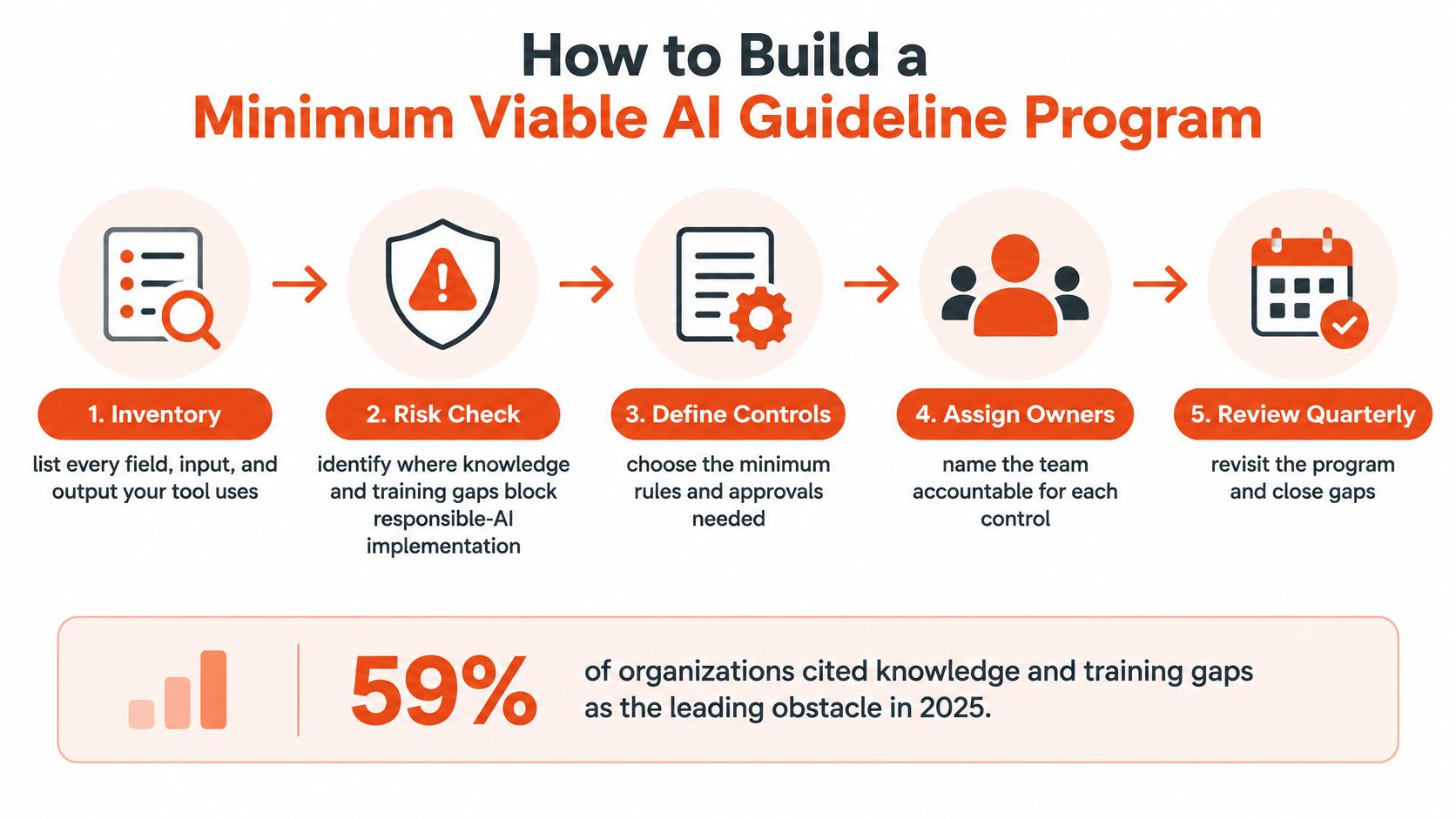
Most programs stall on capability, not conviction. Stanford AI Index data shows 59% of organizations cited knowledge and training gaps as the leading obstacle to responsible-AI implementation in 2025, ahead of budget constraints at 48% and regulatory uncertainty at 41%, according to the Stanford HAI AI Index chapter on responsible AI. A small team needs a short, repeatable program it can run.
Nine Steps That Leave a Record
- Inventory every AI system and the data it touches. Include AI features baked into vendor tools, which is the field most inventories miss.
- Assign one named owner per system. Unowned systems escalate slowly, and a departed owner is the most common way a control disappears.
- Document intended use and known exclusions. Pull exclusions out of vendor documents and into your own page, or nobody will read them.
- Run a privacy and fairness risk assessment. Repeat it on a schedule; a one-time assessment describes a product you no longer sell.
- Set pass thresholds and test frequency. Use the testing table so thresholds exist before anyone sees a result.
- Write customer disclosures and an opt-out path. An opt-out that still runs the model is a disclosure problem and a trust problem at once.
- Log model changes and vendor updates. A vendor update that shifts behaviour without a changelog is the hardest failure to trace.
- Set an incident escalation route with a response time. A route that lands in a shared inbox has no response time.
- Review the program quarterly and record the decisions. A review nobody wrote down can't be repeated or defended.
The minimum set for a smaller ecommerce business is narrower than it sounds: a data inventory, vendor due diligence, a model-change log, an incident route, bias testing, human review, customer disclosures and measurable thresholds. That set is enough to answer a regulator's first questions and enough to catch a bad release.
Publishing principles doesn't demonstrate responsible deployment. The same Stanford chapter notes that only 19% of surveyed organizations reported fully implementing AI-governance frameworks, and fewer than one in four regularly measured AI-risk maturity. Evidence beats aspiration, and every step above produces evidence you can file.
Audit One Sizing Tool Against These Guidelines This Quarter
Audit one AI sizing or try-on system against this guide before you add another to the stack. One system, fully documented, teaches you more than five systems reviewed from memory.
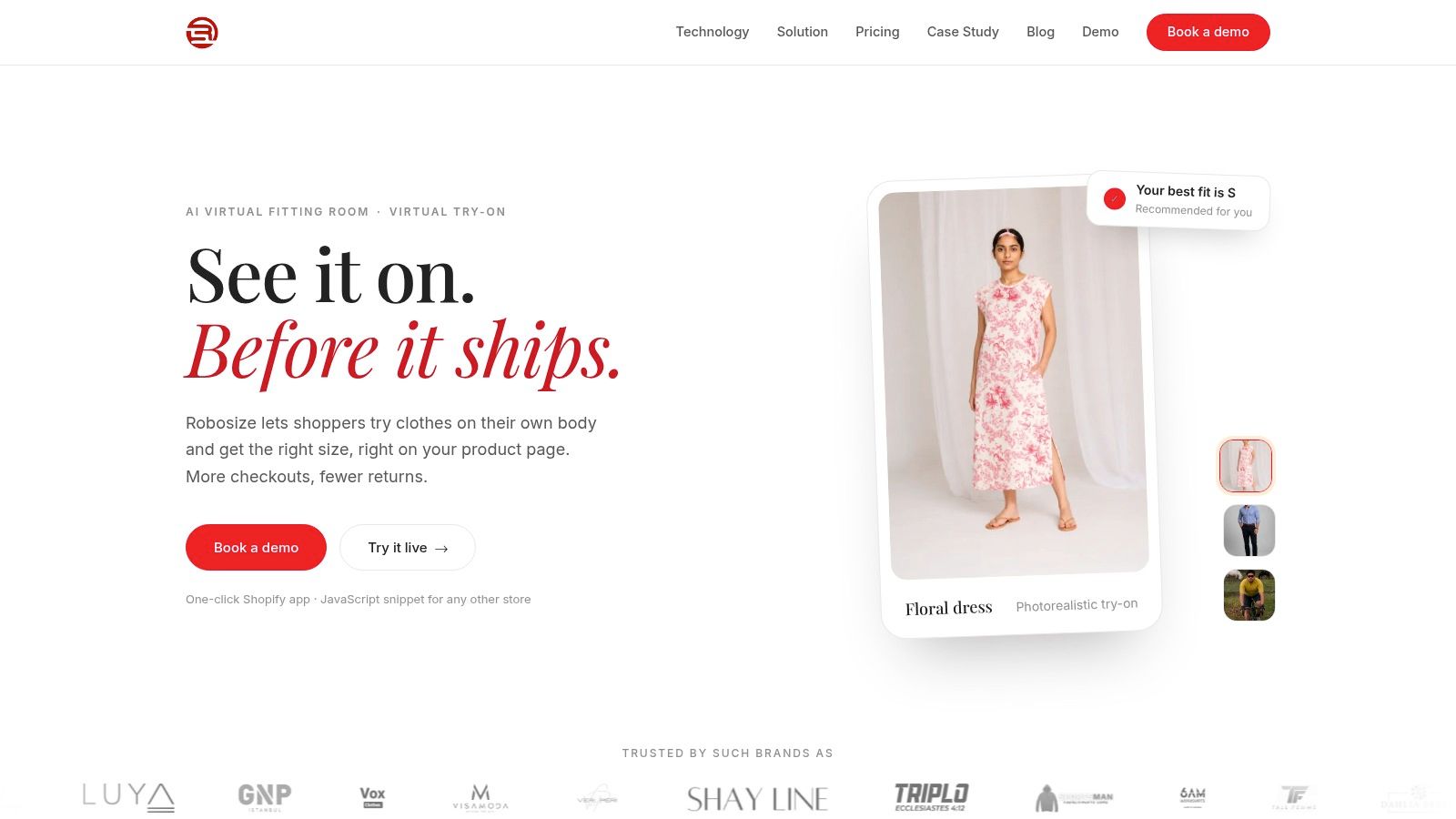
Start with the inventory, because many teams can't list every field their tool collects. Write down each input (height, weight, age, a selfie, a body-shape illustration), where it's stored, how long it's kept and which vendor touches it. In our own flow, shoppers first enter their height, weight, and age, plus the closest illustration of their body proportions, which makes the inventory short enough to finish in an afternoon.
Then run four checks, in this order.
- Match the inventory to the screen. Confirm the fields you listed are the ones a shopper sees being collected.
- Test the no-photo path. Confirm a shopper who declines the selfie still reaches a size recommendation through the questionnaire, held to the same accuracy standard.
- Run the disparate-performance check across body types, skin tones, ages, disabilities and regions, using the quarterly row from the testing table.
- Read the product page as a shopper. Confirm the disclosure explains what the recommendation is based on and how to contest it, in language that fits the store.
Fit confidence is also a commercial lever, since hesitation at the size selector shows up later as abandoned carts and size-driven returns, which is the ground covered in this guide to conversion rate optimization for ecommerce.
Here's the walkthrough of the shopper flow those checks apply to.
Before the audit begins, set the pass threshold for each check, name the owner who signs off, and write the date of the next review in the same record. If a check fails, the system stays as it is until the owner approves a fix, and the failure is logged as an incident. Repeat the full audit each quarter, and add the next system only after this one passes.
Robosize runs the fitting room this guide describes: shoppers enter their height, weight and age plus the closest illustration of their body proportions, with an optional selfie, and the product page returns a per-garment size recommendation you can hold to the checks above. If you'd rather audit a system that already separates the questionnaire path from the photo path than build one from scratch, Robosize is the place to start. Bring your data inventory and your thresholds, and run the four checks against your own catalog this quarter.