A men's S and a men's XXXL can sit far apart on the chest scale, yet both labels mean little until each is tied to a numeric range. That is the central problem with any soccer jersey size chart. The letter is not a physical measurement, and the same letter does not guarantee the same fit across an authentic shirt, a replica, a women's cut, or a youth jersey.
Read a chart as an interval problem. Your chest measurement sets the starting size, waist and height test whether that interval suits your shape, and fit intent settles boundary cases. The same chest number can sit comfortably inside one version's range and on the edge of another's, because ease and proportions change with the jersey version. Once those three jobs are separated, most sizing errors become visible before checkout.
Table of Contents
- How to Measure Your Chest, Waist and Length for a Jersey
- Men's Adult Soccer Jersey Size Chart in Inches and Centimeters
- Why Jersey Sizes Measure the Body, Not the Shirt
- Matching Fit Intent to Authentic, Replica and Women's Jerseys
- Youth Jersey Sizes by Height, Chest and Growth Room
- Converting Inches to Centimeters and Reading International Labels
- Common Sizing Problems and How to Fix Them
- How Retailers Should Map Size Charts to Product Pages
- Confirm the Product Chart and Handle a Poor Fit
How to Measure Your Chest, Waist and Length for a Jersey
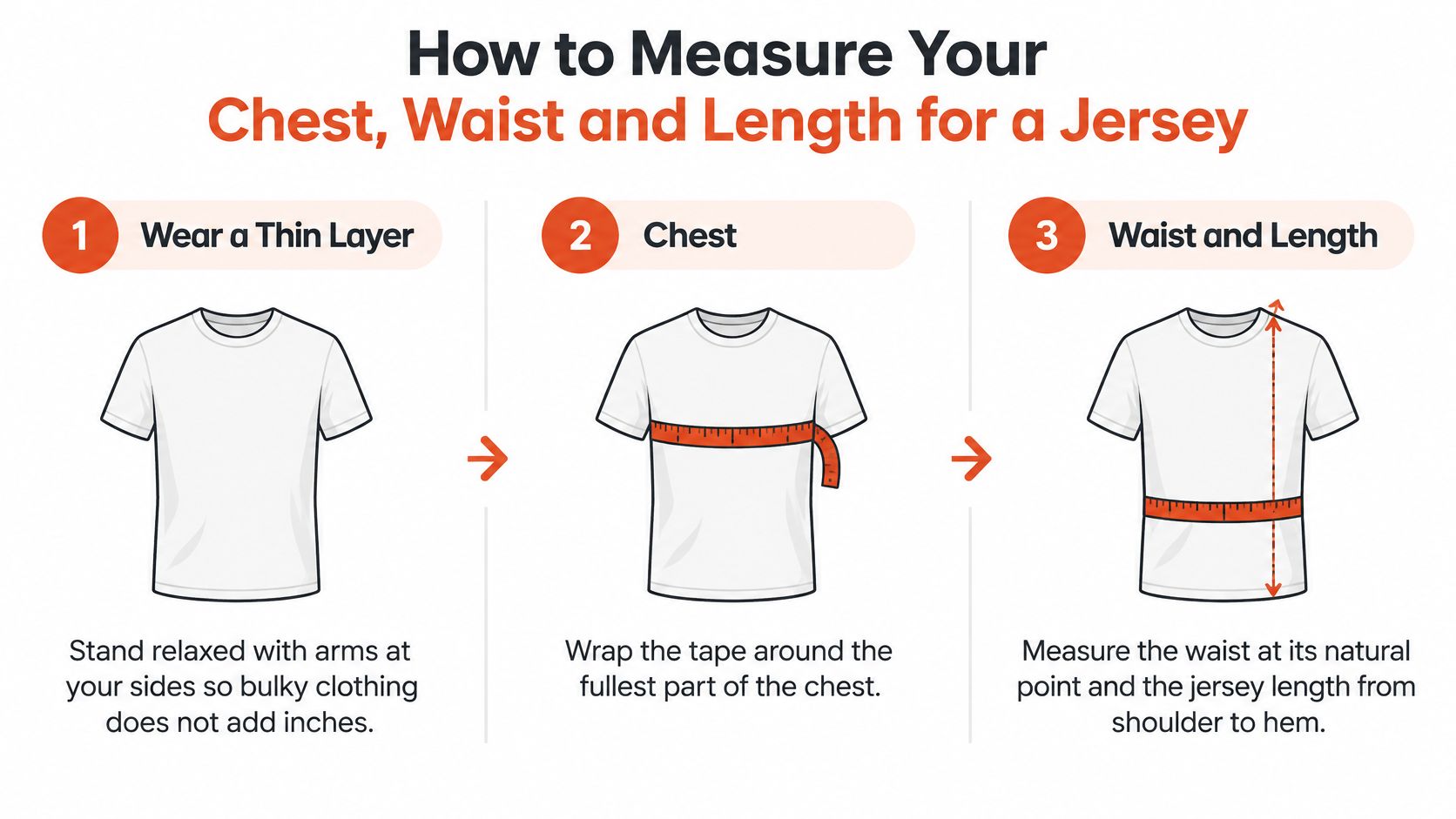
Measure your body, not a coat, a hoodie, or a jersey you already own unless a chart specifically asks for garment dimensions. Small errors matter here because adult ranges can turn on half an inch. A tape pulled tight, tilted at the back, or placed over bulky clothing doesn't create a slightly different result. It can move you into the wrong interval.
Take the Measurements in Order
- Wear a thin layer and stand relaxed. Keep your arms at your sides and breathe normally. Bulky clothing adds circumference that isn't part of your body, while holding your breath or pulling your stomach in understates it.
- Measure chest at the fullest point. Wrap a flexible tape around the fullest part of your chest, keep it level around your torso, and don't pull it tight. The tape should touch your body without compressing it, because chest is normally the primary sizing variable.
- Measure waist at the natural waistline. Keep the tape level all the way round and record the figure without squeezing. Waist rarely overrides chest for a jersey, but it flags a mismatch when your midsection falls in a larger interval than your chest.
- Measure length from the highest shoulder point. Run the tape down to where you want the hem to sit. This gives you a personal reference for comparing torso length, which chest alone can't predict.
- Measure sleeve from shoulder seam to wrist. Bend your arm slightly while you measure. A straight, locked arm can shorten the reading and hide a sleeve problem that appears when you move.
Record Numbers Before You Round Them
Write every result in inches and centimeters, and keep decimals until you've matched it to a chart. Rounding 37.4 in up to 38 in feels harmless, but it can place you on the other side of a size boundary. Regional charts also use different units and intervals, so the conversion habits in this Australian clothing size guide are useful when you're comparing markets.
Practical rule: Compare your body numbers with the chart's body column. If the page lists flat garment measurements instead, don't treat the two sets of numbers as interchangeable.
If you land between sizes, don't decide yet. Note whether you want a close athletic fit, a standard fan fit, or room for a base layer. That preference, not a coin flip, should settle the boundary.
Men's Adult Soccer Jersey Size Chart in Inches and Centimeters
Start with chest, then use waist as a check. The Nike and U.S. Soccer men's jersey chart maps S to a 35–37.5 in chest, M to 37.5–41 in, L to 41–44 in, XL to 44–48.5 in, XXL to 48.5–53.5 in, and XXXL to 53.5–58 in, with waist ranges running from 29–32 in for S through 47.5–52.5 in for XXXL.
| Size | Chest (in) | Chest (cm) | Waist (in) | Waist (cm) |
|---|---|---|---|---|
| S | 35–37.5 | 88.9–95.3 | 29–32 | 73.7–81.3 |
| M | 37.5–41 | 95.3–104.1 | 32–35 | 81.3–88.9 |
| L | 41–44 | 104.1–111.8 | 35–38 | 88.9–96.5 |
| XL | 44–48.5 | 111.8–123.2 | 38–43 | 96.5–109.2 |
| XXL | 48.5–53.5 | 123.2–135.9 | 43–47.5 | 109.2–120.7 |
| XXXL | 53.5–58 | 135.9–147.3 | 47.5–52.5 | 120.7–133.4 |
Read the Range, Not Just the Letter
Chest circumference does the main work: it decides whether the jersey can close around your torso without pulling. Waist is the secondary check. When your chest lands in M but your waist sits inside the XL interval, the M will close at the chest and strain at the midsection, so the letter alone has already misled you.
The intervals widen as sizes grow. S spans 2.5 in, M spans 3.5 in, and XXL spans 5 in. Two buyers at opposite ends of XXL share a label yet keep different amounts of spare room, which explains how the same size on the same product page can draw both "runs small" and "runs large" reviews.
A size interval isn't a promise that everyone inside it gets the same fit. Your position within the interval changes how much room remains.
Adjacent ranges share boundary values: 37.5 in closes S and opens M, so neither answer is automatically wrong at an edge. The deciding factor is which version of the jersey you are buying. A medium in a close authentic cut leaves less margin than a medium in a relaxed replica, and the chart only returns a reliable answer when you read it alongside the jersey's intended fit.
Treat this table as one manufacturer's reference model. Materials and cuts shift the result from brand to brand, so confirm the product page carries this same chart before you order. Retailers shipping teamwear face the problem at scale, which is why guidance on how to size branded apparel with Dirt Cheap Product matters when a single chart must serve many body shapes. For an individual order, the sequence stays short: find your chest interval, check the waist interval, then confirm which jersey version the size label refers to.
Why Jersey Sizes Measure the Body, Not the Shirt
A letter size isn't a fixed physical object. A medium jersey from one manufacturer can measure larger across the chest than a medium from another, and both can still be intended for similar bodies. The difference sits in ease, the extra space a maker adds between body and fabric for movement, stretch, layering, and style.
The ISO 8559 sizing standards make the distinction explicit: ISO 8559-1:2017 defines anthropometric measurements and procedures, while ISO 8559-2:2017 specifies primary and secondary dimensions so manufacturers and retailers can communicate the body dimensions a garment is intended to fit. ISO's designation system is therefore based on body measurements, not garment measurements, and garment dimensions are set separately according to style, cut, fashion elements, and wearing conditions.
Three Numbers That Should Not Be Confused
- Body range: The chest, waist, hip, or height interval the size was designed to fit. This is the column you compare with your tape measurements.
- Finished garment measurement: The jersey's own dimensions when measured as a product. It will often exceed the body range because the maker has added ease.
- Fit intent: The maker's intended relationship between body and garment, such as close athletic, standard, or relaxed. Two jerseys with similar garment measurements can still behave differently if one uses more stretch.
Say your chest measures 40 in and a product page lists a garment chest larger than that. That doesn't prove the jersey is too big. The garment needs room for breathing, shoulder movement, and fabric behavior. The analytical mistake is comparing your body directly with a flat product figure and treating every extra centimeter as wasted space.
Check What the Chart Claims to Measure
Look for three disclosures before you trust a soccer jersey size chart. It should state whether figures describe the body or the garment, identify the target demographic, and explain the measurement method. A men's replica, a women's fitted shirt, and a goalkeeper jersey can use different fit assumptions even inside one brand.
When a page offers only S, M, and L, convert the label into a numeric body range before comparing it with another brand or market. If the seller can't provide that range, you're not comparing sizes. You're comparing names.
Matching Fit Intent to Authentic, Replica and Women's Jerseys
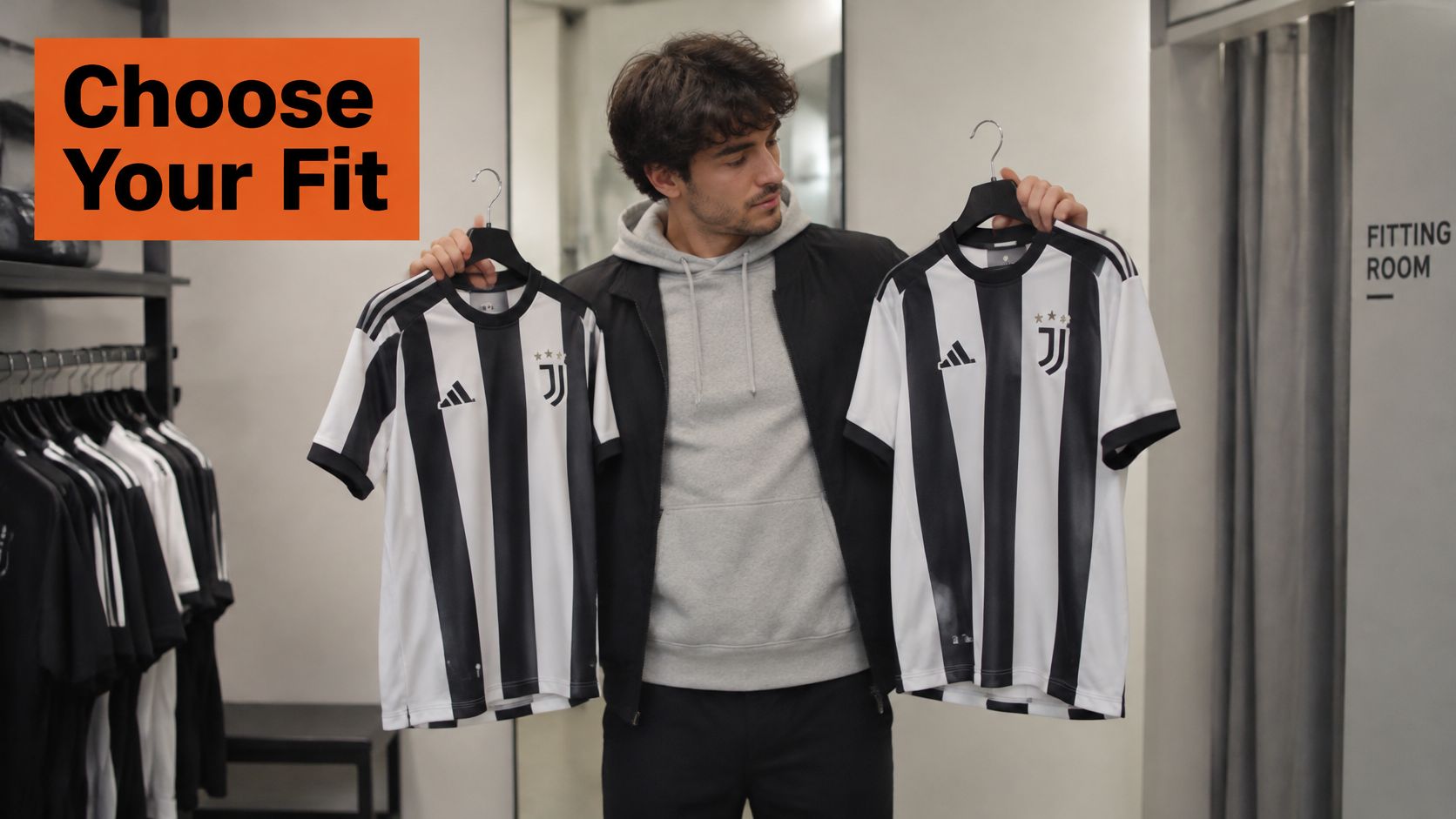
Which size gives you the fit you want: tight for playing, standard for casual wear, or loose enough for a base layer or hoodie? That question matters because the same labeled size doesn't behave the same way across jersey versions. Guidance summarized by ProSoccer's authentic jersey guide indicates that authentic jerseys are commonly closer-fitting, while replicas are generally more relaxed.
A side-by-side look at two versions shows why chest alone can't finish the decision.
| Version | Typical Cut | Choose It When | Sizing Note |
|---|---|---|---|
| Authentic (player-issue) | Closer, athletic fit | Matches and training | Check torso length before sizing up |
| Replica (fan) | Relaxed fit | Casual wear or layering | Sizing up can add shoulder looseness |
| Women's | Women's proportions | Women's body shape | Use the women's chart, not a men's chart |
| Youth | Child proportions | Child's height and chest | Confirm each brand's youth chart |
| Goalkeeper | Room for keeper movement | Keeper-specific movement | Tolerances can differ from outfield jerseys |
Why Sizing Up Isn't a Universal Fix
Sizing up changes more than chest ease. It can add torso length, drop the shoulder seam, and lengthen sleeves. In an authentic cut, one size up may turn a restrictive shirt into a usable athletic fit. In a relaxed replica, the same move can create excess length and loose shoulders while solving a chest problem you didn't have.
Women buying from men's or unisex listings should first check whether a women's chart exists for that exact product. A men's interval may match chest circumference while still producing the wrong torso proportions. Goalkeeper jerseys deserve the same caution because their tolerances can differ from outfield shirts.
The video below is useful for seeing how version and drape change the result on a body, rather than treating fit as a single chest number.
Before you choose, check torso length, fabric stretch, shoulder ease, and whether the product is designed for athletic movement or everyday wear. Then pick the size that produces your intended fit in that version. A generic chart can shortlist a size, but it can't know how you plan to wear the shirt.
Youth Jersey Sizes by Height, Chest and Growth Room
Age is the weakest youth sizing signal. Two children with the same age can differ enough in height, chest, and torso length to need different sizes, and brands don't assign age labels consistently. Market guidance collected by Concept Jerseys' soccer jersey size guide notes that youth labels are inconsistent across brands and that official replicas can fit slimmer than generic practice jerseys.
Measure the Child in Front of You
Use height and chest as the main inputs, then check waist, jersey length, shoulder width, and sleeve reach. Height helps you judge whether the hem and sleeves will sit sensibly. Chest tells you whether the torso has enough room. A narrow child with a fuller chest may need the chest-based size even if height points smaller, while a tall, narrow child may need length without much extra width.
A useful youth soccer jersey size chart separates toddler, youth, and adult or unisex ranges. It also shows height, chest, waist, and jersey length in metric and imperial units. If a chart gives only age, treat it as a starting guess and look for the brand's measured ranges before ordering.
For team orders, that discipline matters even more because one age group can contain several body proportions. Villarreal Houston Academy's advice on customizing youth team soccer uniforms is a useful companion when a coach has to collect sizes for a full squad rather than one child.
Add Growth Room Without Buying a Costume
Moderate extra room can extend wear across a season. Excessive room creates a different problem: sleeves slide over hands, the hem hangs awkwardly, and loose fabric gets in the way during play. The goal isn't the largest jersey a child can technically wear. It's the smallest size that fits today's chest and leaves a modest allowance.
Growth rule: Size for today's measured chest first, then add only enough room for the layer and the season ahead.
If the jersey will go over a base layer, sweatshirt, or protective equipment, measure chest over that layer. Follow this sequence: measure chest and height, match the chest range, check length and sleeves, then decide whether one modest growth allowance is justified. Don't apply both an age-based size-up and a growth-based size-up. That's how a reasonable allowance becomes two sizes too much.
Converting Inches to Centimeters and Reading International Labels
The conversion rule is exact: 1 in equals 2.54 cm. Multiply inches by 2.54 to read a metric chart, or divide centimeters by 2.54 to return to inches. Keep one decimal place during the comparison, because early rounding can move a measurement across a boundary.
| Inches | Centimeters |
|---|---|
| 32 in | 81.3 cm |
| 34 in | 86.4 cm |
| 36 in | 91.4 cm |
| 38 in | 96.5 cm |
| 42 in | 106.7 cm |
| 44 in | 111.8 cm |
Convert the Measurement, Then Match the Interval
Say your chest is 37.5 in. Converted precisely, that's 95.3 cm. On a metric chart, look for the interval containing 95.3 cm rather than rounding to 95 cm or 96 cm first. If 95.3 cm is also a shared boundary, fit intent decides the size just as it does in inches.
International labels become readable once you separate the label from the range behind it. Find the numeric chest and waist intervals, confirm whether they describe body or garment, and note the demographic the chart targets. A foreign letter or number has no transferable meaning until it's tied to those ranges.
Treat Letter-Only Charts With Caution
A product page that lists only S, M, L, and XL asks you to trust an unstated interval. That's risky when brands use different intervals and body-shape assumptions for European, U.S., women's, and youth products. The broader problem of inconsistent terminology is explored in this overview of size in fashion, and jerseys aren't exempt from it.
Run a final unit check before checkout. Convert your measurement, find the matching range, and confirm that the product page uses the unit you think it uses. A correct number entered against the wrong unit is still a sizing error.
Common Sizing Problems and How to Fix Them
A jersey that's tight across the chest is the clearest sizing complaint, but it doesn't always mean you picked the wrong letter. The cause may be a bad measurement, a boundary decision, a closer authentic cut, or fabric with less stretch than you expected. Diagnose the cause before exchanging, because the wrong fix can trade a chest problem for a length problem.
| Symptom | Likely Cause | Fix |
|---|---|---|
| Tight across the chest | Measured at a boundary or authentic closer cut | Choose the next size if you want layering room |
| Long in torso, loose shoulders | Replica cut sized up | Return to the chest-based size and compare length |
| Sleeves too long | Sized up for growth or comfort | Keep the chest-based size and check sleeve length |
| Youth jersey tight over base layer | Sized by age only | Size by chest and height, then add layer room |
| Men's chart fits women poorly | Men's chart used for a women's frame | Use the women's or unisex chart |
Start With the Cheapest Error to Fix
Remeasure before you reorder. A tape pulled tight understates your chest, while a tape over a hoodie overstates it. If the corrected number moves you into another interval, the original jersey may have been manufactured correctly for the size ordered. The error was in the input, not the garment.
Next, check your position in the range. A shopper near the top of an interval has less remaining ease than a shopper near the bottom. At a shared boundary such as 37.5 in, intended use should decide. Match play favors the closer option, while casual wear over layers favors the larger one.
Separate a Size Problem From a Version Problem
- Chest tight, length right: Try the next size in the same version, especially in an authentic cut.
- Chest right, torso too long: Don't size up. Look for a different version or a chart with a shorter length.
- Shoulders loose, sleeves long: You've probably solved width by buying length. Return to the chest-based size.
- Fit fails only over layers: Remeasure over the layer you'll wear. Your base size may be correct for a shirt worn alone.
Fabric stretch also changes perceived tightness. A less elastic jersey can feel restrictive even when its measurements look adequate, so compare the stated stretch and intended use with how you'll wear it. Keep the jersey, tags, and packing materials until you've tested arm movement and layering. An exchange decision based on standing still for ten seconds misses the conditions that create most discomfort.
How Retailers Should Map Size Charts to Product Pages
One general soccer jersey size chart across a whole store creates false confidence. A retailer should upload a separate chart for each manufacturer, gender or category, age range, and fit block. Replica, authentic, women's, youth, and goalkeeper jerseys shouldn't be assumed to share tolerances just because they carry the same club crest.
The FIFA equipment regulations offer a useful discipline model: mandatory elements on playing equipment are measured after permanent application, and proposed measurement methods require formal review and written approval. Retail sizing doesn't need that level of governance for every shirt, but it does need defined procedures rather than informal labels.
Publishing Checklist for Each Product
- State the measurement object: Label figures clearly as body measurements or finished garment measurements.
- Publish both unit systems: Show centimeters and inches while preserving the original precision.
- Name the demographic: Identify men's, women's, youth, toddler, unisex, or goalkeeper ranges on the chart itself.
- Explain the method: Tell shoppers to place the tape around the fullest part of the chest or bust, keep it level, and avoid pulling it tight.
- Show fit intent beside measurements: Name the cut as closer athletic, standard, relaxed, or layering-friendly so shoppers can interpret the interval.
- Map chart to variant: Attach the chart to the exact manufacturer, version, and product page, not to a broad jersey category.
Clear product information also helps shoppers find and trust the right page in search results. Merchants reviewing page structure alongside sizing content can use these Shopify product page SEO essentials to keep product details discoverable without burying the size information.
Build Recommendations Around the Dominant Variable
For automated sizing, use chest as the dominant variable, then add waist, hips, height, and fit preference. Flag shoppers whose measurements fall outside the chart or span two sizes instead of forcing one result. At that point, ask about intended use and preferred looseness.
That flag protects conversion as well as fit. A shopper who receives an honest boundary explanation can choose deliberately, while a shopper pushed into a false certainty is more likely to abandon or return. The same principle sits behind effective conversion rate optimization for ecommerce: remove uncertainty at the moment it blocks the decision, using product-specific evidence rather than generic reassurance.
Confirm the Product Chart and Handle a Poor Fit
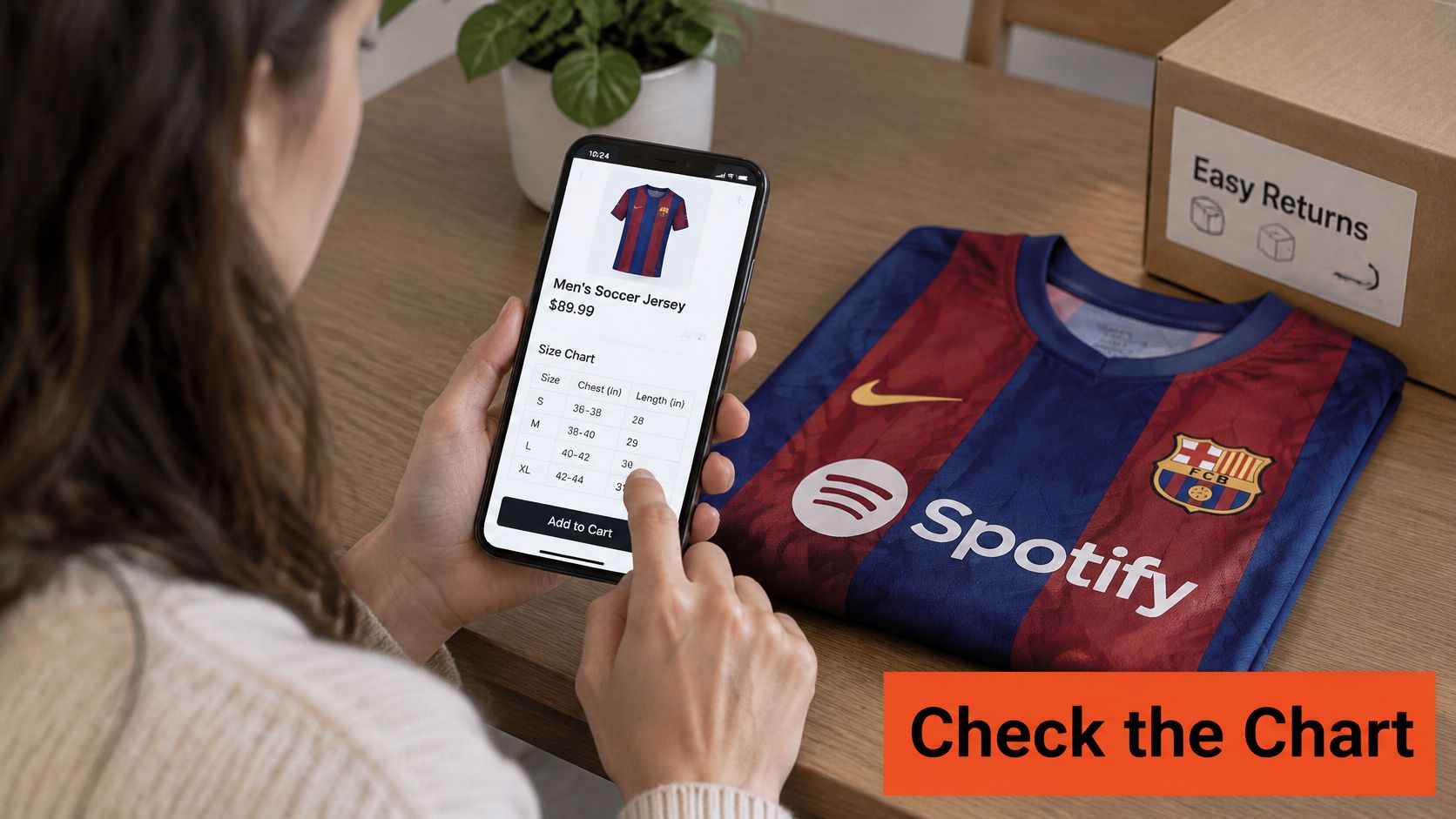
Close the purchase on the chart for that exact jersey, not a generic club chart from another season or a different version. Product pages change cuts, suppliers, and size intervals. The last check should therefore be slower than the search that brought you there.
Run the Final Five Checks
- Confirm units and demographic. Check whether the figures are inches or centimeters and whether the chart targets men, women, youth, or another group.
- Confirm body versus garment figures. Match your tape result only with the corresponding column. Don't compare a body chest with a flat garment chest as if they were the same measure.
- Match your chest interval. On a shared boundary such as 37.5 in, keep the closer authentic size for match play or take the next size when you'll layer.
- Read length and sleeve notes. If a relaxed replica already fits your chest, don't size up again and create shoulder and hem problems.
- Protect the exchange option. Save a screenshot of the chart and keep tags and the packing slip until you've tried the jersey over the layer you'll wear.
For a child, keep the single modest growth allowance you've already chosen. Don't add another size at checkout because the first allowance suddenly feels uncertain. One deliberate allowance is a sizing decision. Two stacked allowances usually become excess length.
Decide Between Exchange and Return
Exchange when the chest is tight or shoulders bind but length and overall proportions look right. The next size in the same cut can solve that narrow problem. Return when both length and sleeves are excessive, because moving within the same cut won't shorten a replica that's already too long.
An on-page fitter can provide a second opinion at a boundary. We match each product to the store's own size chart, the number of size charts a store can load is unlimited, and we give one precise size and fit recommendation for each specific garment. Shoppers first enter their height, weight, and age, plus the closest illustration of their body proportions. Accept that recommendation only when it agrees with the exact product chart in front of you.
Stop asking shoppers to translate letters, units, and fit blocks on their own. Robosize matches each soccer jersey to your store's own chart and gives the shopper one precise size and fit recommendation for that garment, so authentic, replica, women's, and youth products don't collapse into one generic guess. Visit Robosize to put product-specific sizing on the page where the buying decision happens.