You order the same dress in two sizes, keep both tabs open, stare at the size chart, then guess. When the package arrives, one size pulls across the hips and the other hangs loose at the shoulders. The chart wasn't exactly wrong. It just wasn't enough.
That's the everyday problem behind the term body shape model.
Most online fit tools still ask shoppers to translate a three-dimensional body into a few flat facts like height, weight, and usual size. Those inputs help, but they don't tell the full story of where volume sits, how proportions differ, or why two people with the same weight can wear the same garment very differently. A blazer cares about shoulder width and upper torso shape. Jeans care more about hip distribution, rise, and thigh volume. A knit dress responds to the whole silhouette.
A body shape model tries to solve that missing-geometry problem. It turns a rough profile into something closer to a digital body that software can use. Sometimes that model comes from a scan. Sometimes it comes from photos. Sometimes it comes from a short questionnaire and a statistical template. In practice, modern fit systems often mix those approaches.
For shoppers, that changes the question from “What size am I?” to “How will this specific garment behave on my body?” For retailers, it changes the job from showing a generic avatar to matching a person's body data with the measurements and construction of a particular product.
That distinction matters more than most articles admit. Better fit doesn't come from prettier 3D avatars alone. It comes from better body coverage, better garment data, and less dependence on vague labels like pear or hourglass.
Table of Contents
- Introduction Why Online Fit Still Feels Like Guesswork
- What a Body Shape Model Really Is
- Three Ways Body Shape Models Are Built
- How Body Shape Models Power Virtual Try On and Sizing
- Selfie Versus Template Models and When to Use Each
- Fit Accuracy User Experience and What Models Still Miss
- Key Takeaways for Choosing and Using Body Shape Models
Introduction Why Online Fit Still Feels Like Guesswork
Online apparel shopping still breaks down at the same moment. The shopper wants certainty, but the store offers approximation.
A common example is denim. Two shoppers can both wear the same nominal waist size, yet one needs more room through the seat while the other needs more room through the thigh. The size chart treats them as interchangeable. The garment doesn't. That gap is where returns, hesitation, and “I'll think about it” decisions start.
Why size labels fail so often
Traditional apparel sizing was built to simplify production. It gives brands a manageable set of labels, but it doesn't describe real human variation very well. One number might tell you chest circumference. It won't tell you whether your fullness sits higher or lower, whether your shoulders are broad relative to your bust, or whether your torso is long compared with your legs.
That's why many shoppers use workarounds:
- They order two sizes: one for safety, one for comparison.
- They shop by fabric type: trusting stretch knits more than woven pieces.
- They avoid certain categories: especially fitted jackets, trousers, and dresses.
- They rely on habit: buying the same brand repeatedly because switching feels risky.
Those habits make sense. They're also a sign that fit tools often ask too little about the body and know too little about the garment.
Online fit feels random when the system knows your size label but not your shape, and knows the category but not the garment's real dimensions.
The real missing input is geometry
A body shape model fills in what flat sizing leaves out. Instead of reducing a shopper to “medium” or “size 10,” it tries to represent proportions, contours, and measurement relationships that affect fit in the actual world.
That's useful whether you're a shopper trying to picture a blazer or a retailer deciding how to power virtual try-on. The key idea is simple. Better fit prediction starts with a better body representation. But it only becomes practical when that representation can connect to product-level garment information too.
What a Body Shape Model Really Is
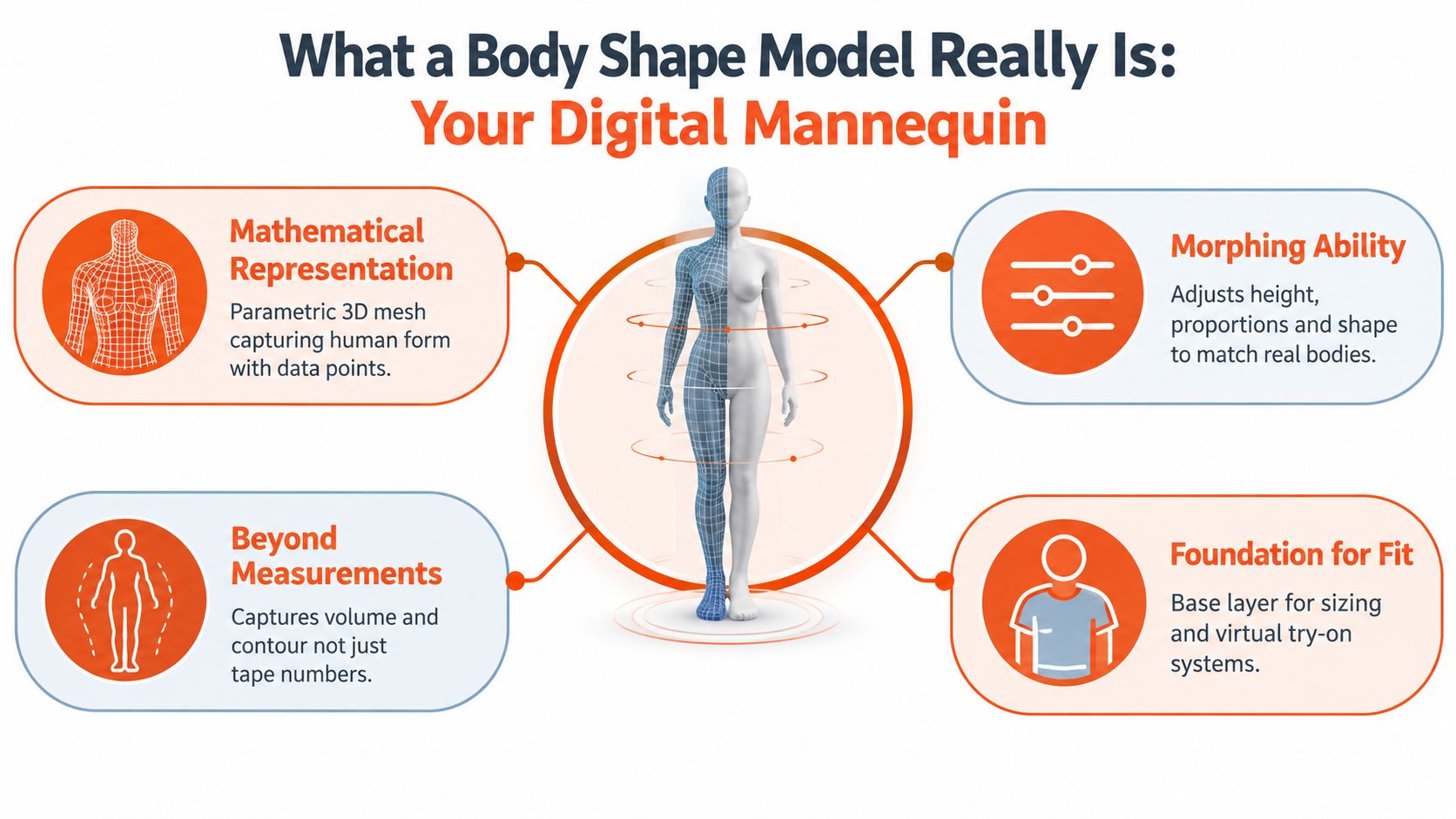
The easiest way to think about a body shape model is as a digital mannequin that can change shape.
Not a static mannequin in a store window. A responsive one. Move a slider, change a measurement, add body volume in one area, reduce it in another, and the mannequin updates as a connected whole.
Core definition: A body shape model is a mathematical 3D representation of the human body that links measurements, proportions, and surface geometry so software can estimate fit more precisely than a size label alone.
It's more than height and weight
A lot of shoppers hear “body model” and assume it means entering basic stats into a rough avatar generator. Good systems go further.
They try to represent at least three layers at once:
- Overall silhouette: the outline you'd notice first, such as straighter, curvier, broader, or narrower proportions.
- Measurement structure: relationships between bust, waist, hip, torso, limbs, and other fit-relevant regions.
- Local geometry: the detailed shape that affects tension, drape, and ease in specific places.
One major milestone in this area came from statistical body-shape modeling built from large scan datasets. A study used 1,224 male scans and 591 female scans from the CAESAR body-scan survey, standardized the meshes, and retained 60 principal components for each model. Those components captured 99.7% of the variance in body shape, landmark locations, and anthropometric dimensions, while the model combined 74 body landmarks, 19 joint locations, and 136 manual anthropometric measurements in the referenced paper. The point for apparel is practical: fit depends on a rich map of the body, not one or two tape measurements.
Why this matters for clothing
A shirt doesn't interact with “body type” as a label. It interacts with geometry.
If the shoulder slope is different, the seam may not sit right. If the torso volume is distributed differently, the same waist measurement can still produce a very different fit. If the hip curve is fuller in one area, a skirt may twist, pull, or hang unevenly.
That's why body shape models are useful even when the shopper never sees the underlying math. The model acts like a fit engine's base layer.
Where people often get confused
The confusion usually comes from mixing up three different things:
- A visual avatar that shows a person on screen.
- A body shape model that software uses to estimate form.
- A fit recommendation that depends on both body and garment data.
Those aren't identical. A polished avatar can still be fed by weak body data. A plain-looking interface can still use a strong body model underneath.
The avatar is the display. The body shape model is the structure behind it.
Three Ways Body Shape Models Are Built
Retail fit systems usually build body shape models in one of three ways. Each route solves a different problem, and each comes with trade-offs in precision, speed, and shopper friction.
Statistical parametric models
This method starts with many body scans and learns the common ways bodies vary. Think of it as building a shape library from real geometry, then turning that library into a flexible template.
The result is a model that can morph across many body forms without needing a full scan from every shopper. This is the logic behind many modern fit tools and computer-vision pipelines. If you want a broader explanation of how AI turns inputs into body measurements, this guide on AI body measurements is a useful companion.
Direct 3D scan models
This route captures a body more directly. A scanner measures the person's surface and produces a true-to-scale digital form.
That's valuable when a brand wants high geometric fidelity for size chart development, custom production, or fit trials. Research on photo-based and multi-view estimation also notes that 3D body scanners can produce true-to-scale models in seconds and are used for size charts, mass customization, and virtual fit trials in the underlying study.
The strength is realism. The limitation is operational. In most consumer shopping flows, dedicated scans are harder to collect than a short questionnaire or phone-based input.
Questionnaire-derived models
This is the lightest approach for the shopper. The system starts from inputs like height, weight, age, body shape cues, and sometimes fit preferences. Then it maps those signals onto a statistical body template.
This approach usually won't capture the same detail as a direct scan, but it reduces friction and works well when speed matters. It also fits mobile commerce behavior better, where shoppers want a recommendation quickly and may not want to upload images.
How body shape models compare by build method
| Build Method | Primary Inputs | Detail Level | Best For |
|---|---|---|---|
| Statistical parametric model | Large scan datasets plus shopper measurements or inferred traits | High, especially for proportion and shape variation | Scalable fit systems and virtual try-on foundations |
| Direct 3D scan model | Full body scan | Very high | Fit labs, size development, custom or high-precision use cases |
| Questionnaire-derived model | Height, weight, age, shape cues, fit answers | Moderate | Fast ecommerce flows with low shopper effort |
Why many systems blend methods
In practice, one method rarely does everything well.
A retailer may use a questionnaire to keep entry friction low, then refine the body estimate with image-based cues. Another may use a statistical template for the body but rely on product-specific garment measurements for the final recommendation. The smartest setups don't ask one model to solve every problem. They split the job between body estimation and garment matching.
How Body Shape Models Power Virtual Try On and Sizing
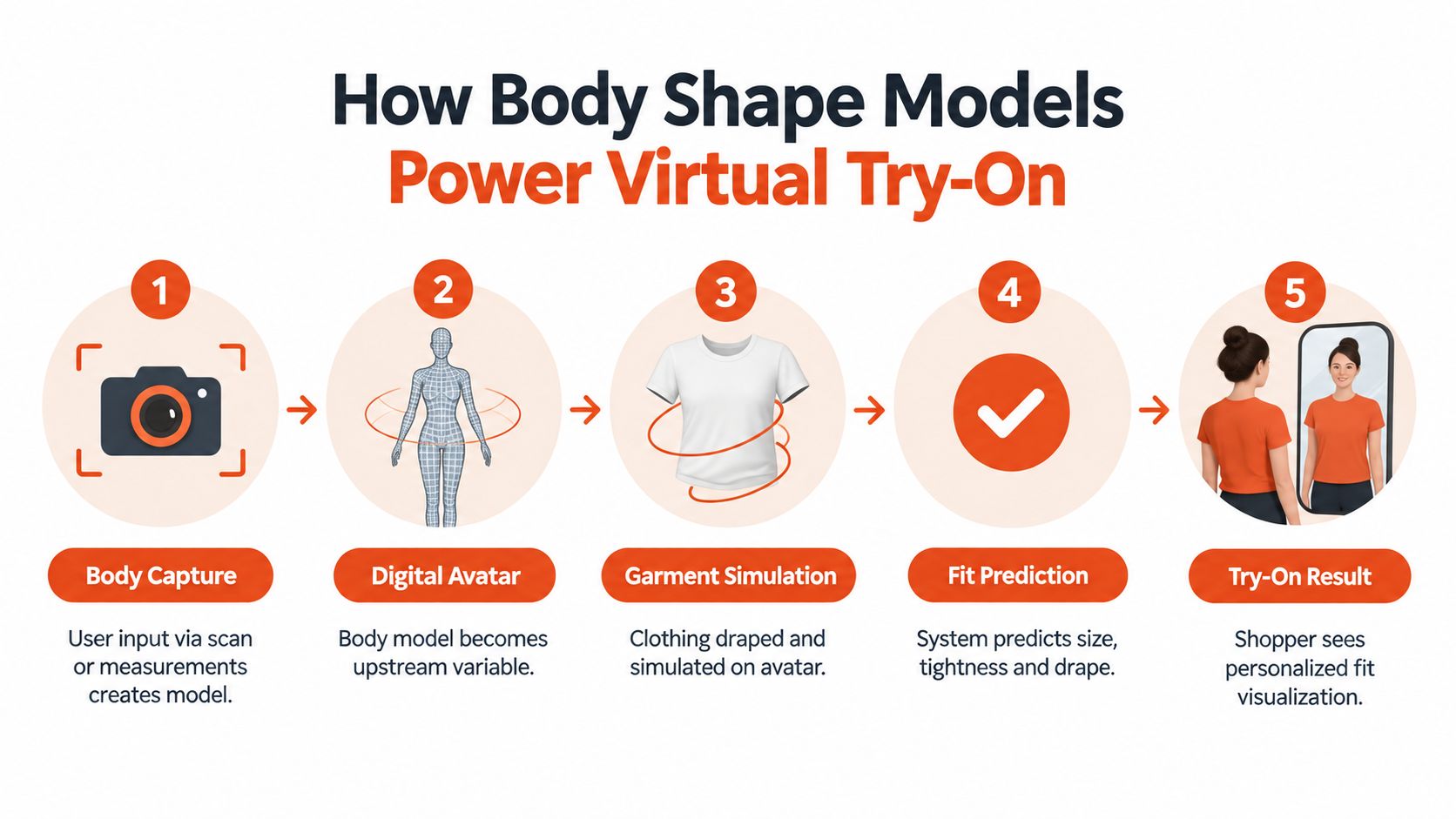
Once a body shape model exists, it becomes the input that other fit features depend on. It's the starting point for rendering clothing, simulating drape, and recommending a size on a product page.
That's why body modeling is upstream. If the body estimate is weak, everything downstream gets shaky too.
The try-on pipeline in plain language
A virtual try-on flow usually follows a sequence like this:
- Body capture: the shopper provides measurements, answers, images, or some combination.
- Body modeling: the system generates a usable 3D body estimate.
- Garment matching: the product's measurements and cut are mapped against the body.
- Fit prediction: the software estimates likely size, tightness, and silhouette.
- Visualization: the shopper sees a rendered preview or fit guidance.
The technical reason this matters is that 3D shape is not just decoration. Research on frontal- and side-view image pipelines found that a two-view process using silhouette segmentation, an autoencoder, and regularized regression can estimate body shape and clothing measurements from limited inputs in this paper. For apparel, shape estimation is what enables the next stages.
Why SKU-level garment data matters more than people expect
Many articles oversimplify. They talk about “knowing the shopper” but not “knowing the product.”
A body shape model can tell you someone has fuller hips or narrower shoulders. It still can't answer whether this exact blazer runs tight in the upper arm or whether this exact dress has enough ease through the waist unless the system also has item-level garment information.
That's why fit guidance increasingly needs SKU-level calibration. Product behavior varies by cut, fabrication, stretch, and construction. If you want a broader consumer-facing view of inclusive fit questions across categories and body types, it helps to find inclusive sizing tips that discuss fit in more practical terms.
Better body inputs improve recommendation quality
Research on 3D body-scanning data and support vector machines showed 89.66% accuracy when predicting size from core measurements such as bust, waist, and hip, but accuracy dropped to 68.97% after compressing 35 body dimensions into PCA-derived horizontal, vertical, and lower-body features in the study. That's a strong practical warning. If a system simplifies body representation too aggressively, it can lose fit-critical details.
For retailers testing tools, that means asking very direct questions:
- Does the system preserve region-specific body information?
- Does it match recommendations to product-level garment measurements?
- Does it show fit output on the product page where the decision happens?
Some commercial platforms are built around that product-page flow. For example, this overview of virtual try-on and size recommendation on product pages reflects the broader pattern: low-friction body input, then garment-specific fit output where the shopper is deciding.
A body shape model helps only when it connects to the garment in front of the shopper, not just to a generic size chart in the background.
Selfie Versus Template Models and When to Use Each
Retailers often frame this as a design choice. It's really a shopper-experience decision.
Some people want to see clothes on something that resembles them. Others want speed, privacy, and minimal effort. That's why selfie-based and template-based body models each have a place.
When selfie-based models make sense
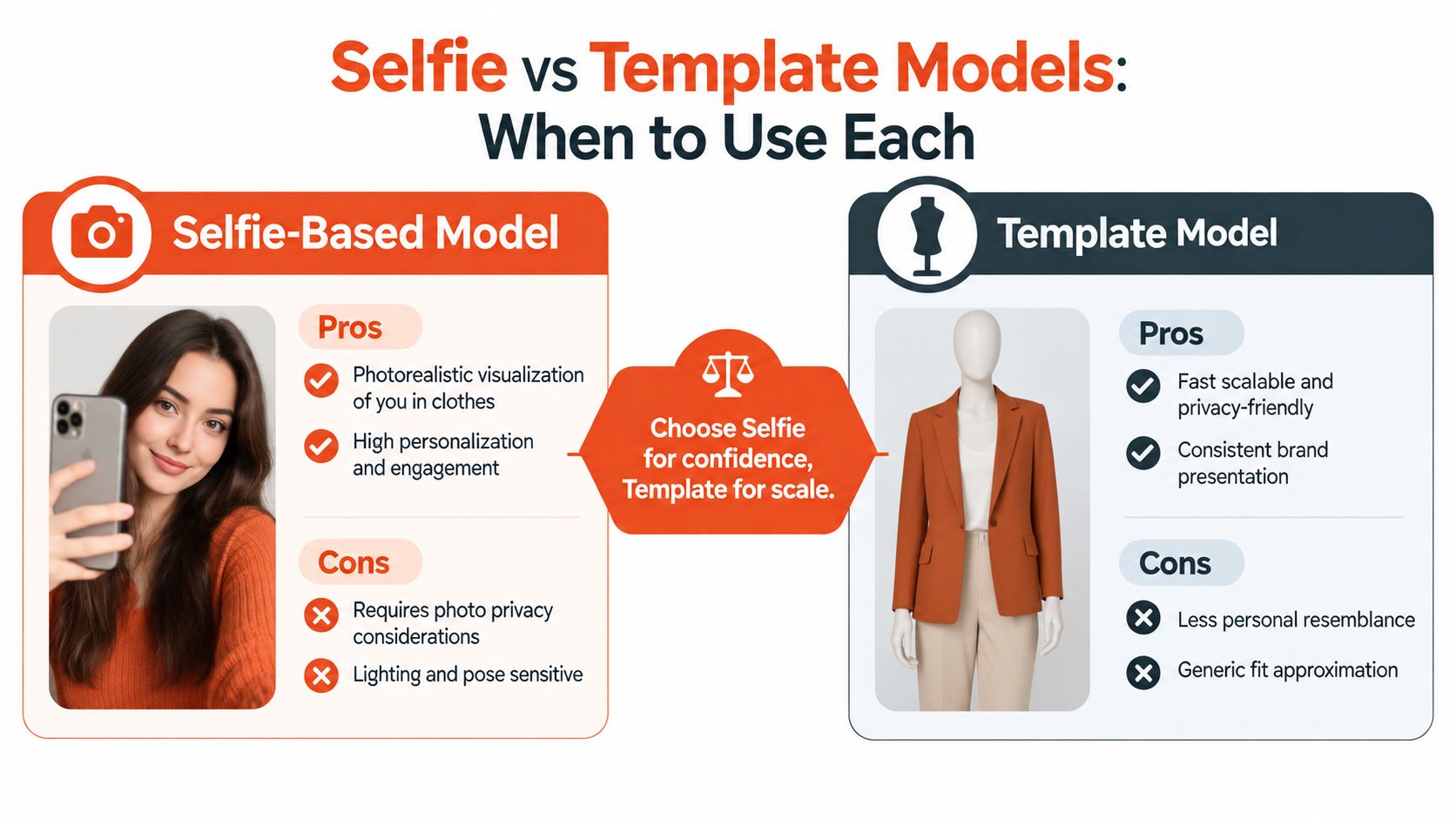
A selfie-based flow can increase personal relevance because the shopper sees a result that feels more like “me” than “a mannequin.” That matters for confidence, especially in style-led categories where silhouette and visual proportion influence the decision as much as pure size selection.
But there's a trade-off. Photo input can create friction. Shoppers may worry about privacy, lighting, pose quality, or whether they want to stop and take a picture during a quick browsing session.
Selfie-based models fit best when:
- Visualization confidence matters most: dresses, occasionwear, fitted tops, or fashion-led categories.
- The audience is comfortable with camera input: especially mobile shoppers already used to photo-first apps.
- The experience is designed to be quick: short capture flows work better than multi-step setup.
When template models work better
Template models start from a pre-built statistical body or a questionnaire-derived body profile. They're less personal visually, but often much easier to deploy at scale.
They're useful when the business goal is reducing friction and getting more shoppers into the fitting flow. They also work well when privacy sensitivity is high or when the catalog spans many products and the key decision is sizing rather than photorealistic self-representation.
Template models fit best when:
- Speed matters more than likeness
- Privacy-friendly setup is a priority
- The retailer wants consistency across the catalog
- The fit tool needs to work smoothly on many devices
The best answer is often optionality
The strongest retail experiences often offer both. Let the shopper begin with a template flow, then optionally upgrade to selfie-based visualization if they want more confidence.
That approach lowers the barrier to entry while still serving the shoppers who want a more personal view. It also recognizes a simple truth: the right body shape model isn't only about accuracy. It's about what the shopper will complete.
Fit Accuracy User Experience and What Models Still Miss
At this point, the biggest misunderstanding is easy to name. A body shape model is not mainly an avatar problem. It's a coverage problem and a garment-data problem.
If the body model was trained on limited populations, some shoppers won't be represented well. If the product data is too generic, even a good body model won't predict item-level fit reliably.
Data coverage shapes trust
Independent fit research has argued that sizing decisions still often rely on outdated or generic datasets rather than a brand's own customer population. Hohenstein's 2026 size-study framing, cited in reporting on size inclusivity, describes a need to connect brands to their own consumers' data instead of broad averages. The same reporting notes that 97.6% of Fall/Winter 2026 runway looks were shown on straight-size models, with 2.1% mid-size and 0.3% plus-size in the Vogue Business report. That doesn't prove how every fit engine is trained, but it does explain why many shoppers question whether a model will work for bodies outside the dominant sample.
If coverage is narrow, the recommendation may still look polished while missing the lived fit reality of many customers.
Human labels are weak inputs on their own
Another source of error is the old language of body categories. Terms like pear, rectangle, and hourglass sound intuitive, but people often misclassify themselves.
Research using a figure rating scale found that only 6.8% of participants correctly identified their own body shape. More recent work moved toward data-driven classification. One 2026 study analyzing 815 valid female 3D body-scan samples identified nine shape types, later grouped into three macro categories, and achieved 93.6% overall classification accuracy with canonical discriminant analysis. Another apparel-focused study using the SizeUSA dataset of 6,300 female subjects reported 80.1% prediction accuracy for female body-shape classification using multinomial logistic regression in the NCSU repository document.
That shift matters because it shows why a static questionnaire alone often isn't enough. Self-description is useful, but it works better when paired with measurable geometry.
Practical rule: If a fit tool asks only for a body label and a usual size, expect broad guidance. If it connects detailed body inputs to brand and garment data, expect a more useful result.
What strong systems still need
Even the better systems can miss important factors:
- Brand-specific variation: one medium isn't another medium across labels.
- Garment construction: woven, stretch, lined, oversized, cropped, and custom-fitted items behave differently.
- Movement and preference: some shoppers want close fit, others want breathing room.
A few retail tools now combine questionnaire input, optional selfie flow, and per-garment matching in one experience. Robosize is one example of that hybrid approach, using shopper inputs and an optional image path to generate a body model, render try-on views, and show item-level size guidance directly on the product page.
Key Takeaways for Choosing and Using Body Shape Models
If you strip away the buzzwords, a body shape model has one job. It should help connect a real person to a real garment with less guesswork.
What to prioritize first
For retailers evaluating fit technology, the most useful questions are practical:
- Body resolution: Does the system preserve region-specific information, or does it flatten the shopper into a few broad variables?
- Garment specificity: Does it use SKU-level measurements and fit rules, or only a brand-wide size chart?
- Coverage: Was the model built for a narrow sample, or can it serve a wider range of customer bodies with credibility?
- Friction level: Will shoppers complete the input flow on mobile and desktop?
- Output quality: Does the result help with sizing, visualization, or both?
If you want a broader perspective on how fit data connects to product experience, this discussion of fit and fashion technology is a useful reference point.
Which approach fits which use case
Questionnaire-first models are often enough when a retailer needs a fast size recommendation with low friction. They work best when the underlying system has strong statistical modeling and good product data.
Photo or selfie-enhanced models are more useful when shopper confidence depends on visualization, especially in categories where silhouette is part of the buying decision.
Parametric richness matters most when the business wants more than a rough recommendation. If the goal is better product-level guidance, preserving local body variation becomes more important than building a flashy avatar.
The clearest way to think about the future
The body shape model that helps shoppers most probably won't be the one with the most dramatic graphics. It will be the one that combines enough body detail, enough brand-specific coverage, and enough garment precision to answer the actual buying question.
That question isn't “What body type am I?”
It's “Will this item fit me the way I want it to?”
Body shape models are getting better at helping answer that. But the progress comes when retailers stop treating fit as a labeling exercise and start treating it as a relationship between a shopper's geometry and a specific garment's measurements and behavior.
If you're evaluating how to turn body data into product-page fit decisions, Robosize offers a practical version of that workflow. It creates a shopper-specific body model from a short questionnaire and optional selfie, then uses it for virtual try-on and garment-level size recommendation inside the storefront. You can see how that works in practice at Robosize.