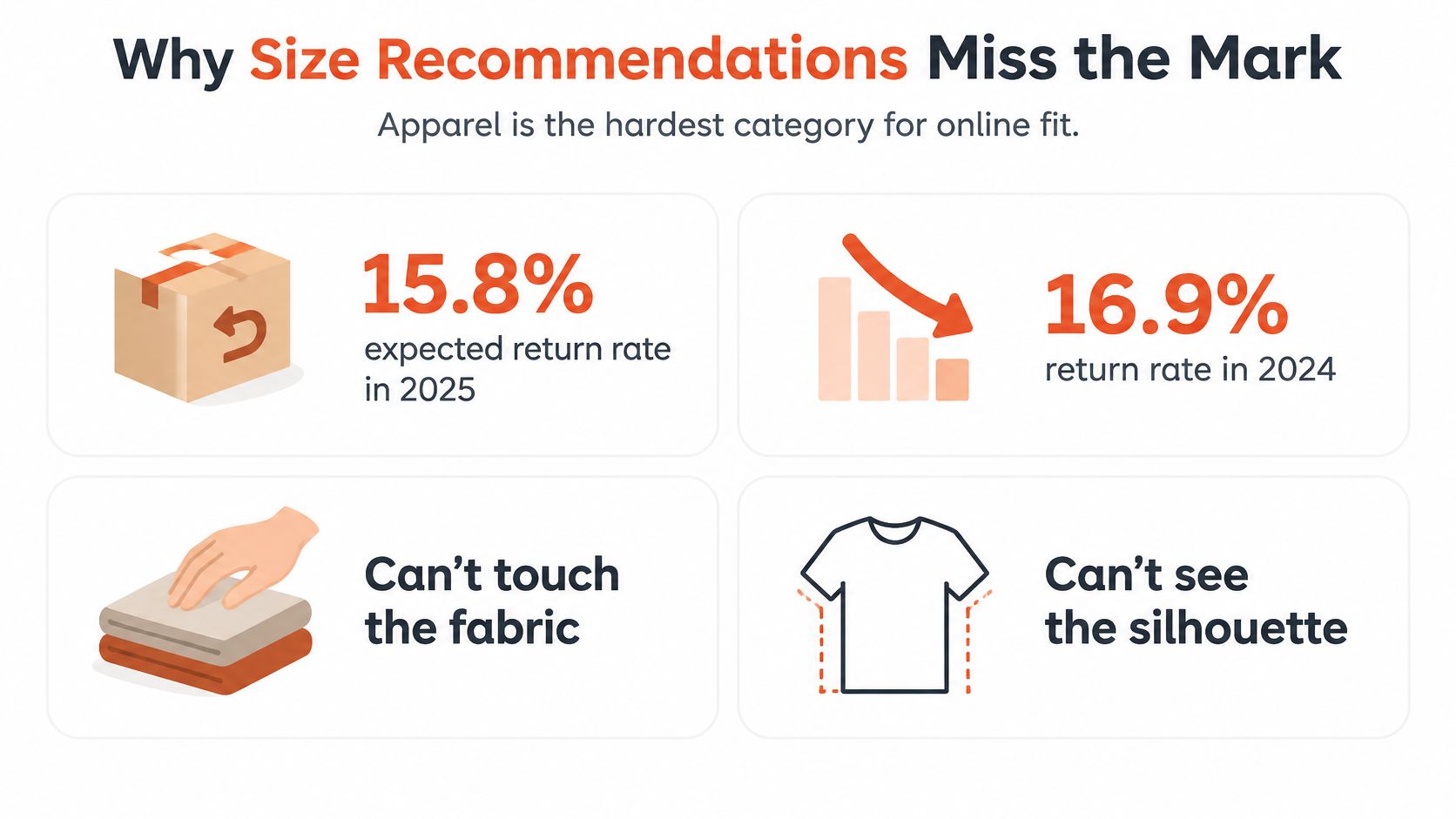
$890 billion of merchandise went back to U.S. retailers in 2024, equal to 16.9% of sales in National Retail Federation and Happy Returns estimates, while online return rates ran 21% higher than aggregate rates in October 2024. In that same EightX apparel return benchmark, Coresight Research found size and fit named as a leading reason for online apparel returns by 53% of surveyed brands and retailers in 2023, against 16% for color and 10% for damage. A fit hybrid review starts from that gap. The job isn't to applaud a widget. It's to separate a signal that proves fit from a comment that only describes satisfaction or styling.
Table of Contents
- Which Fit Hybrid This Review Covers
- Fit Hybrid Verdict at a Glance
- Why Size Recommendations Miss the Mark
- How to Test a Fit Recommendation Step by Step
- Reading Fit Feedback Without Being Misled
- Who Fit Hybrid Sizing Suits and Who Should Skip It
- Where Fit Hybrid Claims Fall Short
- Decide Whether to Trust a Fit Hybrid Recommendation
Which Fit Hybrid This Review Covers
Two products share a crowded name, and scoring the wrong one wastes the test.
This review scores a sizing and fit-recommendation tool. The checks are garment-specific output, body inputs, on-body views, return evidence, and session cost. None of those checks belong on the Honda Fit Hybrid. If the search was for the hatchback, judge economy by how the car is driven. The Cars.co.za review of the 2024 Honda Fit 1.5 Hybrid e:HEV lists a claimed 3.7 L/100 km, about 4.5 L/100 km after a week of urban use, and 3.9 L/100 km on a controlled route. Congestion helps regenerative braking. Speed, climate control, payload, and gradients widen the gap. A used fourth-generation Fit and Jazz review adds that imported cars may lack a factory warranty, and that parts and specialist servicing can cost more, while the newer i-MMD system still has few fleet years behind its reliability talk.
A wearable is a third product entirely. Strap length is covered in Nothing But Bands' range of Fitbit replacement bands, not in a garment recommender. If the sizing tool is what you came to judge, use the scorecard next.
Fit Hybrid Verdict at a Glance
Trust a recommendation when it names one size for that garment, builds it from the shopper's body, and sits next to outcomes you can count. A remembered label, a flattering photo, or a click-through rate doesn't clear that bar.
| Criterion | Good sign | Red flag | Where to check |
|---|---|---|---|
| Garment-specific size output | One size per garment with a stated reason | Generic S, M, L only | Product page test |
| Body inputs | Height, weight, age and body shape used together | Only a size dropdown | Signup or fitting form |
| Fit visualization | Multiple angles of the garment on a body | One flat image | Demo or try-on preview |
| Return-rate evidence | Published before and after size-related returns | Engagement numbers only | Vendor case study |
| Cost per try-on | Clear per-session price and monthly cap | Undisclosed overage charges | Pricing page |
On Robosize, one session is one shopper generating a virtual try-on for a garment. We return one precise size and fit line for that garment, and we can render the try-on from up to three angles. Inputs are height, weight, age, and body shape, with an optional selfie. The Basic plan includes 50 sessions a month, so the cap is visible before you switch the tool on.
Mark every row pass, partial, or unknown. A pass needs the good sign on a live page, not in a slide. A partial pass is a size chart with no body fields, or a single studio flat. Unknown means you never saw the output.
Three or more unknowns is a reason to test before customers rely on the tool. Open one product page, submit the form, and read the size sentence. Then open pricing and write down the per-session figure and the monthly cap. If overage isn't stated, treat cost as a fail until it is.
Why Size Recommendations Miss the Mark
Apparel is the hardest online category because the shopper can't check dimensions, fabric, or silhouette before paying. A tag that says M is a promise from one pattern block. It isn't a body measurement, and it doesn't travel cleanly to the next brand.
Say a shopper with a 92 cm chest buys a size M that fits at brand A. Brand B's size M is cut for a narrower chest and a shorter body. The new top feels tight. The shopper decides their size "changed," then buys the next letter up and drowns in the waist. The failure wasn't the body. It was treating a brand's label as if it were a tape measure.
A generic chart repeats that mistake. It maps a range of chests onto S, M, and L and stops. A body-based recommendation does the opposite. It takes height, weight, age, and shape, matches them to that garment's grade, and names one size with a reason. Only the second path can close the gap the return figures point at. Color and damage are real, but they're not the failure mode sizing tools are hired to fix.
A size label is a promise one brand makes, not a measurement that survives the next store.
What the tool must be judged on
Engagement can rise while the wrong size still ships. A session that looks busy, or a gallery that gets taps, doesn't tell you whether the garment stayed sold. The measure that matches the cost is size-related returns, set beside conversion so you can see whether people bought and whether they kept it.
ServeApps' breakdown of cost per return in ecommerce is a useful companion here, because a saved return is worth more than a saved click once shipping, restock, and refund labor sit on the same line. If your team is still translating photos into body shape by eye, our note on 3D body images shows why a picture without measurements isn't a size.
Judge the tool on the change in size-reason returns for a named category. If the vendor can only show time-on-page, you don't have fit evidence yet.
How to Test a Fit Recommendation Step by Step
A scorecard flags a weak tool. A short log tells you whether this one matches clothes you already trust. Run it before you turn the recommender on for the whole catalog.
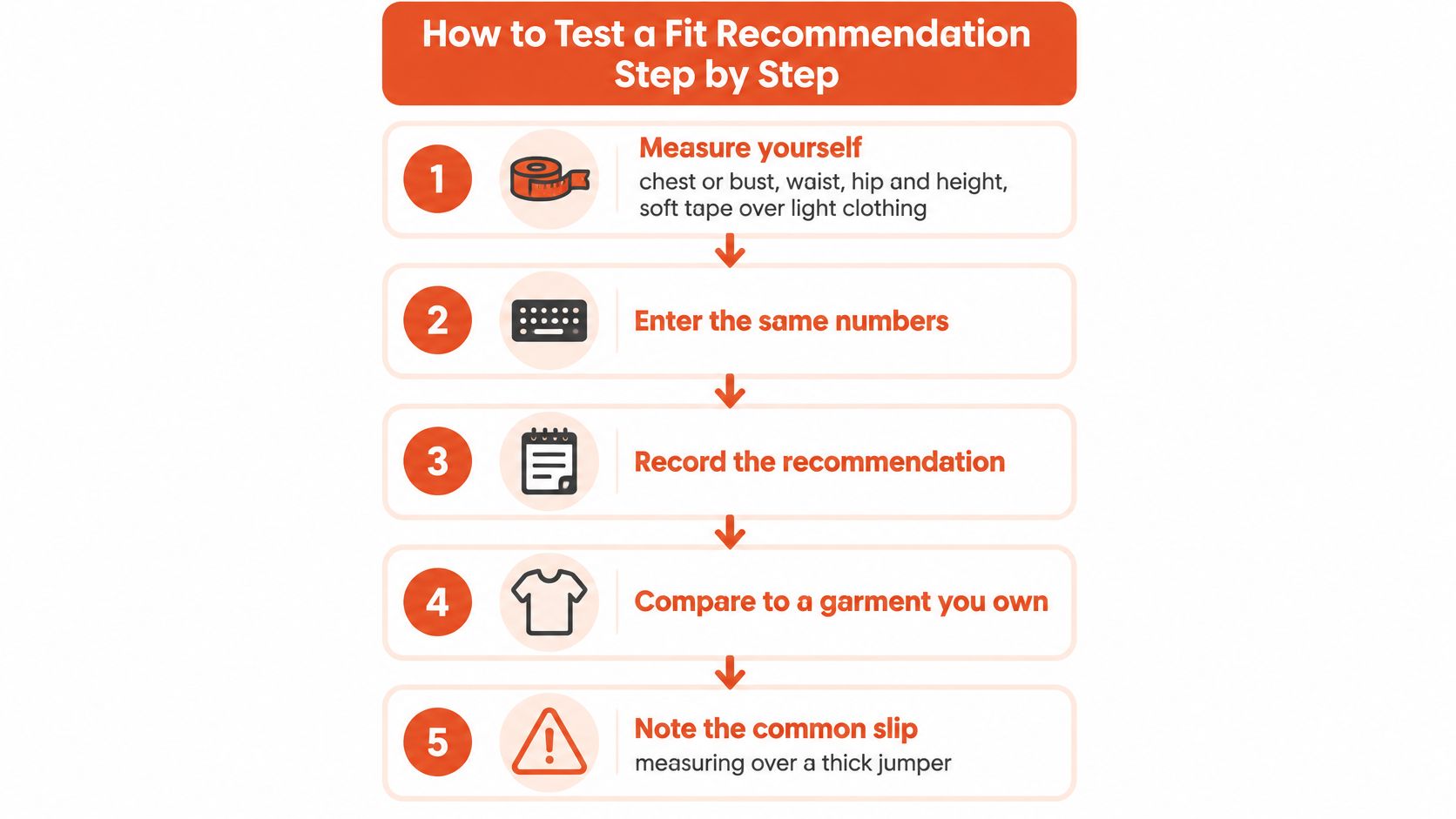
- Measure yourself. Take chest or bust, waist, hip, and height with a soft tape over light clothing. Write the four numbers and the date. Measuring over a thick jumper is the usual slip, and it inflates chest and waist enough to push a size.
- Enter those same numbers. Don't round them to match a size you hope for. If the form adds age or body shape, fill those too, and screenshot the form so you can repeat the entry later.
- Record the recommendation per garment. Note the product name, the size named, and any reason the tool gives, such as "chest" or "hip." A tool that only says "your size is M" hasn't finished the job.
- Compare with the brand chart for that same garment. Flag every mismatch. The chart is the brand's own promise. A clash doesn't prove the tool is wrong, but it tells you where to spend the test order.
- Test three garments you already know fit, from at least two brands. This is the strongest check, because the outcome isn't a guess. Write "matched my proven size" or "didn't," plus which measurement drove it.
- Order one item where the tool and the chart disagree. Log too tight, right, or too loose, and name the measurement that caused it. One disagreed order beats ten opinions.
- Repeat on another product type. A jersey, a trouser, and a jacket don't share a grade. A tool can be right on a tee and wrong on a lined coat. Score matches out of tests, and keep the sheet so next month's run uses the same rules.
Specialist clothing makes the same point in a sharper way. A merchant fitting ceremonial dress can use Judicial Attire's guide to choosing robe accessories for judges to see how collar, cuff, and cut change the size that "fits," which is why step 7 refuses to treat every product type as one test. If you sell into more than one market, line the chart up with a clothing size guide for Australia before you call a mismatch a tool error. Units and grade rules differ, and a centimeter read against an inch chart will invent failures.
What to keep on the sheet
Keep product, brand, your four measurements, the tool's size, the chart's size, and the wear result. Without that row, you can't tell a bad day from a bad model.
Reading Fit Feedback Without Being Misled
Self-reported size is a weak instrument. In a University of Arkansas study that compared choices with 3D body scans, 64.8% of participants, 35 of 54, selected the incorrect shirt size, and exactly 50%, 27 of 54, selected the incorrect pant size. Perceived and actual sizes differed for both, with chi-square significance below 0.001. Cramér's V was 0.709 for shirts and 0.574 for pants, which is a strong association between the mismatch and the garment type, not a small quirk. The University of Arkansas scan study is the record. Separately, a consumer survey in that paper found 72% satisfied or very satisfied with garment fit, while only 36% were satisfied with size consistency across brands.
Someone can love a single top and still be a poor guide to the next brand's label. "I always wear a medium" tells you almost nothing until you know the body and the garment.
| Feedback signal | What it usually means | Weight to give it |
|---|---|---|
| I always wear a medium | Self-reported size with no measurements | Low on its own |
| Runs small, from several reviewers with my build | Consistent pattern for a body type | High if body profile matches |
| Looks great in the photos | Styling and posing, not measured fit | Low |
| Fits well, but sizes differ between brands | Garment satisfaction without cross-brand consistency | Medium; check brand size charts |
| Fits my measurements exactly | Measured comparison with the size chart | High, if the garment is named |
How to weigh a pile of comments
Read for measurements, garment name, and the size bought. A reviewer who shares your height, weight, and a similar shoulder line, and who repeats "runs small in the chest" on the same style, is useful. Five reviewers who only say the color photographs well are not.
Photos fail this test often. A hand on the hip, a tucked hem, or a jacket over the top changes the silhouette you're trying to judge. Treat the image as styling unless the reviewer also states the size and a measurement.
A pattern across several reviewers who share your measurements is strong evidence. One enthusiastic review isn't.
Satisfaction with one garment can sit next to frustration about labels that don't match across brands. That split is why a product-page recommendation has to use the shopper's body and the specific garment. A nominal size doesn't hold a stable meaning from store to store, even when the last purchase felt fine.
Who Fit Hybrid Sizing Suits and Who Should Skip It
The largest gain sits with shoppers whose size changes by brand. A garment-specific pick replaces the guess. Picture someone with broad shoulders and a narrow waist. They buy to the shoulder, then pay to take in the waist. A tool that only protects the chest will keep sending that alteration. A tool that weighs both measurements can name the compromise, or tell them the cut won't work.
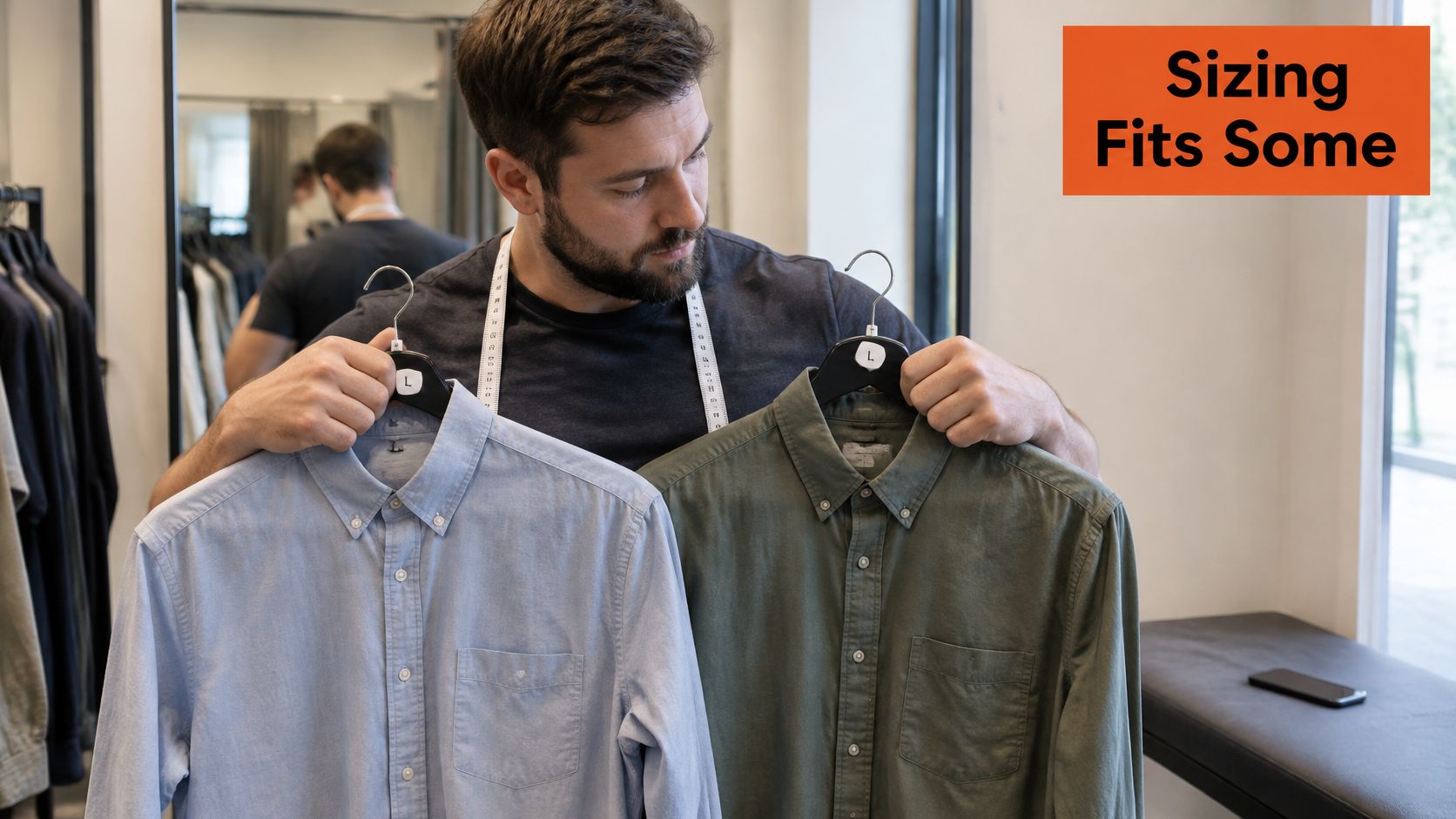
Shoppers with standard proportions who buy basics gain less. A plain tee from a brand they already know may not need a model. Shoppers buying for someone else gain less still, because a measurement taken on the wrong body recommends the wrong person. Petite, tall, and plus-size shoppers should confirm the supported range and the unit system before they trust a result near the edge of that range.
Athletic and jersey buyers are a stronger fit for visualization. A few centimeters change whether a kit binds at the shoulder or bags at the waist, and a flat pack shot hides that. On the store side, fashion retailers with a heavy size-reason return load have something to measure. A shop that sells mostly one-size accessories doesn't.
| Profile | Likely benefit | Watch for |
|---|---|---|
| Shopper with sizes that vary across brands | High, replaces guesswork with a garment-specific size | Confirm the tool covers the garment category |
| Shopper with standard proportions buying basics | Low to moderate, a size chart may already work | Compare results with a known size |
| Shopper buying for someone else | Limited, measurements may not match the recipient | Use the recipient's measurements |
| Petite, tall or plus-size shopper | Only if the tool's body range includes them | Check the supported body range first |
| Athletic or jersey buyer | High, tight fit and garment visualization matter | Test a product type you already own |
| Store with high size-related returns | High, returns data can show the change | Track size-specific returns before and after |
Three checks before you rely on it
Body range. Confirm the shortest, tallest, and largest bodies the form will accept, and what it does at the edge.
Unit system. Confirm metric and imperial, and that a switch doesn't reconvert a stored size.
Garment category. Confirm the style you sell is in the model, not only a demo dress.
If any check fails, skip the tool for that slice of the catalog. Use it where the three checks pass and the profile row says the benefit is high.
Where Fit Hybrid Claims Fall Short
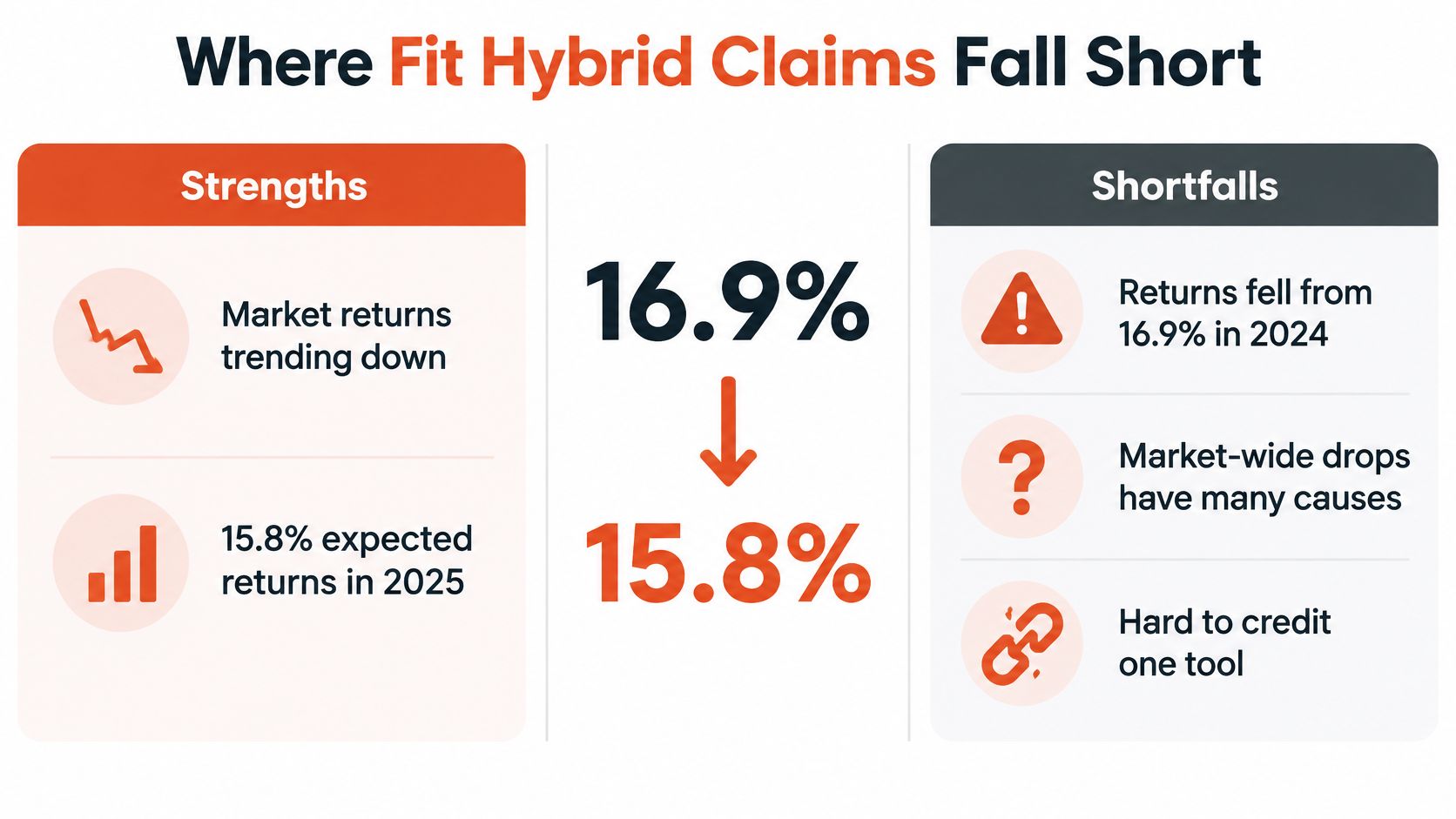
A market-wide dip doesn't belong to one vendor. In 2025, retailers expected consumers to return 15.8% of all purchases, down from 16.9% in 2024, according to the National Retail Federation and Happy Returns as reported by Digital Commerce 360. Freight, fit, fraud rules, and softer demand can all move that rate. A fall after you install a tool doesn't prove the tool caused it.
Metrics that get swapped
Conversion and average order value show whether more people bought, and whether the basket grew. They don't show whether the size was right. Only size-related returns show whether shoppers kept what the tool picked. Our homepage lists 17% more conversions, 24% greater average order value, 7% lower return rates, and 32% engagement with the extension. Read those as selected results. They aren't a substitute for your own before-and-after split by size reason.
Case studies are chosen examples. Ask how many orders sat in the window, how long the window ran, and whether returns were coded by reason. A blended return rate can fall because fewer people sent back the wrong color, while size returns stay flat.
Accuracy also slips by category. A jersey with a stable knit is an easier grade than a layered coat or a style with a lot of stretch. Stretch hides a wrong size until wash and wear. A size can match the tape and still feel wrong, because fabric hand and armhole shape aren't in the chest number.
A polished 3D body model can make a bad grade look convincing. Judge the render after you've seen size-reason returns for that category, not before.
Practical rule: Ask for the sample size, the measurement period, a split of returns by size reason, and the categories tested.
If a vendor can't answer those four, keep the tool in a trial category. Don't roll it across the catalog on the back of a market trend or a single blended percentage.
Decide Whether to Trust a Fit Hybrid Recommendation
Use your own log as the cutoff. Trust the tool for a category when at least 80% of tests match a fit you already know, and the vendor can show size-specific returns. Hold off when fewer than 70% match, or when returns evidence isn't available. Between 70% and 80%, call it partial and test more garments before you rely on it.
- Run the seven-step test on three products you already buy, and keep the match score.
- Record size-related returns for the previous 60 days as the baseline. Use the same reason codes you'll use later.
- Turn the tool on for one category and track that same return measure for the next 60 days. Leave the rest of the catalog alone so the comparison stays readable.
- Extend only if both improve. The test score and the size-reason rate have to move together. A higher conversion with flat size returns means you sold more uncertainty.
A store can see the flow on its own products before that trial. Tell us about the store, and we'll walk through a live demo of the fitting room on your catalog. That session is the place to check angles, the size sentence, and whether your categories are even covered.
Today, write down chest or bust, waist, hip, and height, and pick the three garments you'll score first. Don't turn the tool on for the whole site until that sheet exists.
Robosize is an AI virtual fitting room for online clothing stores. It builds a shopper-specific body from a short questionnaire and an optional selfie, shows the garment on that body, and names one size on the product page. If you want that flow judged the way this fit hybrid review judges fit claims, visit Robosize and ask for a live demo on your own products.