What is My Body Type Male?
Which shirt fits your shoulders but billows at the waist, or fits your waist but pulls across the chest? That difference comes down to proportion, not a permanent label.
A male body type describes how your shoulders, chest, waist and hips relate to one another. Online quizzes can give different answers because they rely on choosing an illustration, while measured proportions offer a more practical starting point. Like a tailor comparing where a jacket needs room, you can use those measurements to build a fit profile and revisit it as your body changes.
The profile describes how clothes may fit. It does not grade your health or define your identity.
Table of Contents
- What Male Body Type Actually Describes
- How to Measure Chest Waist and Hips
- Six Male Shapes Compared by Proportion
- How Shape Changes Shirts Trousers and Jackets
- Why BMI and Somatotypes Miss the Silhouette
- When One Body Label Stops Fitting
- Match the Garment Not a Permanent Type
What Male Body Type Actually Describes
A body type is a snapshot of proportions. Two relationships do most of the work: shoulder width against hip width, and chest, waist and hip circumferences against each other. Nothing in that definition says anything about fitness, attractiveness or health.
The puzzle that sends most men searching is simple. One man carries his size in the chest and shoulders, so a medium shirt strains across the back and hangs loose at the waist. Another man at the same height and weight carries his size through the middle, so the same medium fits the waist and floats at the shoulder. Same scale, different silhouette, and no single letter size serves both.
Three vocabularies get mixed together, and they shouldn't be:
- Retail shape names such as rectangle, triangle, oval, inverted triangle and trapezoid describe a clothing silhouette, meaning how fabric hangs and where a pattern needs room.
- Somatotypes such as ectomorph, mesomorph and endomorph describe a general build tendency, linear, muscular or softer. They don't map onto a size chart and don't tell a tailor where to take in a jacket.
- Research labels such as straight, hourglass and torch come from measured angles, and they change when a study changes its cutoff.
A body type you can remeasure is useful. A body type you have to defend is not.
What follows is practical: measure first, match your numbers to a shape, then look at what each silhouette does to shirts, trousers and jackets. Last comes the part most guides skip, which is what to do when two brands disagree about your size on the same afternoon.
How to Measure Chest Waist and Hips
A tape does not care what you call your shape. It only records where the fabric will have to go. Take the six readings below the same way twice, over underwear or a thin T-shirt, with the tape flat and level all the way around. A size chart is only as useful as those inputs.
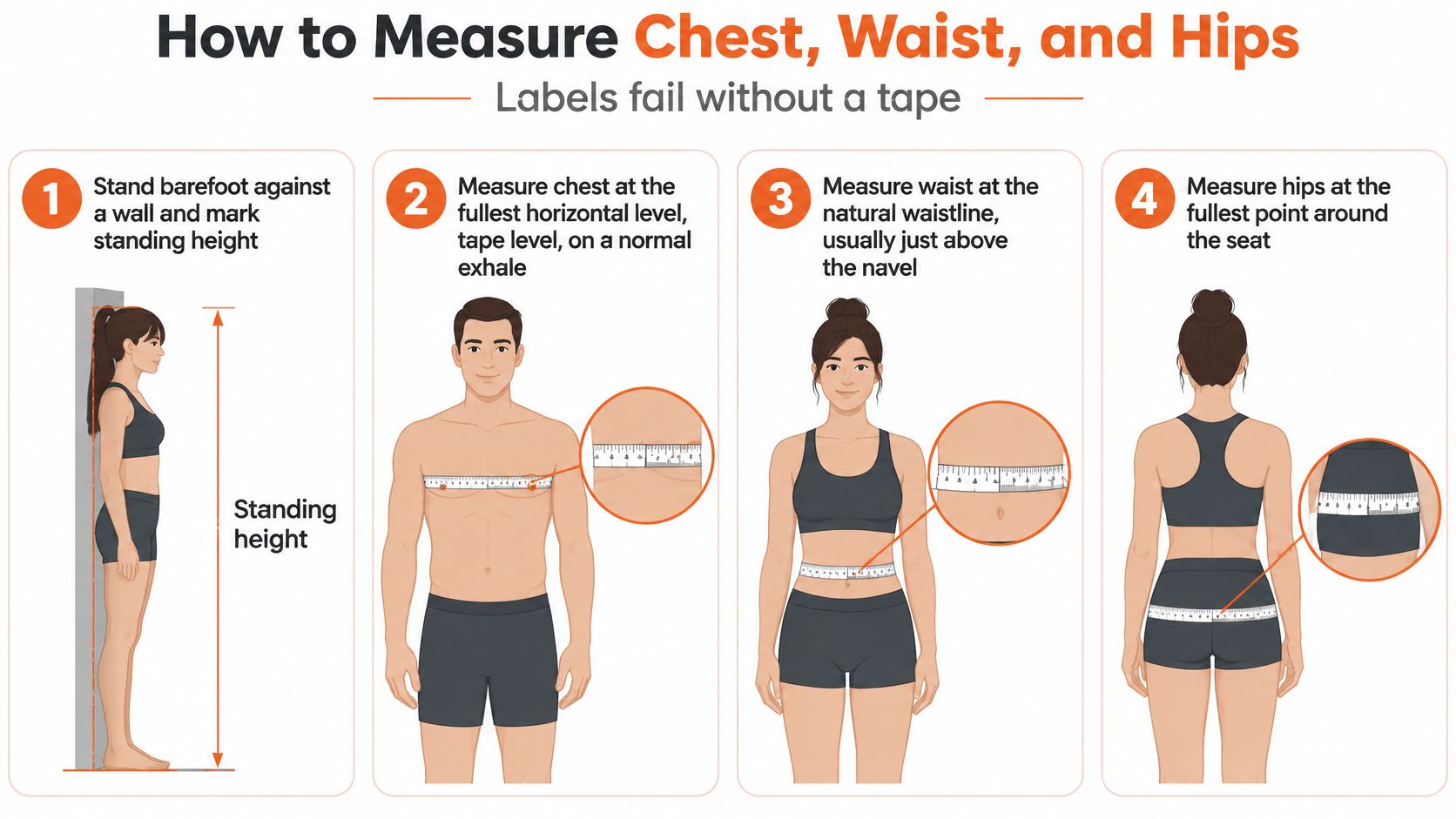
- Stand barefoot against a wall and mark your height. Heels together, back flat, chin level. Height grades sleeves and trouser legs, so half an inch changes the length a brand cuts.
- Chest at the fullest horizontal level. Run the tape under the arms and across the shoulder blades on a normal breath. Do not inflate the chest and do not suck it in.
- Waist at the natural waistline. Bend sideways. The crease that forms is the natural waist, usually just above the navel. Stand relaxed, tape snug but not pressing in.
- Hips at the fullest part of the seat. Feet together, tape level around the widest point of the buttocks.
- Shoulder breadth, bone to bone. From the outer edge of one shoulder point across the back to the other. This reading decides jacket sizing more often than the chest does.
- Neck base and sleeve, only if you buy dress shirts. Neck at the base where a collar sits, with one finger of slack. Sleeve from the shoulder point over a slightly bent elbow to the wrist bone.
Those landmarks are not a brand's private habit. The ISO 8559-1 standard fixes how body points are defined and how the tape should be applied, and ISO 8559-2 specifies which body dimensions a garment sizing system should use. At the rail the useful split is simple: the system is based on body measurements, not garment measurements. A 40-inch chest is a fact about you. A shirt labeled 40 is a claim about the shirt, including how much ease the cutter left.
Two men with the same chest tape can still need different garment dimensions once shoulder width and muscle differ. Raw numbers map onto pattern blocks, ease, and size-chart columns. A self-chosen shape name does not.
Where the Tape Goes Wrong
- Measure over what you'll wear. A thick sweater adds centimeters to a chest reading. If you layer in winter, take a second chest measurement over the layer.
- Keep your posture neutral. Slumping shortens the torso and rolls the shoulder points forward, so every jacket looks long in the body.
- Take each circumference twice. If the two readings differ by more than half an inch, the tape moved or twisted. Keep the clean repeat, not the average of a bad first pass.
- Don't compress the tape. A pinched waist can shave an inch and drop you into a size that buttons but never sits comfortably through a meal.
Different garments grade from different pairs of those numbers. A soccer jersey size chart is usually built from chest and height rather than a dress-shirt neck, so the collar measurement will not pick the jersey. Height-and-chest bands show up in other group orders too: Bulk gown sizing for schools sorts that way, which is why one letter size across a mixed group fits almost nobody well.
Before you shop, write down height, chest, waist, hips, and the gap between chest and waist. That gap is what separates a torso that needs room at the shoulder from one that needs room through the middle. Shoulder breadth stays on the card for jackets. Neck and sleeve stay on it for dress shirts. None of these figures is a permanent identity. Remeasure when your weight or training changes, and match the garment in front of you, not a label you picked last year.
Six Male Shapes Compared by Proportion
Which proportions does a garment need to accommodate first? Compare the chest, waist and hips, then use the shape names as shorthand for how those measurements relate. The names describe common outlines, not ideal bodies or permanent identities.
| Shape | Shoulders vs hips | Chest, waist and hips | First fit clue |
|---|---|---|---|
| Inverted triangle | Shoulders and chest clearly wider | Large chest-to-waist drop | Jackets bind at the shoulder; trousers gap at the waist |
| Trapezoid | Shoulders slightly wider | Moderate waist taper | Often the balanced block brands design around |
| Rectangle | Shoulders and hips similar | Chest, waist and hips close in size | Shirts hang straight with little waist shape |
| Triangle | Hips or seat wider than shoulders | Waist close to the chest | Shirts tighten below the chest |
| Oval | Midsection dominates the outline | Waist larger than chest and hips | Shirts pull at the buttons; rise feels high |
| Hourglass or torch | Study labels, not retail sizes | Defined waist, or a torch-like upper body | Rare as a shopping size; depends on the angle cutoff |
Treat the last column as a fitting clue, not a verdict. For an inverted triangle, a jacket may need room at the shoulders while trousers need a different adjustment at the waist. Sizing down to fix a trouser waist can make the seat too tight.
A shape can also vary by garment. Your chest-to-waist proportions may resemble an inverted triangle, while your seat fits more like a rectangle. For a jacket, start with the shoulders and chest. For trousers, the waist and seat may matter more.
Why the Study Shares Don't Describe You
A 2023 classification used angular differences between shoulder and hip widths. In the study on male upper-body shape classification, a 10-degree angular difference produced a more distinct separation of upper-body forms than the alternatives tested.
Change the cutoff and the share assigned to each category changes. The study included 241 men, so its classification should not be treated as a census of every country, age group or training history. It describes one way of grouping proportions, not a universal retail size system.
A useful label points to a fit question. Does the chest need more room than the waist? Does the shirt fall straight from shoulder to hem? Those relationships can guide a fitting, while weight alone cannot describe the outline.
How Shape Changes Shirts Trousers and Jackets
A garment can fit one part of your body and still pull, gape, or hang loosely somewhere else. The pattern determines where the fabric has room, so the useful question is which measurements the garment needs to accommodate.
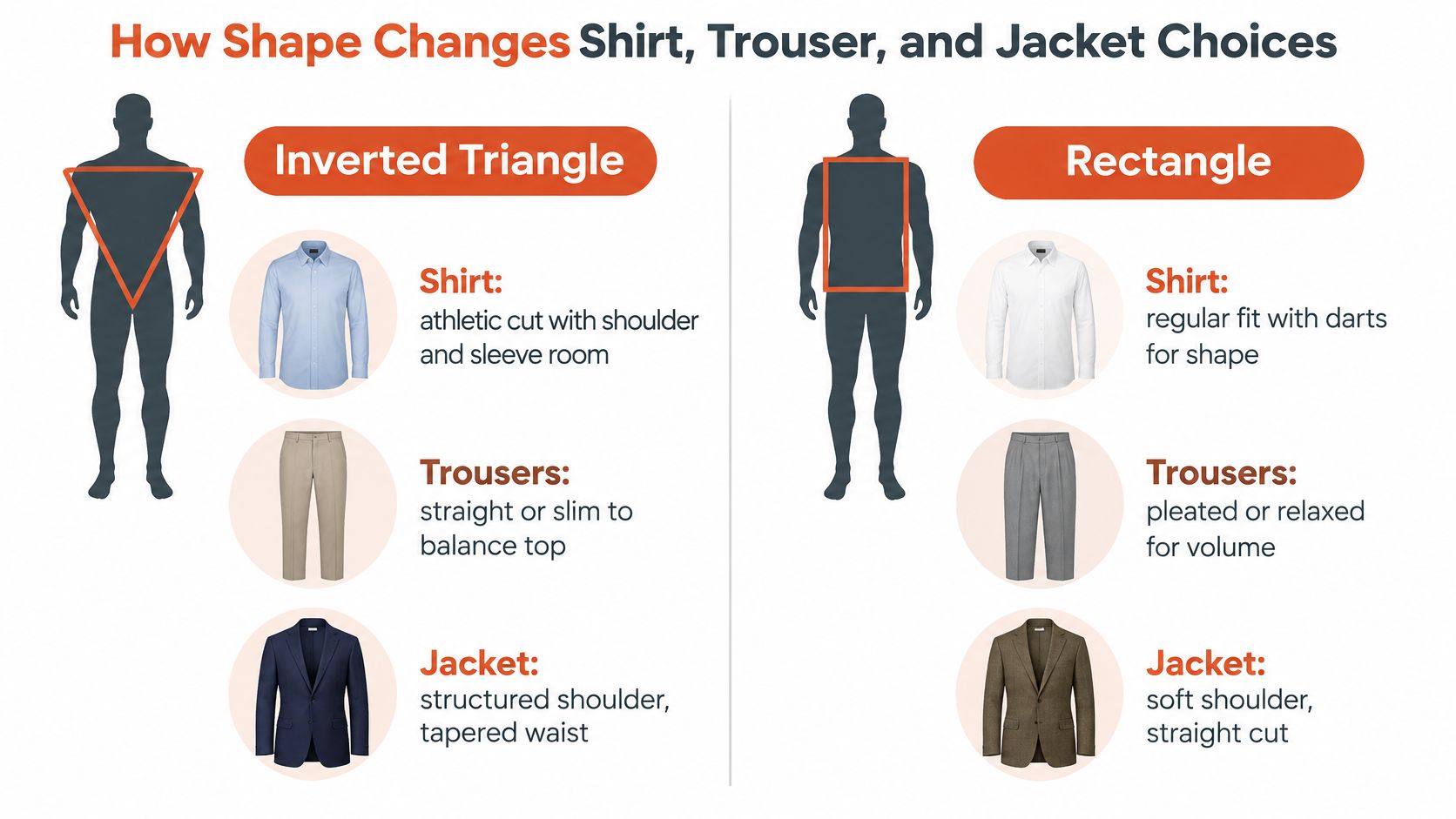
Shirts
Check the shoulder seams and chest first, then see how the shirt falls toward the waist. An inverted triangle may need more room across the shoulders and chest, with a closer cut below. Sizing up to gain chest room can leave the shoulders too wide.
A straight-cut shirt can give a rectangle shape a boxy appearance. A closer cut may follow the torso more cleanly; learn what boxy fit means before choosing between the two. An oval shape may need more ease through the front, while a triangle shape can feel tight below the chest if the pattern assumes broad shoulders.
Trousers
Check the waist, hip, thigh, and rise together. A waistband that fits does not guarantee room through the seat or thigh. If trousers fit at the waist but need a length adjustment, hemming pants at home can shorten them without changing the fit elsewhere.
Jackets
The shoulder seam should sit at the shoulder. From there, check the chest and how the jacket closes. A jacket may fit at the shoulders but need adjustment through the waist. A collar that pulls away from the neck, a twisting sleeve, or a lapel that bows can point to a mismatch in the jacket's balance or your posture.
Sportswear
Test stretch while moving, not just while standing. Raise your arms and squat to check whether the fabric binds at the chest or thigh.
| Garment | Check first | Typical failure |
|---|---|---|
| Shirt | Shoulder, chest, then waist shape | Buttons pull or the body tents at the waist |
| Trousers or jeans | Waist, hip, thigh and rise | Gap at the back waist or a tight seat |
| Jacket or coat | Shoulder seam and chest ease | Collar gap, sleeve twist or a tight button |
| Sportswear | Stretch at chest and thigh while moving | Fine on the hanger, binds in use |
| Dress shirt | Neck and sleeve as well as chest | Collar choke or cuff past the wrist |
These checks describe fit for a particular garment, not a permanent body identity. Shoulder slope, torso length, seat projection, thigh circumference, posture, and fabric stretch can all affect how a piece sits. Use the table to identify where a pattern may need more or less room, then judge the garment on those points.
Why BMI and Somatotypes Miss the Silhouette
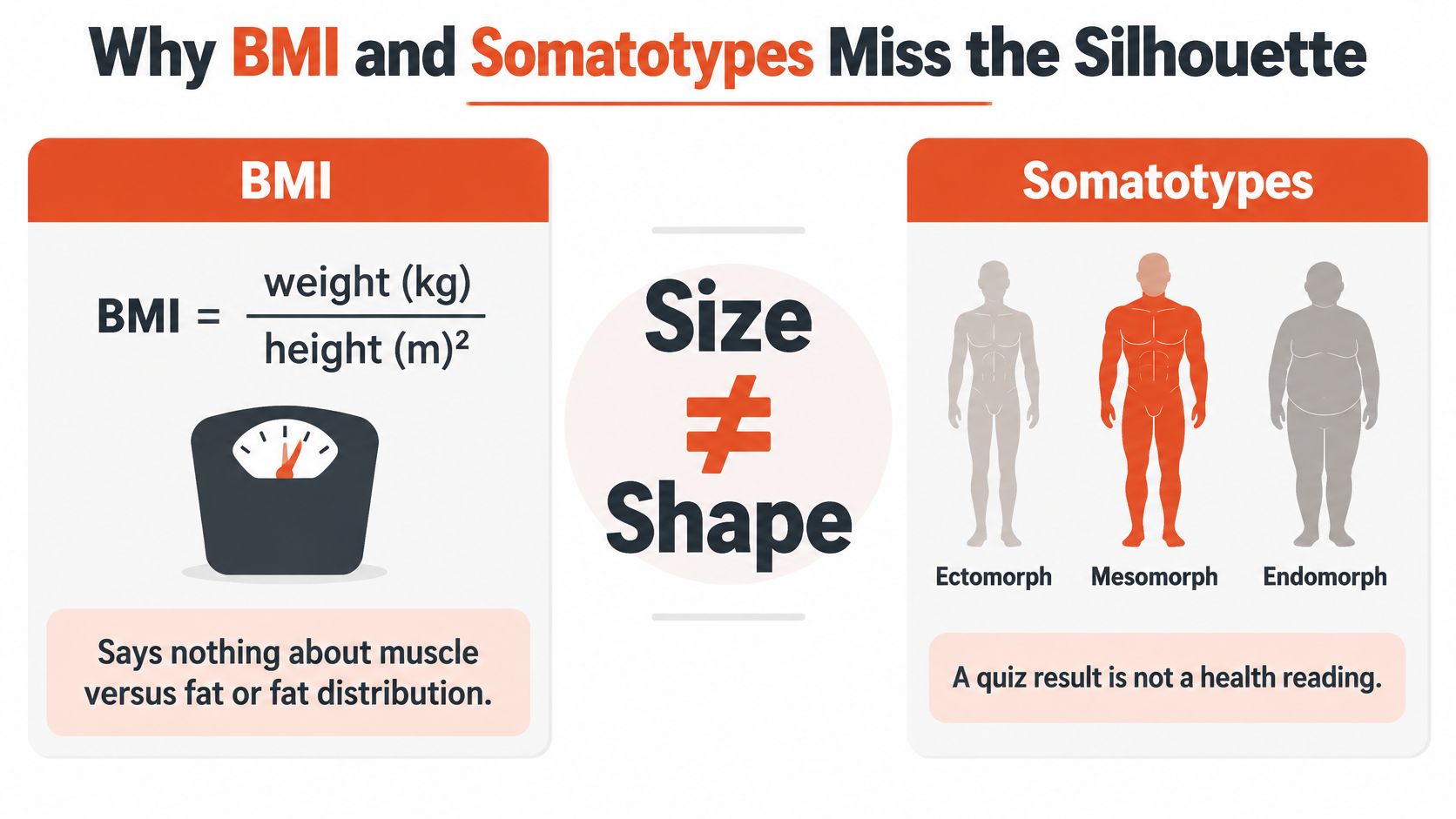
BMI is weight in kilograms divided by height in meters squared. It answers one question, how large you are relative to your height, and it stays silent on the two things a fitter needs: how much of that mass is muscle, and where it sits.
A muscular man with a 44-inch chest and a 34-inch waist and a softer man with a 40-inch chest and a 40-inch waist can land in the same BMI band and need opposite shirt patterns. One needs room at the shoulder and shape at the waist. The other needs ease through the front and a pattern that doesn't assume a taper. No formula built from height and weight alone can separate them.
Waist circumference adds the missing piece. The CDC reference summary for U.S. adults reports average measured values for men aged 20 and older of 68.9 inches in height, 199.0 pounds in weight and 40.6 inches in waist circumference. Treat those as population benchmarks, not targets, and definitely not as global norms.
From there, waist-to-height ratio gives you a scale-normalized descriptor: divide waist by height in the same units. A higher ratio is the familiar conflict of a shirt that fits the chest and pulls at the abdomen, or trousers that fit the waist and leave empty room through the seat and thigh. Combine it with the chest-to-waist difference and your hip circumference and you have a stable model for garment recommendations.
Somatotypes are a separate, older vocabulary. Ectomorph describes the linear build, mesomorph the more muscular build, endomorph the softer, rounder build. They describe a tendency, not a pattern block, and they don't translate into a size chart column. A mesomorph with a strongly tapered waist belongs in the inverted triangle garment row, not the oval one, no matter how the somatotype quiz scored him. Size and shape are different questions, and only one of them helps you choose a shirt.
Where the two meet is 3D shape analysis. In a 3D-imaging study of 4,405 adult men, the first nine principal components captured 90.4% of total torso-shape variation, while individual combinations of size measurements explained anywhere from 3.2% to 84.4% of particular shape features, according to the published anthropometric analysis in Scientific Reports. Size predicts some features well and others barely at all.
That's the argument for treating your profile as multidimensional, which is also how 3D body imaging is used in apparel: not as a single number, but as a set of proportions that can be compared against a pattern block.
When One Body Label Stops Fitting
Two men can share a height and weight yet need different shirt cuts. One is 180 cm tall, weighs 82 kg, and measures 42 inches around the chest and 32 inches at the waist. Another has the same height and weight, but measures 38 inches at the chest and 36 inches at the waist. A medium athletic shirt may fit the first well while pulling across the second man's stomach and sitting loose at his shoulders.
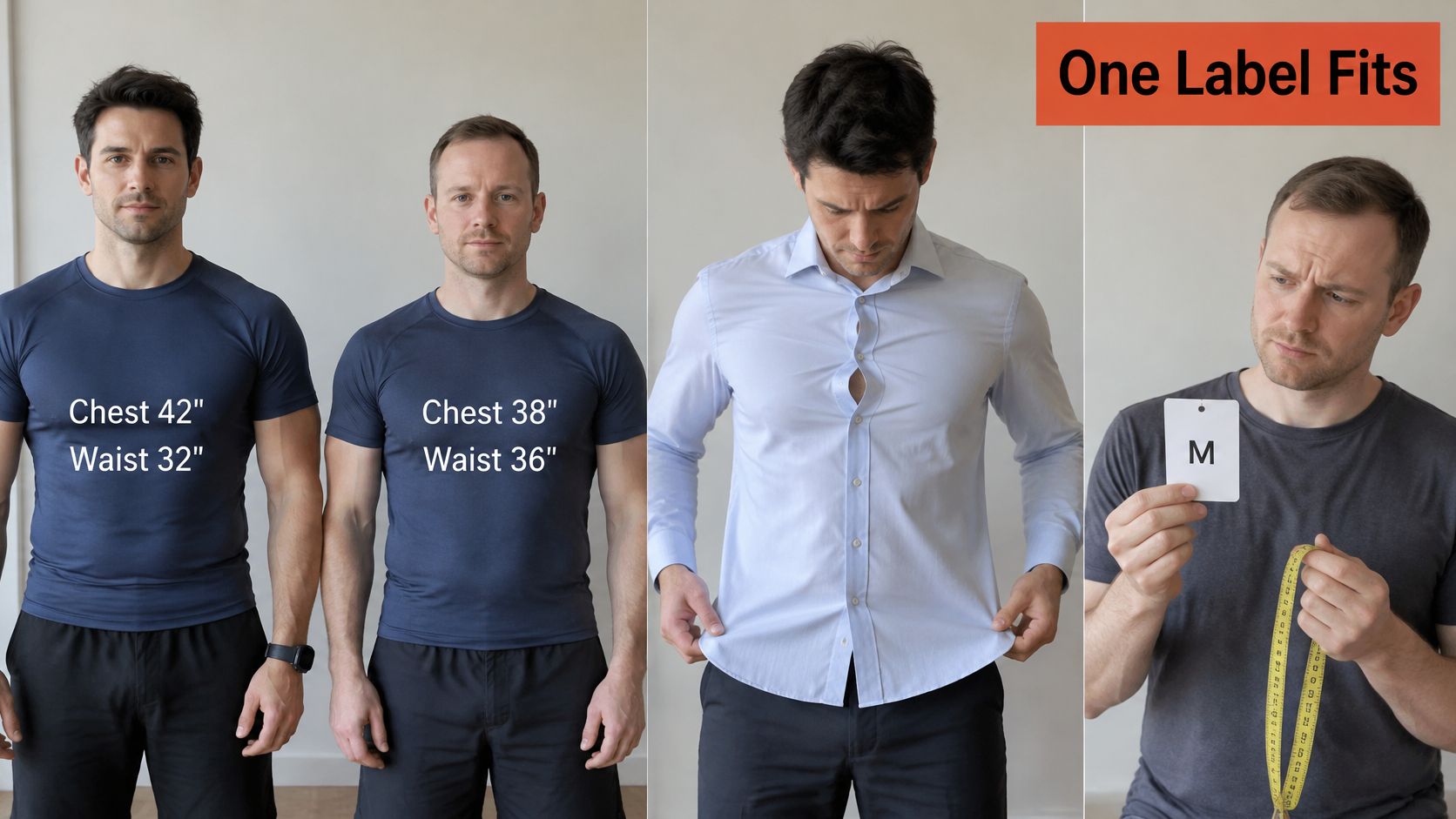
The comparison shows why weight alone is a blunt guide to fit. Chest, waist, and shoulder proportions affect how a shirt hangs, so two men with the same measurements on a scale may need different cuts.
When the Body Changes
A garment-fit profile can change over time. If a man gains weight around his waist, a shirt may still fit his shoulders but pull at the front buttons. The old shape label no longer describes how that shirt fits him. Recheck the relevant proportions rather than treating the label as permanent.
Plus-size bodies also vary in proportion. A study of 493 plus-size Korean men aged 30 to 40 identified five body-shape clusters, including wide-shouldered men with slimmer waists, a highly obese cluster, a tall cluster with larger upper bodies, and a long-lower-body cluster, as summarized in the analysis of plus-size male body shapes. Those differences matter to pattern design: one plus-size block cannot fit every build in the same way.
The range of bodies shown in fashion imagery is also limited. The cited runway analysis reported that 98.3% of the 2,855 menswear looks from Milan and Paris were straight-size, 1.5% mid-size, and 0.2% plus-size. A narrow range of sample sizes offers little guidance for men whose proportions fall outside it.
When the Brand Overrides the Label
The same letter size can fit differently across brands. Companies use different grading rules, so a size that accommodates your waist in one pair of trousers may sit differently in another. That variation is not a measurement failure on your part.
Other proportions can affect the result too. A long torso changes where a jacket hem falls; fuller thighs affect trouser room; uneven shoulders can make a structured jacket hang crooked. A broad shape label cannot account for every detail of the garment's cut.
The label is a filter. The garment has the final say.
Use a shape category to narrow the options, then assess the specific item's cut, intended ease, and fabric. A waist measured over a sweater, or hips measured at the wrong point, can also distort the result. Treat a poor fit as a sign to review the measurements or the garment, not as a flaw in your body.
Match the Garment Not a Permanent Type
A useful fit profile is a set of current measurements, not a permanent label. Keep a measurement card with your height, chest, waist and hip measurements, and update it when your body changes. Use the same units each time so you can compare the numbers clearly.
On a product page, compare your measurements with that garment's size chart. Body measurements describe you; garment measurements include ease, the extra room built into a design. That is why jeans and woven shirts can fit differently, even when you buy them on the same day.
Treat a virtual try-on or size recommender as a check for a specific item. A shape label can help narrow your search, but the garment's cut and fabric determine how it sits on your body.
A 2023 study published on arXiv reported 83% body-shape classification accuracy when evaluated specifically on male images, according to the computer-vision body-shape classification paper. A classification can still place some men in the wrong category. Check whether the result reflects your proportions, especially around the shoulders, waist and rise.
A Measurement Card You Can Update
Record your height, chest, waist and hip measurements, along with the difference between your chest and waist. When a size chart differs from one you used before, these numbers help you compare the fit the brand is describing.
Then choose for the garment in front of you. Your fit profile can change as your body changes, and one label cannot describe how every shirt, pair of trousers or jacket will fit.
Robosize builds a shopper-specific body model from a short questionnaire and an optional selfie. Within seconds of a try-on, it shows the garment on that model with one size and fit recommendation for the item. Try it on your next order at Robosize.