The plus-size apparel market was valued at USD 119.4 billion in 2024 and is projected to reach USD 202.4 billion by 2034, but matching sets can make fit less certain, not more. Visual coordination doesn't guarantee that the top and bottom were proportionally graded for the same body.
That's the uncomfortable truth behind many plus size matching sets. A blazer and trouser may look like a complete solution on a product page, yet the customer still has to solve two separate fit problems. The jacket may pull across the chest while the trousers fit comfortably through the hip. A knit top may accommodate the bust but ride up over the abdomen. A single size selector hides those differences instead of resolving them.
Retailers that treat coordinated outfits as styling products alone miss the commercial issue. Fit intelligence has to connect pattern engineering, product photography, size recommendations, and merchandising. Otherwise, the set looks convenient until the shopper reaches checkout, questions whether both pieces will fit, or returns the outfit because one component failed.
Table of Contents
- Why Plus Size Matching Sets Are Harder Than They Look
- Designing Plus Size Matching Sets Around Body Shape and Measurement
- Fixing Sizing Confusion With Virtual Try-On and Size Recommenders
- Photographing and Merchandising Coordinated Outfits for Plus Size Shoppers
- Real-World Fit Problems and How Better Data Solves Them
- Turning Fit Insights Into Higher Conversion and Lower Returns
Why Plus Size Matching Sets Are Harder Than They Look
The appeal is obvious. A coordinated outfit removes the work of combining colors, proportions, and fabric weights. It can also increase the perceived value of each item because the customer sees a complete look rather than an isolated top or bottom. But the same coordination creates a stricter requirement: both garments must fit the shopper well enough to work together.
A standard size chart often assumes that a body scales evenly from one size to the next. Real bodies don't. A shopper with a fuller abdomen may need more front rise and waist ease in trousers, while another shopper with the same nominal size needs more room through the seat or thigh. The top introduces separate variables, including shoulder width, upper-arm circumference, bust projection, neckline depth, and torso length.
A 3D-scan-based study using the Female Figure Identification Technique classified bodies into nine shape categories, including hourglass, spoon, rectangle, diamond, oval, triangle, and inverted triangle. The same research recorded representative measurements increasing from size 16W, with a 42.5-inch bust, 34.5-inch waist, and 44.5-inch hip, to size 32W, with a 58.5-inch bust, 50.5-inch waist, and 60.5-inch hip. Those figures show systematic size growth, not uniform proportion, as documented in the 3D body-shape and apparel sizing study.
The single-size recommendation is the first failure
Many ecommerce flows ask the shopper to select one size for the entire set. That works only when the brand permits a predictable relationship between the upper and lower body, and plus-size shoppers frequently don't have that relationship. A survey of 687 US and UK consumers found that 91% said their clothing size changes by brand, while 38% often return clothing because it fits poorly, according to Vogue Business's sizing analysis.
For matching sets, the practical answer may be a different size for each piece. The retailer should make that option visible instead of forcing the customer to guess whether the jacket or trouser will be the compromise.
Practical rule: Merchandise a set as one visual outfit, but fit and recommend it as two garments.
The consequences reach beyond the fitting room. A shopper who can't predict the result may delay the purchase, contact customer service, or abandon the cart. If the set arrives and only one piece works, the customer experiences the whole product as unsuccessful, even when one garment was correctly graded.
Designing Plus Size Matching Sets Around Body Shape and Measurement
Good plus-size set design starts with measurement distribution, not a larger version of a straight-size block. The product team needs to decide where the garment will provide ease, where it will maintain structure, and how the fabric will behave under movement.
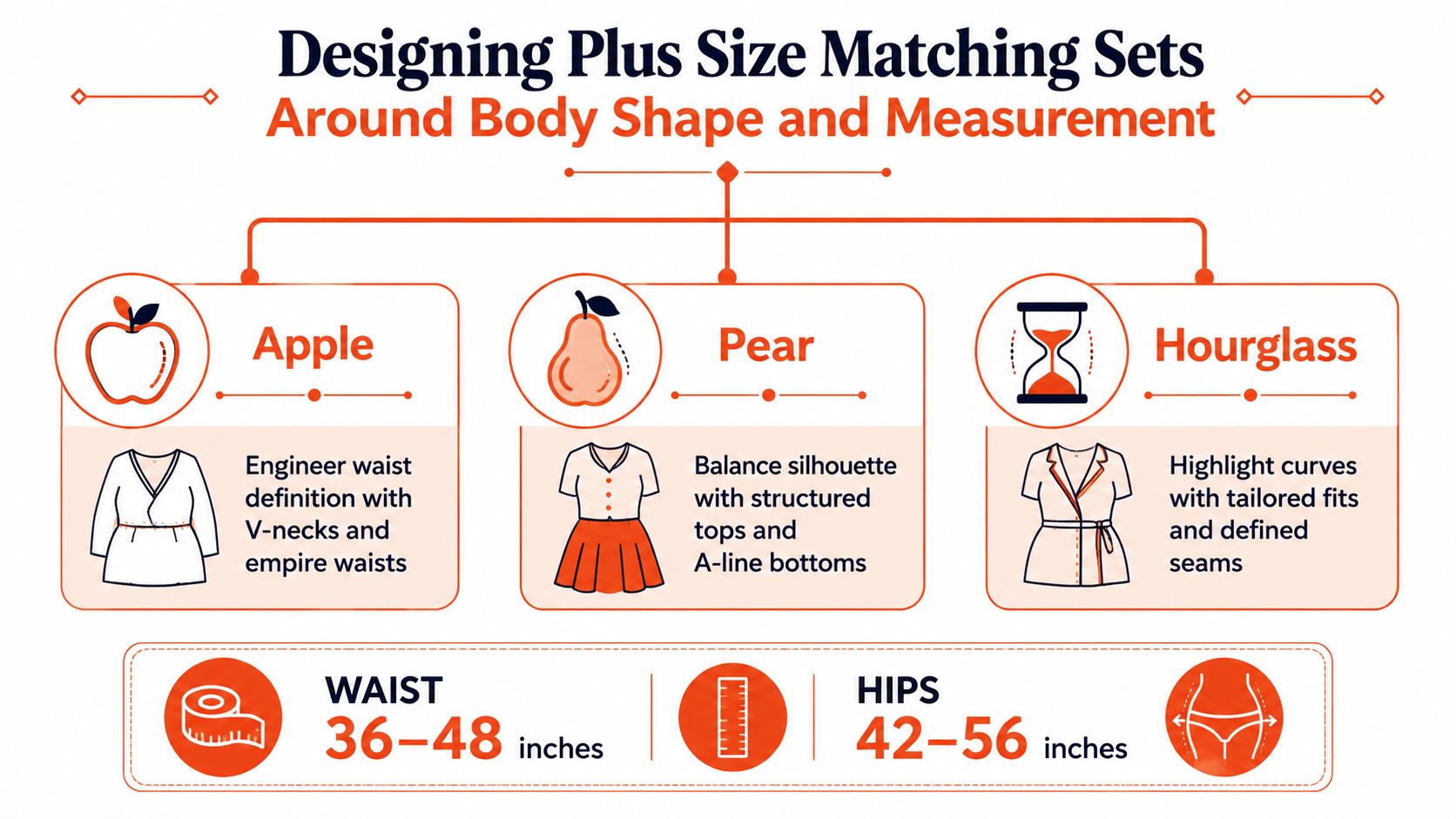
Start by separating the body inputs from the garment outputs. Capture bust, natural waist, and full hip as the baseline. For fitted bottoms, add thigh, rise, and inseam. For structured jackets, dresses, or sets with a defined waist seam, torso length and shoulder-related measurements become important because a correct bust circumference doesn't guarantee a comfortable neckline, armhole, or hem position.
The body-shape categories provide useful direction, but they shouldn't become restrictive style rules. An apple-shaped shopper may prefer waist definition, while a pear-shaped shopper may want room through the hip and a more structured upper body. An hourglass shopper may need a closer relationship between waist and bust or hip measurements. A rectangular proportion may respond better to shaping through seaming, belts, or fabric contrast than to aggressive waist suppression.
Build the set as separate fit systems
The pattern team should establish component-level specifications before the ecommerce team writes size guidance.
- Tops need upper-body logic: Track bust ease, shoulder comfort, armhole depth, sleeve circumference, and torso length. A blazer that fits at the bust but restricts the upper arm still fails.
- Bottoms need lower-body logic: Track waistband, full hip, thigh, front and back rise, and inseam. Waist circumference, hip circumference, thigh circumference, crotch length, and inseam are critical variables in plus-size pant fit, as outlined in apparel fit assessment research.
- Fabric needs its own rule: Record whether the fabric stretches, where it stretches, and how well it recovers. A stretch jersey and a non-stretch suiting fabric shouldn't produce identical recommendations.
- The set needs a size policy: If the shopper's predicted top and bottom sizes differ, allow separate selection or explain the available compromise clearly.
A retailer should also test seated fit, not only standing fit. Waistbands can roll, jackets can pull at the abdomen, and skirts can shift over the hip when the customer sits. Product development should review front, side, and back tension on several body shapes before the set reaches production.
A size label is an index. The actual product decision depends on where the garment needs room.
The commercial benefit of this discipline is clarity. A product page can state that the top runs close through the shoulders, the trouser has a fuller thigh block, or the waistband contains recovery stretch. That information is more useful than expanding a conventional chart and calling it inclusive.
Fixing Sizing Confusion With Virtual Try-On and Size Recommenders
A static chart asks the shopper to become a pattern technician. They must measure themselves accurately, compare those measurements with brand-specific numbers, interpret ease, and decide whether one result applies to both pieces. That process breaks down on mobile devices and becomes even harder when the chart uses body measurements for one garment and finished measurements for another.
AI fit guidance changes the interaction. A shopper can provide inputs such as height, weight, age, and body shape, then optionally use a selfie or select a model for visualization. The system can return a garment-specific recommendation, which matters when the top and bottom don't share the same ideal size. Multi-angle previews also help shoppers evaluate silhouette, drape, and visible tension rather than relying on a single front-facing image.
A virtual fitting room shouldn't replace product data. It should interpret that data and present it in a form shoppers can use quickly.
| Aspect | Traditional approach | AI fit approach |
|---|---|---|
| Size selection | One chart and one label | Recommendation tied to the individual garment |
| Set purchasing | Often one size for both pieces | Separate top and bottom guidance where supported |
| Visualization | Static model photography | Shopper-specific or selected-model preview |
| Fit evaluation | Shopper infers tension and drape | Multiple viewpoints provide more context |
| Implementation | Manual interpretation at checkout | Short questionnaire, optional selfie, and on-page result |
| Retailer insight | Limited visibility into fit uncertainty | Analytics can show fitting-room use and recommendations |
For retailers evaluating visual tooling, virtual models for clothes offers useful context on how model-based product presentation can support apparel merchandising. A practical implementation should also be mobile-first, load within the product-page flow, and avoid sending the shopper to a disconnected fitting experience. For Shopify stores, the three-size visualizer approach illustrates why showing nearby size outcomes can make fit decisions easier to understand.
What the retailer should configure
The recommendation engine needs clean catalog inputs. Map every set component to the correct size chart, distinguish garment measurements from body measurements, and label stretch, rise, lining, and intended fit. If the product is sold only as a fixed-size bundle, the interface should say so before checkout, not after delivery.
Robosize is one example of this workflow. Its virtual fitting room collects shopper details through a short questionnaire, supports an optional selfie or alternative model selection, renders a garment on the resulting body model, and displays a product-level size recommendation. It also supports multi-angle rendering and can connect through a Shopify app or JavaScript snippet for other stores.
Reported case-study outcomes for an AI virtual fitting room include higher conversions, greater average order value, and lower return rates after virtual try-on and size recommendation features were implemented. Those outcomes should be treated as directional evidence, not as a guaranteed result for every catalog. The quality of the garment data, the recommendation logic, and the page experience still determine whether the tool helps.
Photographing and Merchandising Coordinated Outfits for Plus Size Shoppers
Photography has one job beyond making the outfit attractive: it must help the shopper predict how the set will behave on a body. A cropped front image can't show whether the jacket pulls at the underarm, whether the waistband sits securely, or whether the trouser falls cleanly over the thigh.
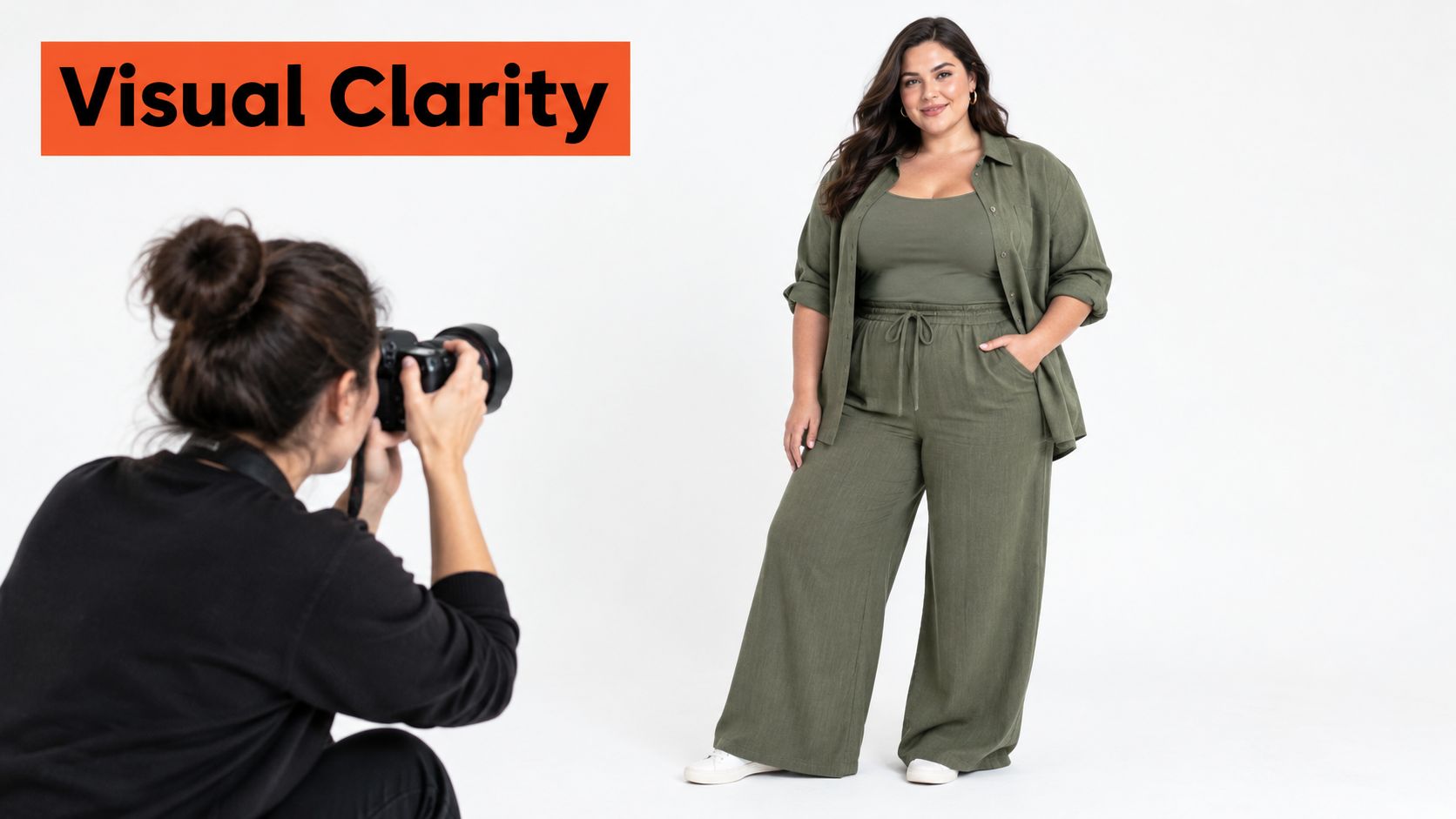
Shoot each set in a front view, a side view, and a back view. Add a seated or walking pose when the fabric's behavior matters. Keep the camera angle consistent enough for comparison, and avoid poses that pull the fabric artificially smooth across the abdomen or hip.
Show the outfit as a system
The primary image should present the top and bottom together, because the customer is buying a relationship between garments. Secondary images should isolate each piece and show how it works with other items. A blazer can appear with denim, a trouser with a simple knit, and a skirt with a contrasting top. This communicates versatility without hiding the coordinated look.
Merchandising copy should identify the fabric composition, stretch and recovery, lining, opacity, waistband construction, and intended ease. Explain whether the set is sold as a bundle or as separately purchasable pieces. If shoppers can mix sizes, place that information beside the size selector rather than burying it in a fit FAQ.
A short motion clip can reveal drape and movement more effectively than a still image. Retail teams planning that asset can use this practical guide to video marketing for ecommerce, while still keeping the footage focused on fit evidence rather than decorative transitions.
Color presentation matters too. Show the set under consistent lighting and provide enough separation between the garment and background for shoppers to see seams, folds, and hem lines. Guidance on color space for product imagery can help teams maintain more reliable color across catalog assets and storefront displays.
Real-World Fit Problems and How Better Data Solves Them
Plus-size fit failures tend to appear in predictable locations. Virtual and live fit assessments have identified problems around the underarm, neckline, abdomen, buttocks, hip girth, and thigh. Those locations explain why just adding width to a standard block often produces a garment that fits one area while creating tension somewhere else.
A coordinated set amplifies the problem. If the top pulls at the abdomen, it can change the way the waistband appears. If the bottom is tight through the seat, the shopper may perceive the entire outfit as poorly made, even when the jacket fits correctly. If the rise is too short, the trouser can drag the top upward and distort the intended silhouette.
Translate failure points into product rules
The product team should connect each fit concern to a measurable specification:
- Underarm and upper arm: Review armhole depth, sleeve circumference, and movement ease.
- Neckline and chest: Check neckline placement, bust projection, shoulder balance, and closure tension.
- Abdomen: Test front length, front rise, waistband stability, and fabric recovery.
- Seat and hip: Measure full hip, back rise, seat extension, and side-seam balance.
- Thigh: Add circumference and movement room instead of grading only from the hip.
- Hem and inseam: Validate inseam against the intended footwear and trouser break.
This information should appear in the catalog feed as structured garment data. A fit engine can then use the relevant variables for each component instead of treating the set as one undifferentiated product.
The broader online shopping problem is often not a lack of desire. It's uncertainty about whether the item will work. Retail teams reviewing that friction can use this analysis of the issues in online shopping as a starting point, then compare it with their own search exits, size-selector interactions, customer-service questions, and return reasons.
Make the output actionable
A recommendation that says “size 22” without explanation leaves the shopper with the same concern. A stronger result can state that the top is recommended in one size and the bottom in another, identify the relevant fit preference, and show the garment from more than one angle. It should also acknowledge uncertainty when the available measurements aren't sufficient.
The objective isn't to promise a perfect prediction. It's to replace an opaque guess with a transparent decision supported by better inputs.
Turning Fit Insights Into Higher Conversion and Lower Returns
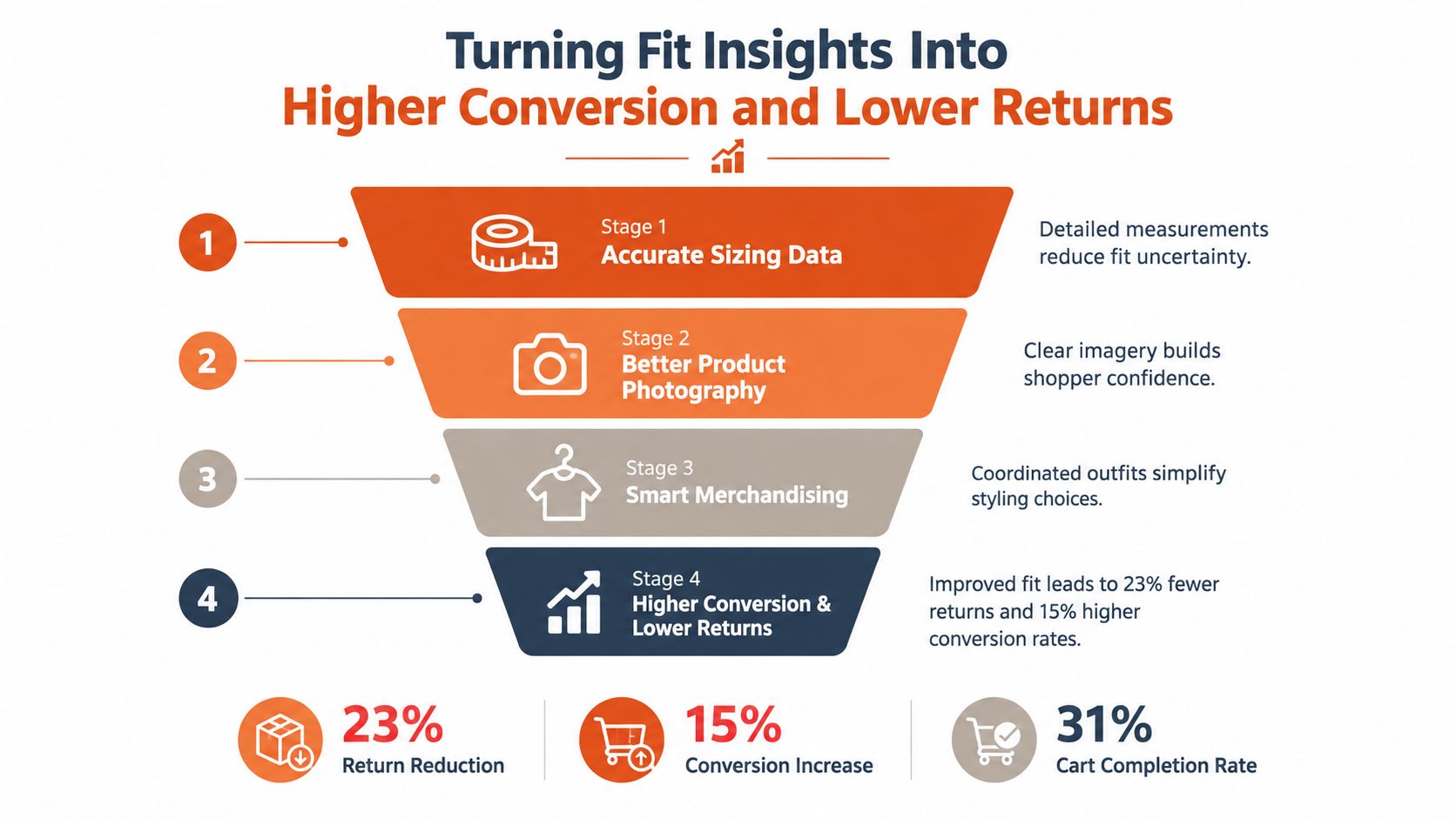
Fit improvements work best as a connected retail workflow. Pattern engineers create useful blocks, photographers document how those blocks behave, merchandisers explain the trade-offs, and the fitting tool converts the information into a product-page recommendation. Removing any one of those steps weakens the result.
The market context supports serious investment. One industry estimate placed plus-size apparel at USD 119.4 billion in 2024, with women's plus-size clothing representing 48.4% of market revenue in that estimate. The same estimate projected the total market to reach USD 202.4 billion by 2034, while noting that published totals vary according to definitions, regions, and product categories, as shown in the plus-size clothing market estimate. Matching sets aren't isolated in those figures, so retailers should use them as category context, not as direct set revenue.
Measure the workflow, not just the widget
Start with a narrow catalog group and establish a baseline. Track product-page engagement, size-selector use, fitting-room starts, recommendation acceptance, set attachment, completed orders, average order value, and size-related returns. Then segment the results by product type, fabric behavior, and whether the customer selected one size or mixed sizes.
A useful operating sequence looks like this:
- Clean the garment data: Match each component to its own chart and store stretch, rise, inseam, and fit intent.
- Improve the visual evidence: Add front, side, back, movement, and separate-piece imagery.
- Expose the size logic: Explain how the recommendation uses body and garment measurements.
- Review outcomes: Compare conversion, order value, and returns against the baseline without attributing every change to the fitting tool.
Teams optimizing their storefront can also apply broader principles from this guide to conversion optimization for Shopify stores. The important distinction is that fit guidance should be integrated into the buying path, not added as a decorative badge after the page is already complete.
Visualization still has limits. An AI preview can't fully communicate hand feel, breathability, friction, warmth, or how a fabric behaves after sitting and washing. Pair the model with composition, care instructions, opacity notes, stretch recovery, and candid fit language. That combination gives the shopper both a visual prediction and the physical information needed to make a sound decision.
Robosize helps apparel retailers add shopper-specific body modeling, virtual try-on, multi-angle previews, and garment-level size recommendations to product pages for coordinated outfits. Review your plus-size set catalog, identify where top and bottom sizes diverge, and visit Robosize to see how a fit-intelligence workflow can support more confident purchases and more useful return data.