You're on a product page with a matching loungewear set in the cart. The top looks roomy, but the waistband on the bottom seems less forgiving. The size chart offers one answer for both pieces, so you're left wondering whether to size up the top, the bottom, or the entire set. That hesitation isn't a shopper failure. It's a merchandising failure.
Plus-size matching sets loungewear creates a two-garment fit problem under one product label. The set has to work across bust, shoulders, waist, hips, rise, thighs, inseam, stretch, and movement. A retailer that grades and presents it as one uniform size is asking one number to describe two different garments on a body that may not fit standard proportions.
Table of Contents
- Why Plus Size Matching Sets Break the Standard Playbook
- What Matching Set Loungewear Actually Is in 2026
- Sizing for Sets Means Sizing Two Bodies at Once
- Fabric Engineering That Holds Up on the Couch and in the Cart
- PDP Photography That Predicts Loungewear Behavior
- Virtual Try-On, Model Preview, and Size Recommenders Compared
- Driving Conversion and Cutting Returns With On-Page Fit
- The Merchandiser's One-Sprint Launch Checklist
Why Plus Size Matching Sets Break the Standard Playbook
A shopper lands on a ribbed top-and-jogger set. The top needs room through the bust and upper arms, while the joggers need more room through the hips and thighs but still need a waistband that stays put. The product page offers small through extra-large, one combined size chart, and a standing model photo. The shopper can't tell whether the fabric recovers after sitting, whether the rise is long enough, or whether choosing the larger size will make the sleeves and inseam unusable.
That uncertainty matters because a coordinated purchase gives the shopper two opportunities to reject the fit. If the top pulls across the chest, the set fails. If the bottom rolls at the waist or bags at the knees, the set also fails. The matching color and fabric don't rescue a garment that behaves badly during sitting, stretching, sleeping, or walking around the house.
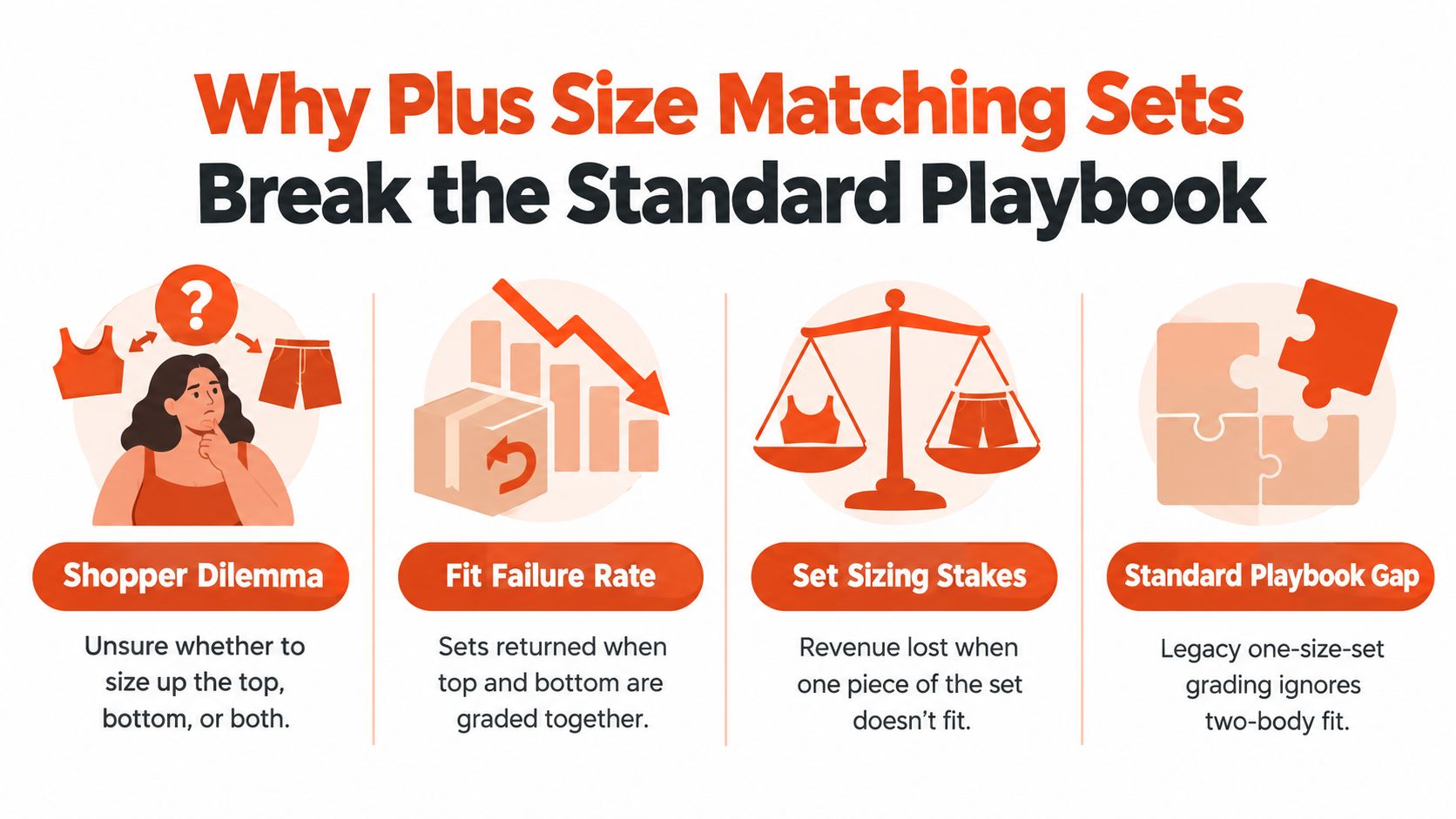
The old grading logic creates a false choice
Plus-size apparel represents a large but historically underserved part of women's clothing. Approximately 67% of women in the United States wear size 14 or larger, according to Cotton Incorporated's Lifestyle Monitor. Yet plus-size clothing generated about $21.4 billion in 2016, compared with an estimated $120 billion U.S. women's apparel market, or roughly 18% of the category's value, according to the same cited market context.
The commercial opportunity is obvious, but the product problem is technical. Scaling a smaller block upward can add circumference without fixing where that circumference belongs. A shopper may need more bust and upper-arm ease, a different waist-to-hip relationship, or a deeper rise without needing a proportionally longer body or inseam.
Merchandising rule: A matching set is two fit decisions wearing one coordinated label.
Treat the set as a pair from the first pattern review through the final PDP. That means independent grading, garment-level measurements, behavior-based photography, and recommendations that can return different sizes for the top and bottom.
What Matching Set Loungewear Actually Is in 2026
“Matching sets loungewear” covers more than a sweatshirt and sweatpant sold in the same color. The category includes waffle-knit sets, ribbed jersey co-ords, modal separates, brushed-cotton outfits, fleece sets, relaxed tees with pull-on pants, and polished travel sets. The common thread is coordination across pieces, not a single construction method.
The shopper job changes by use case. A sleep-oriented set needs soft seams, low-pressure waistbands, and enough ease for turning in bed. A work-from-home set needs a clean shoulder line and fabric that doesn't look collapsed on video calls. A travel set needs recovery after prolonged sitting, a stable rise, and fabric that won't become transparent or visibly bagged at pressure points. A sleep-to-brunch set needs enough structure to look intentional outside the home.
The product page should describe the set through the attributes that control those experiences:
- Top fit: Bust, shoulder width, upper-arm ease, sleeve length, hem width, and neckline recovery.
- Bottom fit: Waistband construction, waist and hip measurements, rise, thigh ease, inseam, leg opening, and cuff placement.
- Fabric behavior: Fiber percentages, fabric weight, stretch direction, opacity, softness, and recovery.
- Use-case fit: Sitting, resting, sleeping, walking, travel, and casual public wear.
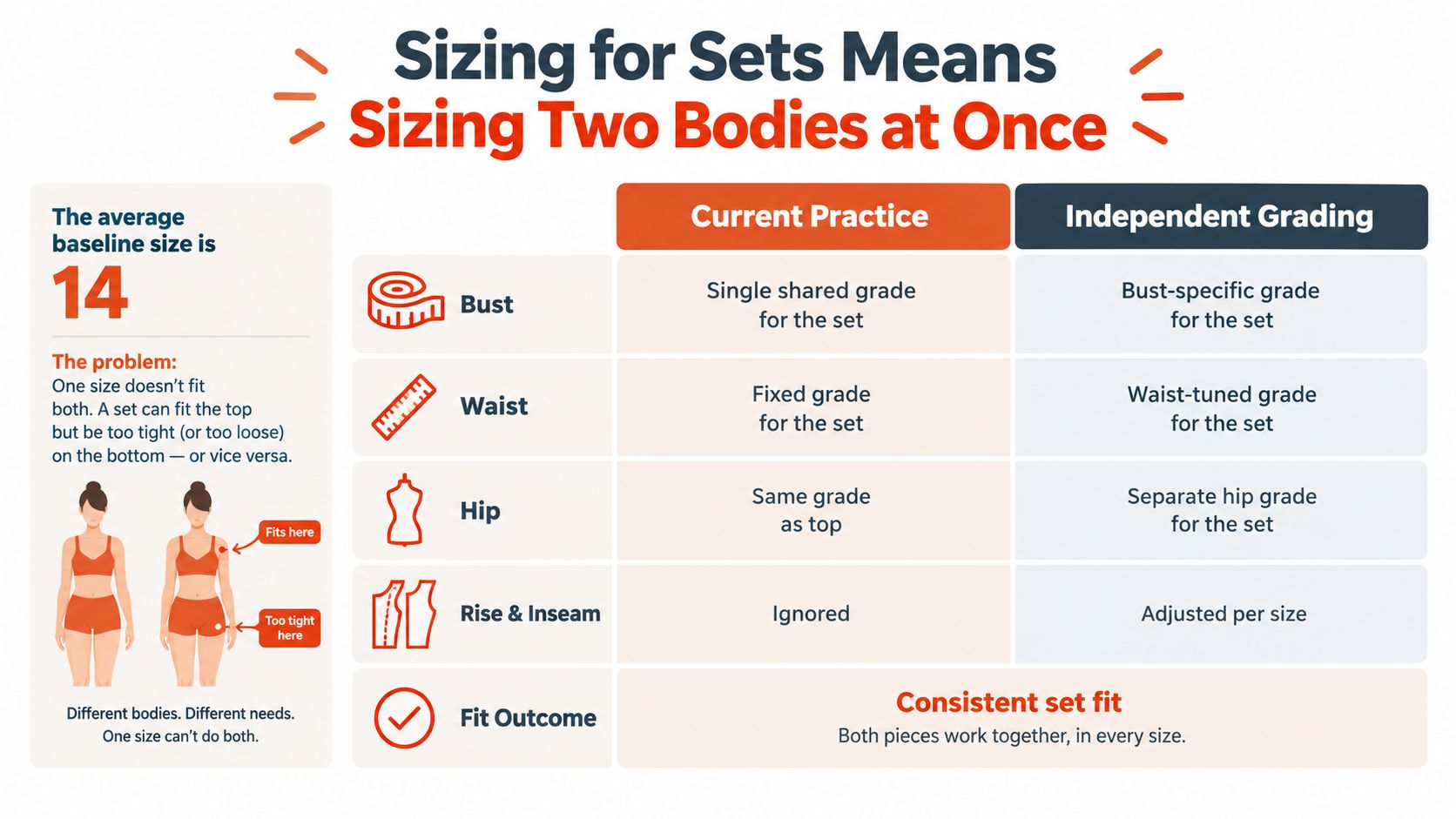
The market context makes generic grading especially weak. Approximately 67% of U.S. women wear size 14 or larger, and an academic review identifies size 14 as the approximate average women's size in the United States, as reported in the cited apparel sizing review. Extended sizing is therefore a mainstream fit requirement, not a niche add-on.
| Set category | Top fit priority | Bottom fit priority |
|---|---|---|
| Waffle knit | Bust ease, shoulder balance, sleeve recovery | Waistband comfort, hip ease, knee recovery |
| Ribbed jersey | Stretch across bust and arms, neckline stability | Stretch recovery, opacity, thigh ease |
| Modal | Soft drape, arm mobility, hem behavior | Smooth waistband, non-cling through hips, inseam |
| Brushed cotton | Warmth without bulk, sleeve length | Rise, seat ease, laundering stability |
| Fleece | Layering room, cuff placement | Waistband grip, bulk management, leg opening |
The category team should stop describing a set as “relaxed fit” without defining where the relaxation lives. A generous top with a controlled jogger can be comfortable and balanced. Sizing both pieces up can create sleeve drag, waist slippage, excess fabric pooling, or an unintentional silhouette.
Sizing for Sets Means Sizing Two Bodies at Once
A plus-size set needs independent grading because body dimensions don't increase in a single, predictable ratio. The academic review cited above compares a women's plus-size 16 fit model measuring 41.5 inches at the bust, 33.5 inches at the waist, and 43.5 inches at the hip with a misses size 8 model measuring 35, 27, and 37.5 inches, respectively. Those measurements show differences in both magnitude and distribution, not a simple instruction to enlarge every part of a smaller block.
Build the set as separate garments
Grade the top around bust, waist, shoulder, upper arm, sleeve length, and body length. Grade the bottom around waist, hip, thigh, rise, inseam, and leg opening. Keep the color, surface, and visual language coordinated, but don't force the pattern logic to match when the fit requirements don't.
A shopper may need a larger top because of bust or upper-arm ease and a different bottom size because the hip-to-waist relationship is different. That should be a supported outcome, not an embarrassing workaround. If the set can only be purchased under one shared size, the PDP must explain which measurement controls the choice and what trade-off the shopper should expect.
Put the decision data on the PDP
A strong product page should expose enough information to replace guesswork:
- Show garment measurements separately. List bust, hem, sleeve, waist, hip, rise, thigh, inseam, and leg opening by piece.
- List model dimensions. Include height, bust, waist, hip, and the sizes worn for the top and bottom.
- Explain stretch and opacity. State whether the fabric stretches horizontally, vertically, or both, and show how it behaves under tension.
- Give a top recommendation and a bottom recommendation. Don't collapse both outputs into one nominal size.
- Ask for shape relationships. Height, weight, age, and body shape can support a recommendation, but waist-to-hip and bust-to-waist differences often matter more than a label.
- Show fit pressure points. Explain waistband tension, crotch depth, hem position, and intended ease.
A size chart still matters because it gives the shopper control and makes the recommendation auditable. A tool such as Robosize's height and weight body model guide can also help teams think about the shopper inputs needed for a more individualized body model.
PDP standard: If the shopper can't tell which measurement controls each garment, the page hasn't finished merchandising the set.
Fabric Engineering That Holds Up on the Couch and in the Cart
Fit can be correct at try-on and still fail after an afternoon on the sofa. Sitting loads the seat and knees, bending stresses the waistband and elbows, and repeated laundering exposes weak recovery. For plus-size loungewear, fabric engineering is part of fit engineering because the garment has to maintain comfort and appearance while it is being used, not just while it is standing still.
For everyday knit sets, specify a mid-weight fabric around 250–300 GSM when the priority is a balance of opacity, warmth, and drape, based on the fabric guidance for sweatpants. Lighter fabrics can feel breathable, but they may reveal contours more readily or lose recovery sooner. Heavier fabrics can feel substantial, but they may add heat and bulk around the waistband, seat, and cuffs.
Set a recovery standard before you approve the color
An elastane range of approximately 5–8% spandex is cited as a useful range for mobility and recovery without creating a strongly compressive hand feel, according to the same fabric guidance. The exact hand feel still depends on the yarns, knit structure, finishing, and garment construction.
Test the top and bottom as a pair. A top that snaps back while the jogger remains bagged will make the set look mismatched after wear. The shopper experiences that as poor quality, even if each garment passed an isolated inspection.
Require testing for:
- Stretch and recovery in both wale and course directions.
- Repeated extension cycles at the seat, knees, bust, elbows, and waistband.
- Seam slippage and waistband roll.
- Pilling from couch friction and laundering.
- Dimensional change after care cycles.
- Opacity under stretch and in seated positions.
Polyester-elastane knits can support moisture transport and shape retention. Cotton-rich blends often provide a softer, familiar hand feel, but they may dry more slowly and need stronger recovery engineering. Neither fiber story replaces a measured performance specification.
Publish the information shoppers need
List fiber percentages, GSM or fabric weight when available, stretch direction, opacity, and care instructions. These details help shoppers distinguish a sizing problem from fabric behavior. If a waistband stretches out after washing, the shopper shouldn't have to infer whether the problem came from choosing the wrong size or from insufficient recovery.
Product rule: Photograph, test, and approve the top and bottom together. Matching color is not matching performance.
PDP Photography That Predicts Loungewear Behavior
Standing front photos are inadequate for loungewear. They hide waistband pressure, crotch depth, seat pull, knee bagging, hem drag, and sleeve behavior. A shopper buying a set for sitting needs to see the garment seated, not only styled upright under studio lights.
Give the studio a behavior-led shot list
Use at least three meaningful views for the complete set and make the garment construction easy to inspect:
- Front view: Shows overall balance, hem position, waistband placement, and whether the pieces look coordinated.
- Three-quarter view: Reveals bust projection, hip shape, side seam behavior, and the amount of intended ease.
- Seated or bent view: Tests waistband comfort, rise, seat coverage, thigh pull, knee behavior, and fabric opacity.
- Movement detail: Capture a sleeve lift, a step, or a reach so shoppers can judge recovery and mobility.
- Construction close-ups: Show the waistband, drawcord, cuffs, hems, neckline, and seam finish.
List the model's height, bust, waist, hip, and worn size beside the imagery. If the top and bottom are different sizes, say so clearly. That single disclosure teaches shoppers that separate recommendations are normal rather than signaling a product defect.
The shoot should also include close-ups after movement. A fabric can look smooth in the initial frame and show bagging or transparency after sitting. Use the same lighting and camera distance for the standing and seated shots so the comparison feels credible.
A short video can add motion that still images can't communicate. Place it after the primary image sequence rather than hiding it below unrelated content.
The visual system should support conversion too. For teams refining PDP layout, P-3 color space guidance can inform how product color and fabric texture appear across compatible displays, but it shouldn't replace accurate lighting and construction photography.
Virtual Try-On, Model Preview, and Size Recommenders Compared
These tools solve different problems, so the category team shouldn't treat them as interchangeable. A static chart offers transparency. A model preview reduces the effort of imagining the garment on a different body. Selfie-based try-on gives the shopper a more personal visual reference, but it introduces camera hesitation and requires careful handling of the input flow.
| Tool | What it solves | Main trade-off | Best use for matching sets |
|---|---|---|---|
| Static size chart | Measurement transparency and shopper control | Requires the shopper to measure and interpret two garments | Always include as the baseline |
| Model-based preview | Visualizes drape on a selected representative body | The body may not resemble the shopper closely enough | Useful for camera-shy shoppers and broad style comparison |
| Selfie-based try-on | Shows a shopper-specific body model and garment rendering | Adds a privacy and participation decision | Strong option when body-shape uncertainty drives hesitation |
| Questionnaire recommender | Reduces manual chart interpretation | Depends on the quality of questions and garment data | Useful for separate top and bottom outputs |
The static chart remains essential. It should include per-garment measurements, not only a shared set range. A model preview is a practical fallback for shoppers who don't want to upload a selfie. It also helps merchandising teams show how an oversized top balances against a more controlled bottom.
Selfie-based try-on earns its place when the biggest issue is visual uncertainty. The shopper can compare silhouette, drape, and proportion without relying only on a standing model who may wear a different size. The interface should make the selfie optional and offer a short questionnaire as an alternative.
For a coordinated set, the tool must produce separate top and bottom recommendations. A single output defeats the purpose. It should also support multiple viewing angles, show the waistband and hem relationship, and connect each garment to the correct size chart. A visualizer built around three sizes illustrates why size comparison needs to stay visible rather than being buried in a generic chart.
Use the tool that addresses the dominant cause of your size-related returns. If shoppers complain about measurement confusion, improve the chart and questionnaire first. If they understand measurements but can't picture the result, prioritize model or selfie visualization. Don't buy visual technology as a substitute for clean product data.
Driving Conversion and Cutting Returns With On-Page Fit
A shopper lands on the PDP, likes the set, then stalls because the sweatshirt looks forgiving while the jogger looks strict at the hip. If your page answers that tension with one shared size label, you create doubt right before checkout. Matching sets convert better when the PDP treats the top and bottom as two fit decisions inside one coordinated purchase.
Keep the fit guidance close to the add-to-cart area and make it specific. The page should explain which measurements drive the top recommendation and which drive the bottom recommendation. Bust ease can point one way. Hip, rise, and waistband tension can point another. That level of explanation cuts hesitation because the shopper can see why a split recommendation makes sense instead of feeling pushed into an arbitrary label.
Reported case-study outcomes for AI virtual try-on and size recommendations on apparel PDPs include higher conversions of +17%, greater AOV of +24%, and lower return rates of -7%, as reported in Robosize's published case study. These are reported outcomes, not a promise for every retailer. The practical takeaway is simple. Fit guidance works best when it sits on the PDP, next to the decision, not buried in a generic help page.
Start with a short questionnaire. Ask for height, weight, age, body shape, and the few measurements or proportion cues that affect the garment. Then let shoppers stop there or add a selfie if they want visual confirmation. Selfie try-on helps with silhouette anxiety. It does not replace clear measurement logic, and it should never be a forced gate.
The output must return the top and bottom separately. It should also state the reason for each result, such as a roomier top for bust and arm ease, paired with a different bottom size because the fabric recovers less at the waistband. That is how you reduce returns on sets. You stop pretending one label can carry two different grading problems.
Use multiple views when the tool supports them. Front alone is not enough. Show front, three-quarter, and seated or movement-oriented views so the shopper can judge waistband position, hem length, and how the pieces behave together. Teams that also use RankEngine for Shopify SEO can organize those fit details, fabric specs, and structured PDP content so shoppers find them faster.
Set priorities in this order:
- First, fix the product data. Publish accurate top and bottom measurements plus model dimensions.
- Second, fix the recommendation logic. Support different outputs for each piece.
- Third, add visualization. Use model preview or selfie try-on based on shopper preference.
- Fourth, measure outcomes. Track size-related returns, recommendation usage, conversion, and basket value for matching sets.
The Merchandiser's One-Sprint Launch Checklist
Ship the minimum viable fit system before adding more colors or promotional creative. A focused sprint can make a matching set materially easier to buy.
- Separate the garment specs. Publish top and bottom measurements, including bust, waist, hip, rise, thigh, inseam, sleeve, and leg opening where relevant.
- Document the model. Show height, bust, waist, hip, and the size worn for each piece.
- Add fabric evidence. List fiber percentages, GSM or fabric weight, stretch direction, opacity, recovery expectations, and care.
- Reshoot for behavior. Require front, three-quarter, seated or bent, movement, and construction-detail images.
- Support split sizing. Let the PDP recommend one size for the top and another for the bottom when the shopper's proportions call for it.
- Add a fit decision layer. Keep the static chart, then add a questionnaire, model preview, or optional selfie flow based on your return data.
- Measure the right baseline. Start with size-related returns on matching sets, then compare conversion, AOV, and recommendation engagement after launch.
Use merchandising systems that connect fit guidance with related product discovery. For broader catalog planning, personalization and upsells for Shopify offers useful context on coordinating recommendation and merchandising workflows without treating every shopper as a single size label.
Robosize provides an AI virtual fitting room with a questionnaire, optional selfie-based or model-based try-on, and product-specific size recommendations. For plus-size matching sets loungewear, use it to test separate top and bottom outputs and multi-angle fit visualization on the PDP, then visit Robosize to evaluate the setup for your store.