You've found a swimsuit that looks smooth on the hanger. In the fitting room, the front looks promising, too. Then you turn sideways, reach for your bag, and feel the back edge fold into a tight ridge.
That's the key challenge with bathing suits for back fat: finding a suit that keeps its shape when you move, not just when you stand still. Back fullness is normal. If you want more coverage or a smoother outline, the useful question is where the suit distributes tension, and whether its edges stay comfortable when you reach, bend, sit, or swim.
Table of Contents
- Swimsuit Styles That Hide Back Fat Best
- How to Measure for Back Coverage Before You Buy
- Test Fit in Motion and Avoid Sizing Errors
- Fabric and Construction Details That Smooth the Back
- Confirm the Fit Before You Check Out
Swimsuit Styles That Hide Back Fat Best
A one-piece that rolls at the back isn't necessarily the wrong style. It may be too short through the torso, too tight at the edge, or too loose to stay anchored. Start with your preferred coverage, then judge the actual garment rather than trusting the silhouette's name.
Swimsuit styles compared by back coverage
| Style | Back coverage | Silhouette effect | Best for | Main trade-off |
|---|---|---|---|---|
| High-back one-piece | Full, up to the shoulder blades | One continuous vertical line | Even smoothing for everyday wear | Can slide down if the band is loose |
| Tankini with high-waist brief | Medium, covers the torso to the waist | Softens the ribs and upper back | Bikini look with more cover | Two pieces can shift while swimming |
| Longline bikini top with high-waist bottoms | Partial, covers ribs and upper back | Breaks the back line at the ribs | Active swimmers | Less smoothing under heavy tension |
| Ruched wrap one-piece | Medium, back cut determined by the design | Diagonal lines distract the eye | Photos and beach days | Crossover can gape with a fuller bust |
| Rash guard with swim leggings | Full, long sleeves cover the back | Close-fitting knit with little visible edge | Swimming and sun cover | Heavier when wet and less sculpted |
Choose where you want the fabric to end
A high-back one-piece creates an uninterrupted panel rather than placing a narrow band across the middle of the back. Look for a high rear neckline, not just a high front neckline with a deep scoop behind it. The latter won't provide the coverage you're expecting.
A tankini extends torso coverage without joining the top to the briefs. It's useful when you want easier changing or separately sized pieces, but the hem needs enough overlap to remain covered when you reach. A floating hem gives a softer outline, not firm shaping.
A longline bikini top extends below a conventional bust band and places its lower edge farther down the ribs. That broader area can distribute tension, provided the fabric doesn't fold upward. For active swimming, choose secure shoulder straps rather than assuming the longer band alone supplies support.
Separate visual detail from physical support
A ruched wrap one-piece uses gathers and diagonal detail to interrupt surface lines. Check the rear view, though: front ruching doesn't mean the back has the same construction. For styling ideas after you've established fit, Cedar & Lily Clothier's guide to elevated poolside looks for occasion shoppers offers another direction to explore.
A rash guard with swim leggings offers extensive coverage without needing a sculpted silhouette. Choose swim-specific fabric and check any stated sun-protection rating rather than treating coverage alone as a guarantee.
Practical rule: More coverage gives you more fabric, not automatically more support. Loose panels can drag and hold water.
Before choosing, inspect the side-back view in a mirror, check that the band lies flat without pulling, and consider a darker tone or pattern that visually breaks up the back line. For laps, prioritize secure athletic construction; for lounging, a tankini may feel easier; for photos, wrap detailing can provide the visual effect you want without extreme compression.
How to Measure for Back Coverage Before You Buy
Sizing from the waist alone misses the measurements that determine whether a swimsuit pulls across your back. Bust volume, hip circumference, and torso length all affect how the garment settles. Use a flexible dressmaker's tape, a mirror, and the product's own chart.
The DHgate swimwear buying guide emphasizes body measurements and garment engineering rather than choosing a tighter size. Treat measurements as a starting point, not a promise that every suit in that size will fit identically.
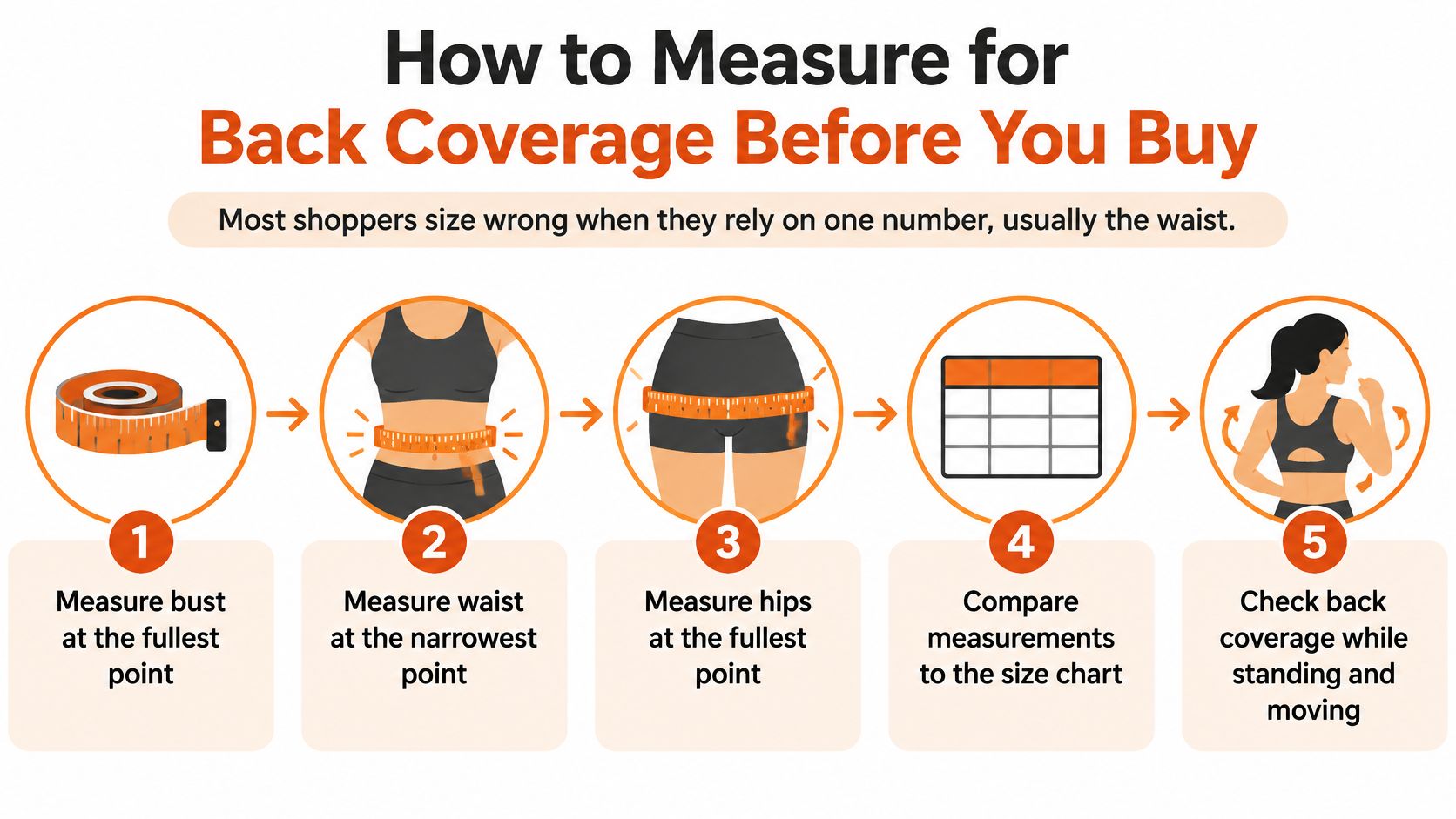
Take measurements without adding tension
Record bust, waist, hips, and torso length. Keep the tape against your body without indenting the skin, and stand naturally rather than holding your stomach in. Record shoulder-to-top-of-hip length for reference, but follow the brand's diagram if its torso measurement uses a different route, such as a full girth measurement.
Compare against the brand's chart. Your regular clothing size isn't a reliable substitute, especially across swimwear brands. Our guide to women's clothing size charts helps clarify how to read measurement-based sizing rather than relying on the label.
Start with the size accommodating your largest relevant measurement. For a one-piece, consider all the charted dimensions; for separates, evaluate each piece independently. If the bust fits one size but torso length doesn't, try a long-torso or fuller-bust cut instead of forcing a compromise.
Check the back panel's position. Look at rear product photographs and compare where the upper edge sits relative to the waist and shoulder blades. A body-size chart rarely tells you back-panel height, so don't mistake a model's coverage for a garment measurement.
Choose concealment or compression deliberately. Concealment means covering an area, while compression applies pressure through the fabric. If you mainly want coverage, you don't need to accept a tightly sculpting lining.
Body measurements and common slips
| Measurement | How to take it | Common slip |
|---|---|---|
| Bust | Fullest point, level under the arms | Measuring over a padded bra |
| Waist | Narrowest point | Pulling the tape tight |
| Hips | Widest point | Tape not level at the back |
| Torso length | Shoulder to top of hip | Measuring with a slouched posture |
A measurement taken over padding can send you toward excess room, while a tightly pulled tape can send you toward an undersized suit. Recheck any result that seems inconsistent before ordering.
Fit the largest relevant measurement first, then verify the cut. That gives your back a better starting point than sizing down, but it doesn't eliminate the need for a movement test.
Test Fit in Motion and Avoid Sizing Errors
Sizing down to look smaller often produces the opposite result: a sharp back edge with fullness above or below it. The useful distinction isn't whether the suit feels tight. It's whether the pressure stays broadly distributed as your posture changes.
A 2023 wetsuit pattern-development study published in Sustainability scanned 96 women and collected 42 static and dynamic measurements. That's evidence for considering movement when developing close-fitting garments, not proof that a particular retail swimsuit will smooth your back.
Use front, side, and rear views together rather than approving the suit from a single angle.
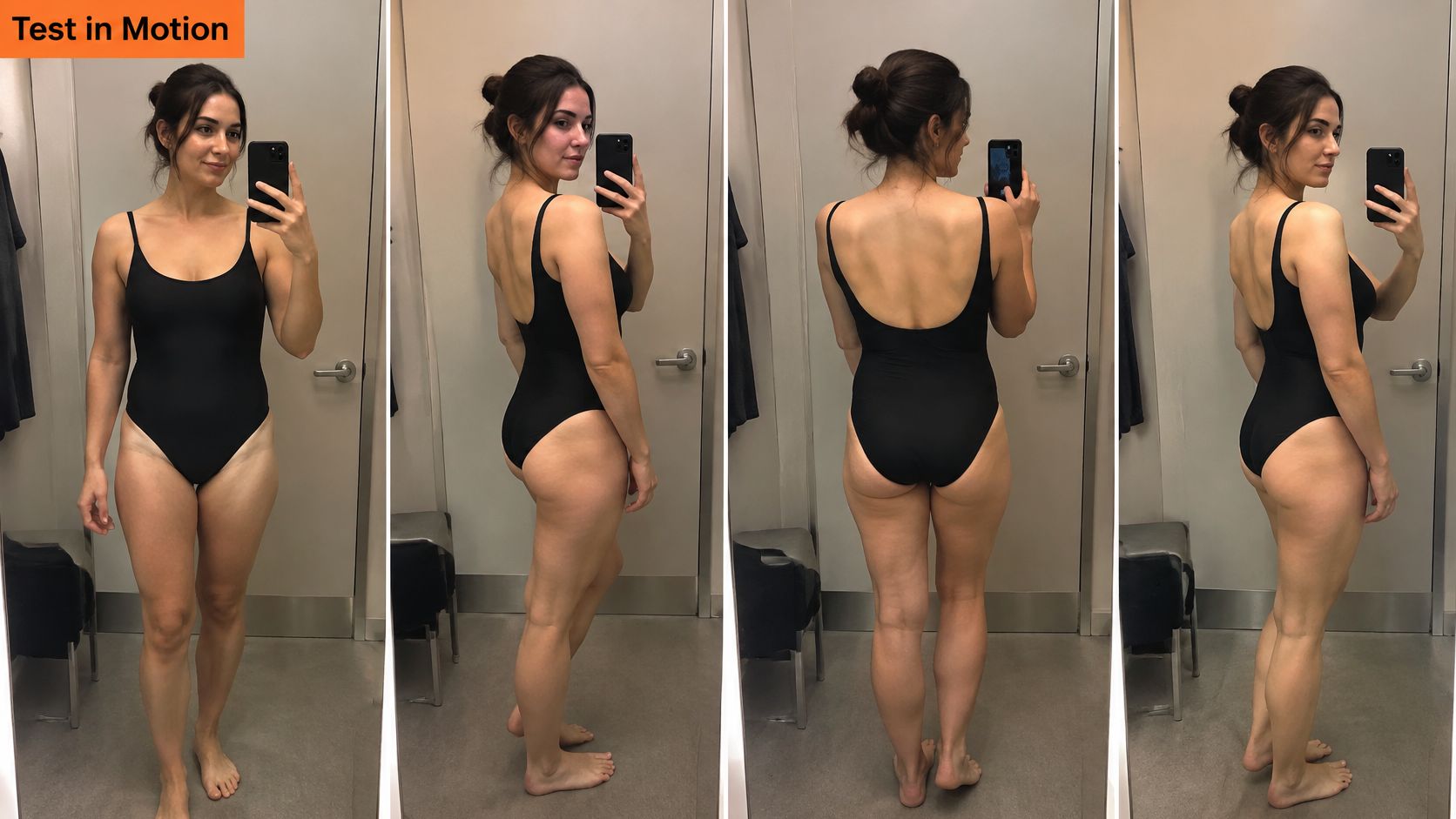
Run the movement test without readjusting
Put the suit on properly, settle the bust into its support, and adjust the straps once. Then leave the fabric alone as you move. Repeatedly pulling the panel down between poses can hide a fit problem.
Movement checks for back smoothing
| Pose | What to check | Warning sign |
|---|---|---|
| Arms overhead | Back panel stays flat | Band rides up or back edge lifts |
| Forward bend | Fabric holds without rolling | Roll at the band or gaps at the armholes |
| Torso rotation | Straps and back stay centered | Strap slip or diagonal pull across the back |
| Sitting down | Band sits flat | Digging or sharp edge at the back |
Raise your arms as if beginning a swimming stroke, not just lifting your hands slightly. Notice whether the suit returns to position when your arms come down. A panel that stays displaced will probably need ongoing adjustment.
Bend forward and rotate in both directions. Some fabric creasing is normal, especially around a moving waist; what matters is whether the edge folds into a persistent cord or an armhole opens away from the body.
Sit on a firm chair and breathe normally. You shouldn't have to straighten rigidly or hold your breath to tolerate the back band. Keep hygiene liners in place and follow the retailer's fitting conditions.
Diagnose the failure before changing sizes
Digging throughout the suit suggests insufficient room or excessive compression. Try a larger size or a less compressive construction. Don't choose a smaller size when pressure already concentrates at the armholes or back edge.
A loose band with slipping straps calls for a different response. Tightening the straps may lift the whole back panel without fixing the loose circumference. Our guide to signs your bra doesn't fit helps distinguish band, cup, and strap problems that also appear in structured swim tops.
Sizing up indiscriminately can trade one problem for another. You may reduce edge pressure but lose bust support, develop neckline gaps, or find the shoulders no longer stay in place. Industry commentary from The Curvy Fashionista makes the broader point that fuller-body clothing needs considered pattern engineering, not merely enlarged dimensions.
A suit that needs your hands to stay smooth isn't staying smooth on its own.
Say you have a long torso and full bust, but your waist falls into a smaller chart size. A longer-torso, fuller-bust top paired with bottoms sized to your hips may work better than a fixed set. If your shoulders are narrow, prioritize strap placement and adjustability rather than choosing the widest straps available.
Finish by mimicking your intended activity. For swimming, move through a stroke pattern; for beach lounging, sit and stand naturally. Stable tension matters more than maximum tightness, and normal folds when bending don't mean the suit has failed.
Fabric and Construction Details That Smooth the Back
The same high-back cut can feel supportive in a resilient, lined fabric and flimsy in a thin, slack knit. Stretch recovery matters: after a gentle stretch, the fabric should return toward its original shape instead of remaining elongated. Don't judge support by thickness alone, because a bulky fabric can still lack recovery.
Separate visual smoothing, physical support, and freedom of movement. A suit may conceal surface lines while offering little bust support, or hold the bust securely while leaving the back uncompressed. The functional, versatile swimwear discussed in Particl's swimwear report reinforces why activity needs deserve attention alongside appearance.
Construction features and their trade-offs
| Feature | What it does | Trade-off |
|---|---|---|
| Double or triple layer fabric | Flattens the back edge and hides lines | Heavier when wet |
| Ruching | Diffuses surface lines across the torso | Can add bulk at the sides |
| Adjustable tie-back | Lets you fine-tune tension | Ties can loosen in water |
| Nylon/elastane blend | Stretch with shaping support | Chlorine can wear elastane over time |
| Polyester/elastane blend | Stable shape with stretch recovery | Can feel less soft against skin, depending on the knit |
Inspect the inside as carefully as the outside
Turn the suit inside out and check whether the back receives meaningful lining or only the front has a shaping panel. A tummy-control label doesn't tell you how the rear is built. Look for smooth seams and elastic that lies evenly rather than puckering before you put it on.
Gently stretch the back panel and inspect the lining. If it becomes noticeably more transparent or strained than the outer layer, it may be taking too much of the load. Avoid aggressive stretching that could damage a garment you haven't purchased.
Ask whether the design is intended for sustained swimming or mainly poolside wear. For regular pool use, look for an explicit chlorine-resistance claim and follow the care instructions; fiber names alone don't establish durability or softness.
Construction check: Prefer broad panels, compatible layers, and adjustable support over a narrow band doing all the flattening.
Tie-backs are useful only if you can secure them reliably and reach them comfortably. Ruching is worthwhile only if you like the added texture. Choose the construction that solves your fit problem, not the longest list of shaping features.
Confirm the Fit Before You Check Out
Before buying, make sure the suit meets your actual use case. A swimsuit for relaxed poolside wear doesn't need to behave like a training suit, but it still needs to remain comfortable when you sit down.
- Coverage goal: Choose the back height and silhouette you want, not just a flattering front photograph.
- Measurement match: Compare bust, waist, hips, and the brand's torso measurement with the relevant chart.
- Movement result: Reject persistent rolling, slipping, digging, or gaping.
- Construction check: Confirm the rear lining, closures, strap adjustment, and intended activity.
Use a virtual preview as a decision aid
On stores offering our fitting room, shoppers enter height, weight, age, and the closest illustration of their body proportions. A real-time phone or webcam selfie completes the body model, or they can pick a model. Within seconds of the try-on, Robosize shows the outfit with one precise size and fit recommendation for that specific garment.
Our guide to trying a new look virtually explains the approach. Where the available views allow, inspect the rear band edge and the fabric's appearance from a three-quarter angle. A static preview can help assess the silhouette, but it can't confirm how the armholes feel when you reach or how wet fabric behaves.
For a sailing day rather than a pool visit, use PADL's sailing attire guide to consider the rest of your clothing alongside the swimsuit.
Treat the recommended size as a candidate, not an instruction to ignore a visible mismatch. If the front looks right but the rear band gaps, return to the size chart and reassess the cut rather than automatically ordering the next size up. Proceed only when the available views look consistent with your coverage goal.
Before paying, confirm the return window, hygiene requirements, and size-exchange rules. Preserve the tags and liner until you've completed the permitted at-home fit check.
Robosize offers shopper-specific virtual try-on and garment-specific size recommendations to help you assess coverage before ordering. Visit Robosize to explore how a body-model preview can support your swimsuit choice, then confirm comfort with a hands-on movement test.