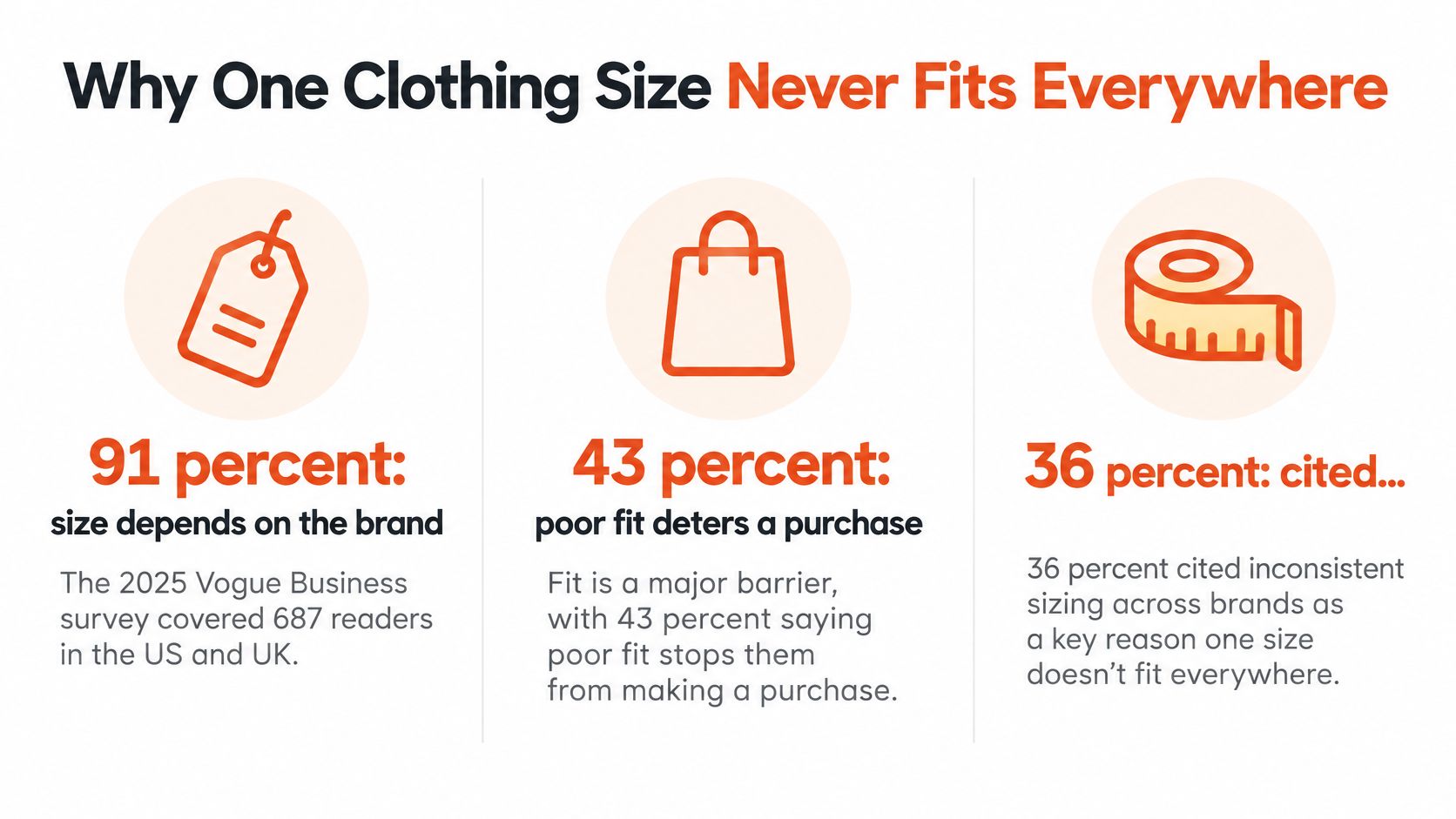
In a 2025 Vogue Business survey of 687 readers in the US and UK, 91% said their clothing size depends on the brand. That finding changes the question from “What size am I?” to “What size works for this garment, in this brand's system?” The Vogue Business survey points to a practical truth: in size in fashion, a label is a starting clue, not a description of your body.
Table of Contents
- Why One Clothing Size Never Fits Everywhere
- Women's Size Labels Across Major Markets
- How Vanity Sizing Unhooked the Number
- How to Take Your Body Measurements
- Which Measurement Should Win by Garment
- What Body Data Can and Cannot Predict
- Best Practices for Brands and Product Pages
Why One Clothing Size Never Fits Everywhere
A shopper might wear a 10 in one brand's jeans, a 12 in another's dress, and a medium in a stretchy top. That doesn't mean their body changed between purchases. It means the brands used different measurements, patterns, and fit preferences to make those garments.
The same Vogue Business survey found that 43% of respondents said poor fit deters them from purchasing, while 36% cited inconsistent sizing. The inconsistency was a concern for 46% of plus-size respondents, 34% of mid-size respondents, and 25% of straight-size respondents. Those figures describe the survey respondents, not every shopper, but they show why a single personal size can't reliably guide every purchase.
Keep the body, garment, and label separate
To choose a size, keep three things distinct:
- The body: your bust or chest, waist, hip, and height measurements.
- The garment: its finished dimensions, stretch, ease, and the rules the brand used to grade it across sizes.
- The label: the shorthand printed on the tag, such as S, 8, or 38.
A size is a label for the body a garment was designed to fit, not a measurement of the person wearing it.
A label can suggest where to start, but it doesn't tell you how much room a garment has or how its cut will work with your proportions. Think of shoe sizing: knowing a shoe's length doesn't tell you its width. A letter size without information about ease leaves out a similarly important part of fit.
That's why a chart can be useful and still leave you uncertain. It translates a brand's label into body measurements, but the garment's shape, fabric, and intended fit determine whether those measurements will feel comfortable. For sleepwear, for example, fabric hand and airflow can matter alongside circumference, so a guide to breathable fabrics for plus size pyjamas can help you think about comfort beyond the number on a tag.
A conversion chart is a bridge between labels, not a promise of fit. After translating a foreign size, check the brand's chart and compare the measurements that matter for that particular garment. By separating those steps, you can make sense of a foreign label and recognize when the label itself isn't enough to trust.
Women's Size Labels Across Major Markets
Use the chart below as a working translation, not a fit guarantee. These are common ready-to-wear numeric equivalents used by many international retailers. They convert labels, not body measurements or garment ease.
| US | UK | EU | Italy | Australia | Japan |
|---|---|---|---|---|---|
| 0 | 4 | 32 | 36 | 4 | 3 |
| 2 | 6 | 34 | 38 | 6 | 5 |
| 4 | 8 | 36 | 40 | 8 | 7 |
| 6 | 10 | 38 | 42 | 10 | 9 |
| 8 | 12 | 40 | 44 | 12 | 11 |
| 10 | 14 | 42 | 46 | 14 | 13 |
| 12 | 16 | 44 | 48 | 16 | 15 |
| 14 | 18 | 46 | 50 | 18 | 17 |
| 16 | 20 | 48 | 52 | 20 | 19 |
| 18 | 22 | 50 | 54 | 22 | 21 |
| 20 | 24 | 52 | 56 | 24 | 23 |
Translate first, then check the chart
Take a US 8 as an example. In this conversion, it corresponds to UK 12, EU 40, Italian 44, Australian 12, and Japanese 11. A handy pattern is that UK sizing is often the US number plus 4, EU sizing is often the UK number plus 28, Italian sizing is often the EU number plus 4, and Australian sizing often tracks the UK number.
Those patterns help you get oriented, but they don't confirm a garment will fit. On a product page, open that retailer's size chart and compare your bust, waist, and hip measurements in centimetres. If you're shopping for a structured jacket, for example, its chest and shoulder measurements may matter more than the chart's general label conversion. A women's sizing chart for golf outfits is a useful example of the kind of garment-specific guide to look for when a general conversion table isn't enough.
Men's sizing offers a useful shortcut for chest labels. A US or UK chest size of 38 inches is often labeled EU 48, and each two-inch step typically corresponds to about two EU sizes: 40 to 50, 42 to 52, and 44 to 54.
Why the conversion can fail
A US label may be affected by vanity sizing, including among brands that use the same number. UK high-street sizing can drift too. Some Asian brands cut for a shorter torso, so a label conversion won't reveal whether the garment's proportions suit you. Stretch garments, especially leggings, can also fit differently from a non-stretch item carrying the same label.
Europe's EN 13402 standard was developed to make size information more meaningful across markets by describing body measurements in centimetres and using a standardized pictogram. Its framework covers measurements including height, bust or chest, waist, and hip, among others. The European clothing-size designation standard EN 13402 represents a move toward saying what body a garment is designed to fit rather than relying only on a national number. Adoption has been uneven, however, so a label can still vary by country and retailer.
Translate the label, then measure the garment. That's the reliable way to use an international size chart without mistaking a label match for a fit guarantee.
How Vanity Sizing Unhooked the Number
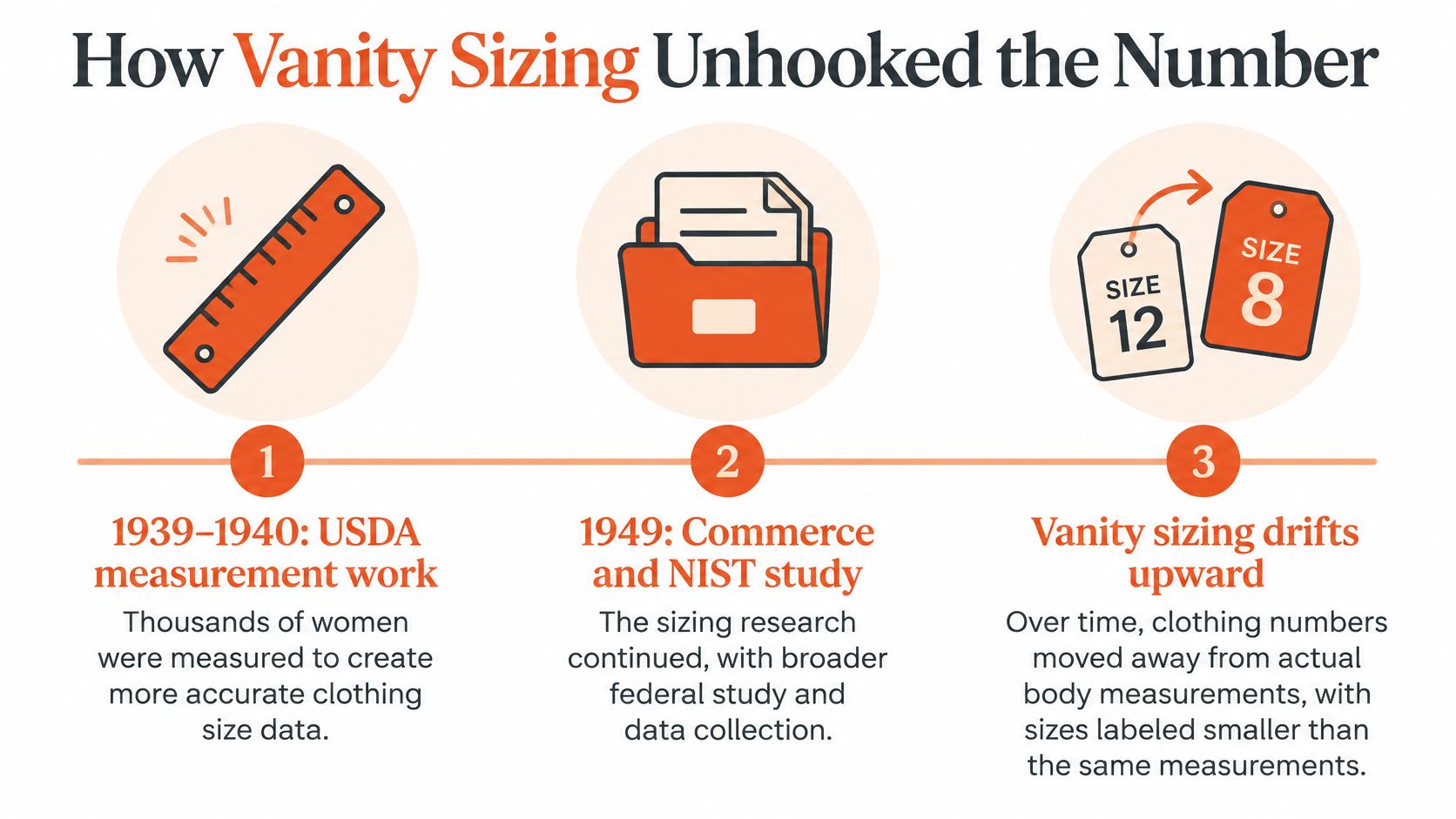
Numeric sizing began with efforts to create more representative measurements for clothing patterns. In 1939–1940, the US Department of Agriculture measured thousands of American women; the US Department of Commerce and the National Institute of Standards and Technology conducted a further study in 1949. Released in 1958, the resulting work was the first officially recognized US garment-industry sizing standard, with 32 women's sizes from 7 through 42, as described in Fashion Magazine's account of vanity sizing.
Then the labels drifted. Women's size labels have shifted over the decades, so a number from one era does not reliably match the same number today. That drift is called vanity sizing: the practice of assigning a smaller label to measurements that would once have carried a larger number, or grading a line around a brand's own customer rather than a shared reference.
Read the measurements behind the tag
Two pairs of jeans can both carry a 28 label. One may run wider at the waistband or deeper through the hip; the other may sit lower on the body or use fabric with more stretch. The number tells you none of that. Fit lives in the garment's actual measurements, the ease the pattern allows for movement, and how the brand grades each step between sizes.
Letter sizes hide the drift even further, because S, M, and L reveal nothing about the measurements underneath. When a shopper returns something that fails to fit, the cause is usually a mismatch between the garment's grade and the shopper's body, not a mistake the shopper made.
A shopper's confidence can't rest on the label alone.
A size label works like a currency exchange rate printed decades ago: the number may look familiar, but it no longer buys what it used to. Read the tag as a rough map, and let the garment's listed measurements serve as the territory.
How to Take Your Body Measurements
Use a soft measuring tape and take measurements over underwear or close-fitting clothes. Loose layers can add room to a reading, so keep the tape against your body without pulling it tight enough to compress you.
Measure the chart's key points
- Bust or chest: For a bust measurement, wrap the tape around the fullest point, keeping it parallel to the floor. For a chest measurement, pass it under the arms and across the shoulder blades.
- Waist: Find the natural narrow point, usually above the navel. Keep the tape snug, but don't compress your skin.
- Hip: Stand with your feet together and measure around the fullest point of your seat.
- Height: Stand straight against a wall without shoes.
- Inside leg: For trousers, measure from the crotch down to the ankle bone.
Stand in a relaxed position and keep the tape level, particularly around the bust, waist, and hip. If you're measuring yourself, check that the tape hasn't slipped upward or dipped at the back. A second person can help keep it level, but you can also use a mirror to check its position.
Make the numbers useful
Record each measurement in centimetres, then convert it to inches if the retailer's chart uses them. Repeat each measurement twice and average the two readings. If the readings differ noticeably, check the tape's position and measure again before using the result.
Save the numbers in one place so you don't have to start over for every purchase. When you open a size chart, compare those measurements with the brand's figures; don't substitute a letter size you usually wear. If a chart gives a range, see where your measurement falls within it rather than treating the range as another label.
Body measurements are inputs, not a verdict about what you should wear. A chart can tell you which size corresponds most closely to your bust or hip, but it can't make the decision for every pattern and fabric. The next step is to decide which measurement deserves priority for the garment in front of you.
Which Measurement Should Win by Garment
Bust, waist, and hip measurements can point to different sizes on the same chart. The right choice depends on which part of a garment needs to fit closely, how the fabric behaves, and how much room the pattern allows.
ISO 8559 standardizes methods for defining body measurements and size profiles, but brands still build their own measurement tables for their target customer, market, and product strategy. So an M, a 10, and a 32 aren't interchangeable across retailers. The apparel-sizing analysis on brand-specific measurement tables supports a useful rule: use bust or chest as a key control for upper-body garments, waist and hip for lower-body garments, and height as a proportion clue rather than a replacement for circumference measurements.
| Garment | Size to this first | Then check | Typical ease |
|---|---|---|---|
| Jeans and trousers | Waist and hip | Rise and inside leg | About 0 to 2 cm, sometimes slightly negative |
| Knit tops | Bust or chest | Shoulder width | About 2 to 6 cm |
| Woven shirts | Bust or chest | Neck and sleeve | About 6 to 10 cm |
| Blazers and coats | Chest and shoulder | Sleeve and back length | About 8 to 12 cm |
| Dresses | The fullest of bust, waist, or hip | Height and torso length | Varies by style, often 4 to 10 cm |
| Bras | Underbust band, then bust difference | Cup shape | Band is firm or slightly negative |
Ease is the difference between your body measurement and the garment's measurement. A garment with positive ease is larger than the body; one with negative ease is smaller and relies on stretch or compression. The ranges in the table are practical starting points, not universal rules. A garment's intended silhouette and fabric can change how much room feels right.
Choose for the point that can't be compromised
Say your bust measures 96 cm and your waist measures 70 cm. For a knit top, choose by the bust first, then check whether the extra room at the waist gives you the shape you want. For high-rise jeans, use the waist and hip as the main checks, then look at the rise and inside leg. A waistband that fits doesn't guarantee the seat or thigh will feel comfortable.
A short torso with long legs can fit a dress at the bust and still find that its waist seam sits too low. In that case, a petite length may suit the wearer better even when the circumference measurements point to a different label. Height helps brands and shoppers estimate proportion, but it can't substitute for knowing the bust, waist, and hip.
Broad shoulders, a fuller stomach, or muscular thighs can also affect where a garment feels restrictive. Look for the fullest relevant point, compare it with the brand's chart in centimetres, and prioritize the measurement that would make the garment uncomfortable if it were wrong. For school teams ordering several garment types, size references for school sports coordinators can help illustrate why the fit checks should follow the item rather than a single label.
For bras, the band and cup shape work together, so a band measurement alone won't settle the fit. If the band, cups, or straps feel wrong, this guide to a bra that doesn't fit can help you identify which part may need a different size or shape.
What Body Data Can and Cannot Predict
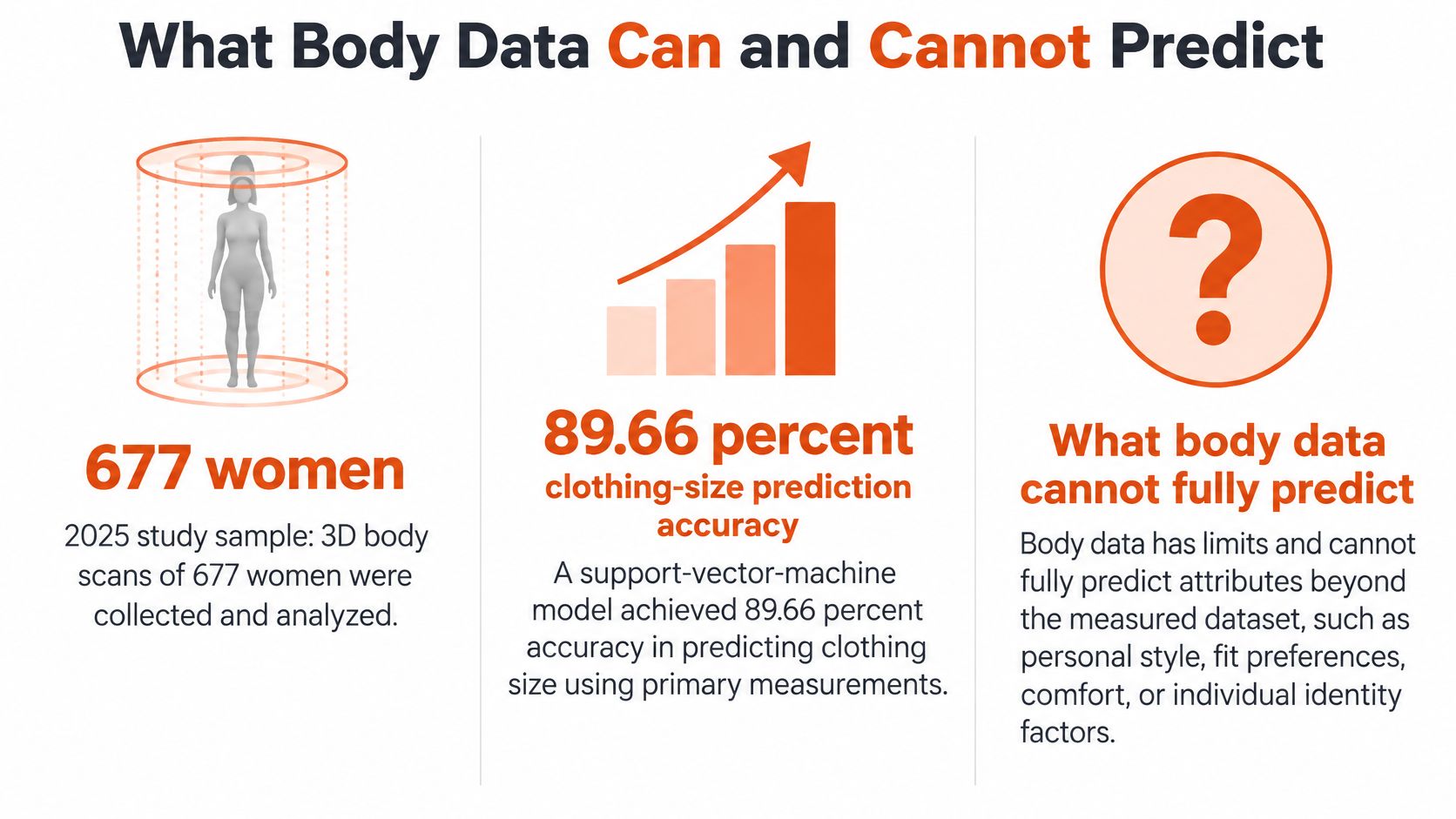
More body measurements don't automatically produce a better size recommendation. In a 2025 study using 3D body-scan data from 677 women, a support-vector-machine model using primary measurements achieved 89.66% clothing-size prediction accuracy. A principal-component-analysis/SVM model using a broader reduced feature set reached 68.97%. The 2025 study of body measurements and clothing-size prediction also reported that 35.45% of participants didn't fit any single predefined sizing category.
Use relevant inputs, not measurements for their own sake
The lesson isn't to collect every possible measurement. A useful recommendation starts with reliable inputs such as bust, waist, hip, and height, then relates them to the way a particular brand grades a particular garment. If the product's chart doesn't use a measurement, asking shoppers to provide it may add effort without improving the recommendation.
A static chart maps measurements to a label, but it can't explain what happens when someone sits between sizes or falls outside the chart's assumptions. A garment-specific recommendation can give a more useful rationale: the bust is the constraint, for example, and the next size may be looser at the waist or tighter at the hip. That explanation helps the shopper weigh fit rather than treating the label as a definitive answer.
The same body inputs may point to a medium knit and a large woven blazer. A knit can stretch and may be cut with less room; a blazer needs room through the chest and shoulders to allow movement and layering. The shopper hasn't changed size. The garments have different construction and ease.
Height can help estimate whether a garment's proportions may suit someone, but it shouldn't outweigh circumference measurements when the fit-critical area is the bust, waist, or hip. Body data can guide a recommendation; it can't guarantee that every pattern suits every body. A virtual preview, such as guidance on choosing a bathing suit for back fit, can give shoppers another way to assess how a garment may sit, but the product's cut still matters.
A model can only recommend among the sizes and shapes a brand makes. If a pattern was scaled up from a block that doesn't match the shopper's proportions, a prediction can identify the closest available size, but it can't correct the pattern itself.
Best Practices for Brands and Product Pages
A size range tells shoppers which labels a brand sells. It doesn't tell them whether those garments were developed to fit the people those labels are meant to include. Inclusivity is a matter of fit, construction, and representation, not only the largest number on a size chart.
Vogue Business's Autumn/Winter 2025 analysis of 8,703 runway looks found that 97.7% were straight-size, 2% were mid-size, and 0.3% were plus-size. Only 12 of 198 shows included any plus-size models. In the same report, 38% of surveyed consumers said they often return clothing because it is ill-fitting. Those findings show why listing more sizes doesn't solve fit problems. Vogue Business's size-inclusivity report also notes that plus-size respondents particularly reported tops that were too tight at the shoulders, armpits, or chest.
Scaling a straight-size pattern upward can widen measurements without changing the underlying proportions. A larger bust may still sit in a pattern with a narrow shoulder or insufficient room through the armhole. Some mid-size and plus-size shoppers need a different pattern block, not just a larger number applied to the same shape.
A practical checklist for brands
When you're evaluating a brand, start with the product, not the size range headline:
- Check the size range: See which sizes the brand offers in the item you want.
- Look for proportional pattern work: Does the brand explain whether it developed or re-blocked patterns for different body shapes, rather than only scaling one pattern upward?
- Check fabric and construction: A stretch knit and a structured woven jacket won't respond to body measurements in the same way.
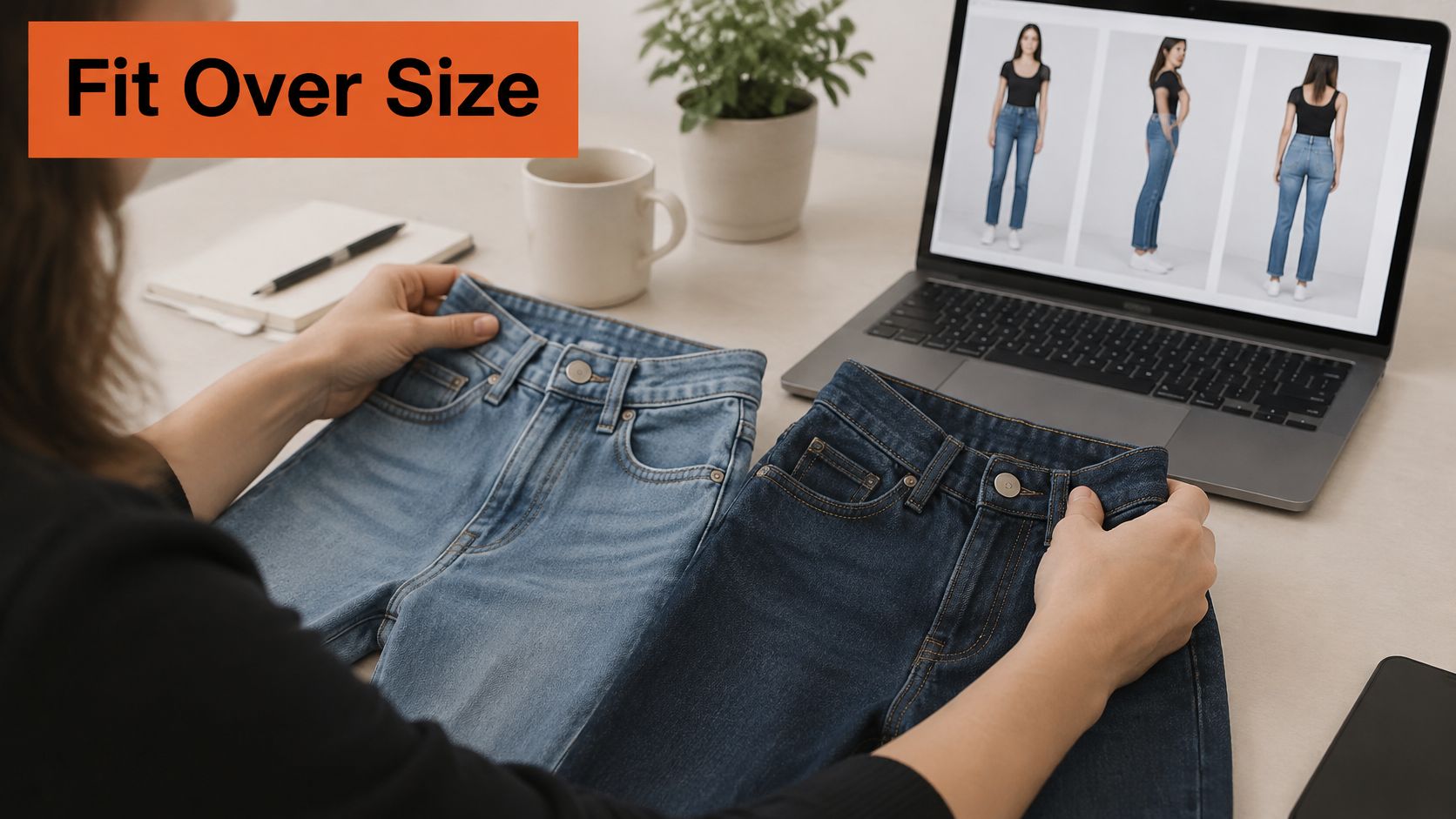
- Look at the product photography: Images showing a range of bodies and garment views give shoppers more information about drape and proportion.
A useful product page should also make fit decisions easier. It should publish finished garment measurements in centimetres and inches, and link each product to its own chart. One chart for an entire catalogue can hide differences between a close-fitting top and a relaxed coat.
Ask shoppers for information that can support a recommendation, not just the size they usually buy. For example, Robosize's fitting flow asks shoppers for their height, weight, and age, plus the closest illustration of their body proportions. A clear result should give one size for the specific garment and explain the fit reason, rather than making shoppers guess between two labels.
Product photography should help shoppers see how clothing sits on a body close to their own. A text recommendation can't show whether a shoulder seam falls in the right place or whether a jacket has the intended silhouette. Brands can also give shoppers several views of a garment and show finished measurements, so the recommendation has useful product information to work with.
Fit technology can help match shoppers to the charts a store already uses, but it can't repair a poor pattern or replace representative photography. Robosize gives one size and fit recommendation for each specific garment, matched to the retailer's own size chart. Fit confidence delivers 7% lower return rates. For retailers refining product pages, a guide to shirt fit and sizing can help frame the questions shoppers need answered before they choose.
For shoppers, the action is simpler: convert the label if you must, then trust the measurements the garment was cut for. If the product page doesn't give enough detail to compare fit, the label can't fill in the missing information.
Robosize gives online shoppers a garment-specific size and fit recommendation, using the retailer's own chart, so a familiar label doesn't have to do all the work. Visit Robosize to see how its virtual fitting room can help shoppers compare fit on a product page.