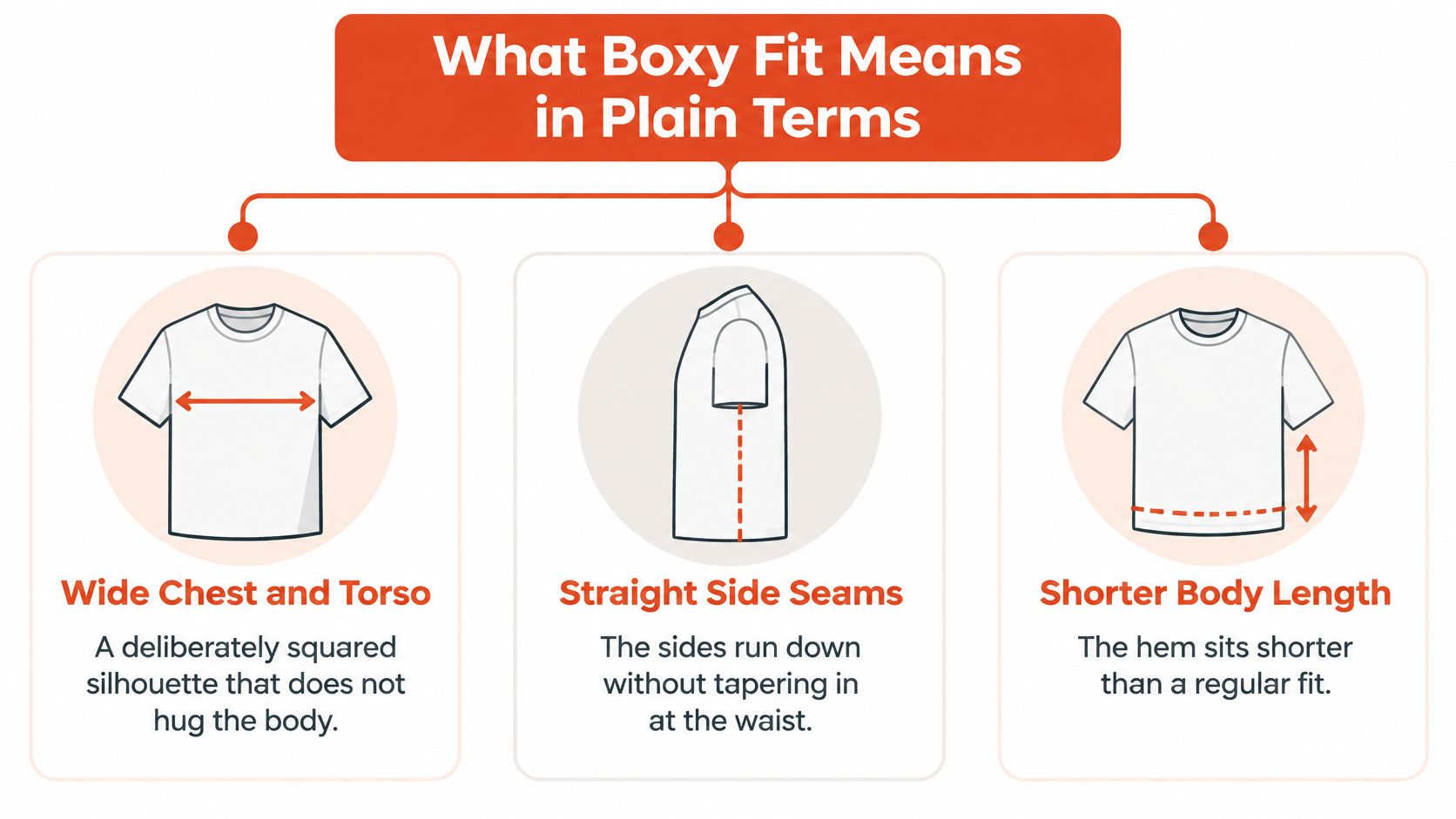
A boxy fit is a deliberately squared silhouette, with a chest that might measure 55 cm across rather than 50 cm in a regular medium, straight side seams, little waist taper and a shorter body length. It gives you horizontal room without necessarily making the whole garment bigger.
You're looking at a shirt online, and your usual size is available. But the photos show a wide body and a high hem, leaving you wondering whether to size down or trust the label. The useful question isn't whether it will fit, but where it will be roomy and where it will end.
Table of Contents
- What Boxy Fit Means in Plain Terms
- Boxy, Oversized and Regular Fits Compared
- How Boxy Fit Looks on Different Body Shapes
- Sizing a Boxy Garment Without Guessing
- Styling Boxy Fit Without Looking Shapeless
- Presenting Boxy Fit Well on Product Pages
- Confirm the Boxy Fit Before You Buy or List It
What Boxy Fit Means in Plain Terms
Think of a shipping box beside a tapered bottle. The box keeps roughly the same width from top to bottom, while the bottle changes width along its outline. A boxy garment follows the straighter outline: the fabric doesn't pull inward to trace your waist.
That doesn't mean the shirt must form a perfect square when laid flat. Boxy describes the relationship between width, shaping and length, not a requirement that every edge measure the same.
Read the outline before the size letter
Say you compare a regular medium T-shirt with a boxy medium. The Fashion-a-Holic boxy fit glossary illustrates the difference with approximately 55 cm across the chest and 66 cm from shoulder to hem for the boxy version, versus 50 cm across and 72 cm long for the regular version.
The important detail is that the measurements move in opposite directions. The boxy shirt gains width while losing length, so neither “bigger” nor “smaller” describes the whole change.
Across-the-chest measurements are taken with the garment flat. They aren't the same as the circumference of your body, and you shouldn't compare those measurements as though they were interchangeable.
Practical rule: Read boxy as a shape instruction, not a direction to buy a smaller size.
What makes the shape intentional
Look for these construction clues rather than judging looseness alone:
- Broad chest and torso: Fabric stands away from the body instead of closely outlining it.
- Straight side seams: The sides don't narrow substantially toward the waist.
- Controlled body length: The hem helps keep the wider torso from becoming a long, loose column.
- Coordinated sleeves and shoulders: Their placement and volume should support the intended outline.
You'll encounter this silhouette in cropped T-shirts, sweatshirts, jackets and contemporary streetwear. A jacket might hold the outline firmly, while a sweatshirt expresses it through softer volume.
A boxy garment can fit exactly as intended even when it doesn't touch your waist. Equally, loose fabric alone doesn't prove that a garment is boxy. When you're deciding whether to buy, use a shirt you already like as your measuring reference rather than expecting the size letter to settle the question.
Boxy, Oversized and Regular Fits Compared
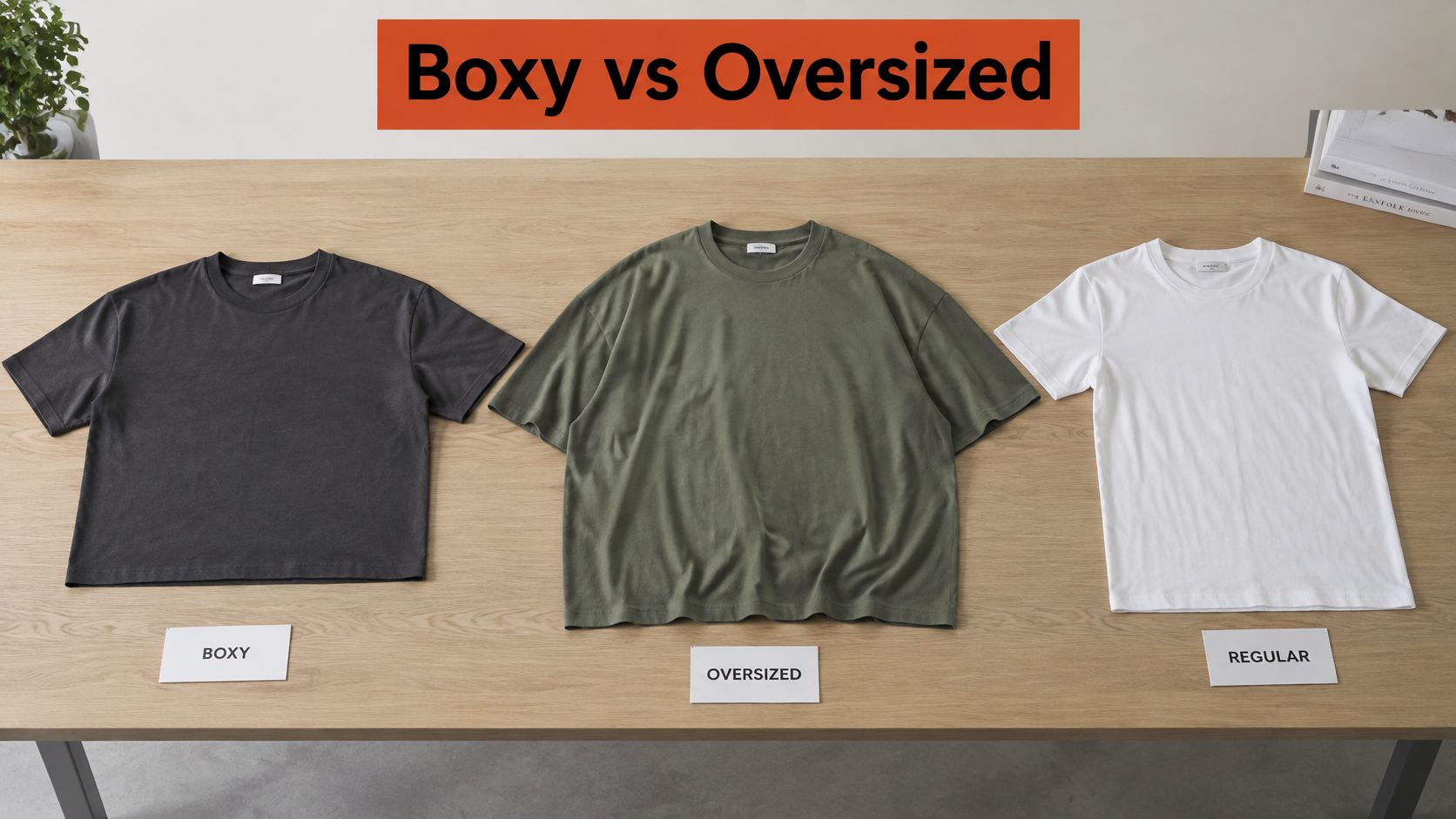
Boxy isn't the same as oversized. Boxy describes a particular arrangement of proportions; oversized generally describes additional scale across more of the garment. Regular fit offers a more conventional relationship between the wearer's body and the cut.
The distinction becomes clearer when you compare the whole shirt, rather than a single feature such as a dropped shoulder.
Regular, boxy and oversized fits on the same criteria
These are useful comparison patterns, not universal manufacturing specifications. The Team Sunday fit glossary distinguishes boxy's lateral room and limited length from oversized garments that generally add volume in several dimensions.
| Criterion | Regular | Boxy | Oversized |
|---|---|---|---|
| Torso width | Follows the body | Wide and relatively even from chest to hem | Added volume throughout |
| Waist shaping | Moderate taper | Little or none | Little or none |
| Side seams | Gently curved | Nearly straight | Straight or loose |
| Body length | Standard | Shorter | Longer, often past standard |
| Shoulders | At natural point | Often dropped | Often dropped |
| Sleeve volume | Fitted to arm without clinging | Moderate | Wide |
Shoulder placement alone won't identify the fit. Both a compact boxy shirt and a long oversized shirt can have a seam that sits down the upper arm. Look at what happens below that seam, especially through the body and at the hem.
Similarly, regular doesn't mean skin-tight. If you want the garment to grip your waist, you may be looking for a fitted or slim cut rather than regular.
Choose the result, not the adjective
Choose boxy when you want a broad, compact outline. Choose oversized when you want more enveloping volume, including additional length. Choose regular when you prefer a less exaggerated silhouette with some body shaping.
There's an in-between case that often causes confusion: a shirt can feel generously roomy while remaining quite contained vertically. Calling it loose isn't wrong, but that description misses the feature that makes it different from a larger regular shirt.
Before ordering, look for these listing details:
- Flat chest: How much horizontal space does the garment provide?
- Body length: Where is the hem likely to land?
- Shoulder drop: Where should the shoulder seam sit relative to your own shoulder?
Those measurements make the difference visible even when the product photos are styled similarly.
How Boxy Fit Looks on Different Body Shapes
The technical term behind the room inside a garment is ease, the difference between its dimensions and the corresponding body measurements. The garment-fit paper available through Semantic Scholar explains why ease and body proportions must be considered together, rather than treating chest size as a complete predictor of fit.
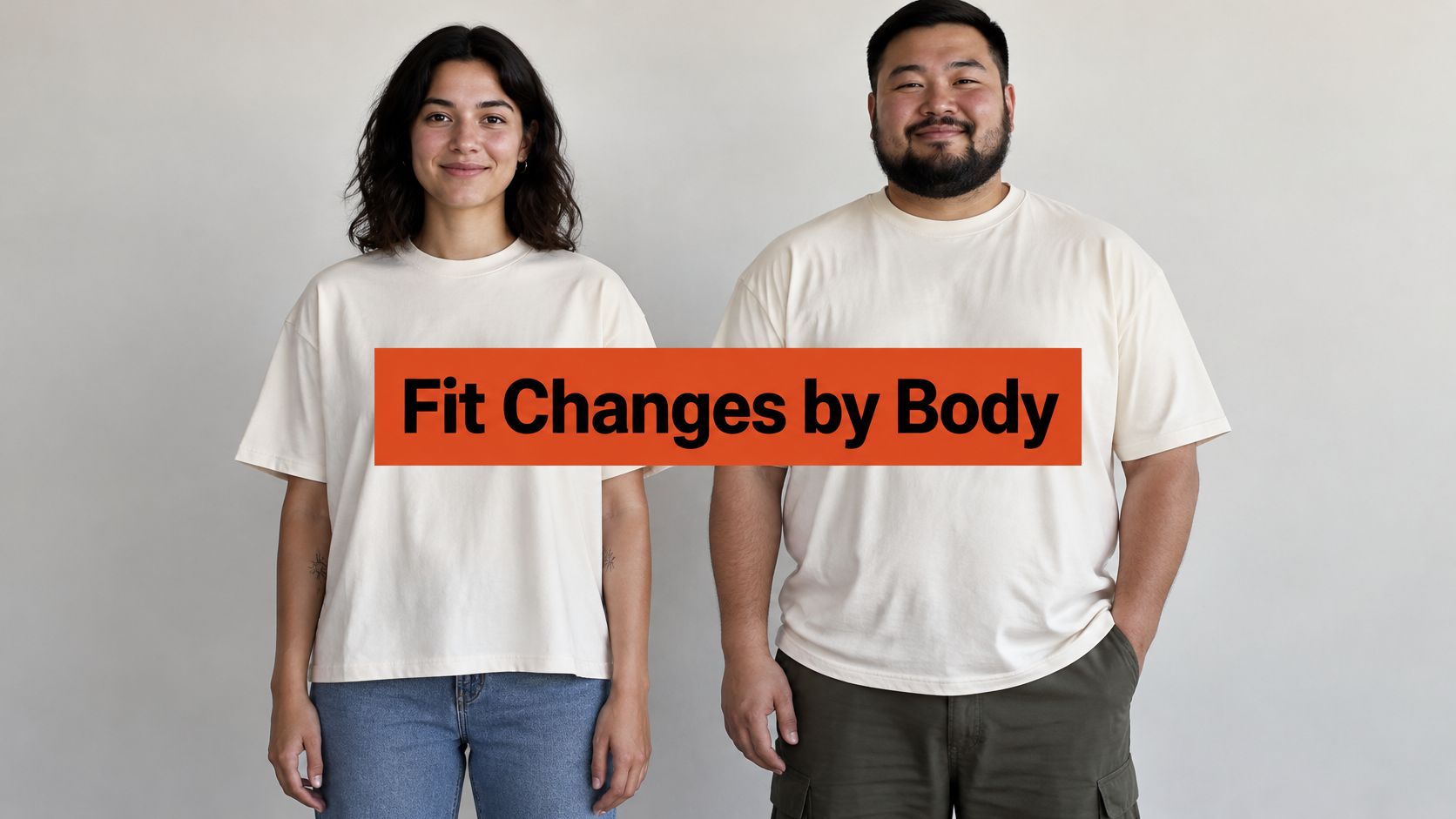
In a boxy top, room is concentrated around the chest, ribcage and upper torso without much inward waist shaping. Think of placing the same box on shelves of different depths: the box hasn't changed, but its relationship to the space has.
How boxy fit sits on common body profiles
Treat these as possible outcomes to investigate, not rules about which bodies can wear the style.
| Body profile | How boxy usually sits | What to check first |
|---|---|---|
| Shorter torso | Can read as strongly cropped in the overall outfit | Body length and hem position |
| Longer torso | Can read as merely wide, or expose more waist than wanted | Whether extra length is wanted |
| Broad shoulders | Torso roomy but sleeves may feel short | Shoulder seam and sleeve length |
| Fuller midsection | Straight shape without clinging | Hem that catches or rides up |
| Petite frame | Width can overwhelm the frame | Chest width against height |
Torso length doesn't operate alone. Trouser rise, bust projection, shoulder position and your preferred coverage all influence whether you perceive a top as cropped. Don't assume that being shorter automatically means the hem will sit higher.
For broad shoulders, follow the garment from the neckline through the sleeve. Generous torso fabric can coexist with a restrictive armhole or a sleeve that ends sooner than you'd like.
Check movement, not just the mirror
Reach forward, lift your arms and sit down during a try-on. A hem that looks comfortable while standing may lift beyond your preferred coverage, while the shoulder and armhole can pull even when the chest feels spacious.
If you have a fuller midsection, notice whether the hem clears your body or rests against it. You might enjoy the non-clinging torso but dislike having to pull the bottom edge down after moving.
Roomier through the chest doesn't automatically mean more comfortable everywhere.
Personal taste belongs in this decision too. You may deliberately want a broad outline rather than a conventionally balanced one; resources for trying a new look can help you separate unfamiliarity from an actual fit problem.
Finish by checking hem position, shoulder seam placement and sleeve length. Those visible reference points give you a more useful answer than deciding whether boxy is universally flattering.
Sizing a Boxy Garment Without Guessing
A size letter on a boxy garment describes a proportion profile, not a fixed amount of room. Chest width, shoulder drop, sleeve shape and body length shift independently, so two shirts marked M can sit wide and short in one brand and wide and long in another. The apparel sizing guidance in Amazon Seller Central's overview of separate sizing attributes points to the same lesson. Read the individual measurements for the product in front of you.
Published figures show how quickly length and width part ways. The Chinti and Parker guide to its boxy cut lists its medium at 54 cm flat chest, 52 cm hem width and 60 cm body length. For comparison, typical large T-shirt lengths reported in the RushOrderTees guide to boxy T-shirts run about 30 inches for standard and 28 to 29 inches for boxy, which shows a shorter hem paired with a squarer body.
| Garment | Flat chest | Hem width | Body length |
|---|---|---|---|
| Boxy medium garment, Chinti and Parker | 54 cm | 52 cm | 60 cm |
These are reference points from specific brands, not equivalents you can transfer. A medium from one label never equals a large from another.
Measure against a shirt you trust
Lay a shirt you like flat, smooth it without stretching, then measure straight across the chest below the armholes and from the high point of the shoulder to the hem, unless the retailer names another method. Check that the chart lists finished garment measurements rather than the body those garments are made to fit. Hold your reference shirt against your torso and note where you want the new hem to land, higher, lower or in the same place.
Broad shoulders deserve separate attention. Sleeve reach and shoulder placement decide comfort during movement, even when the chest feels generous. Learning why clothing sizes shift between cuts and brands makes that step easier, because a change in cut can change your best size without changing your body.
Choose the size that supplies your preferred width and coverage together. The difficult case is a roomy chest with a hem that catches around the middle, where sizing down often makes the catch worse. If the chart gives only a chest number, ask the merchant for flat chest, hem width and body length before you decide.
Styling Boxy Fit Without Looking Shapeless
Start with a clear relationship between the top and bottom of the outfit. You can balance a broad top with a defined or slimmer bottom, or wear a continuous, roomy outline with clean boundaries. Neither approach requires hiding the boxy shape.
The easiest test is whether you can identify where the top ends and the trousers begin. When both pieces bunch at that meeting point, adjust the hem or waistband before assuming the shirt is the wrong size.
Outfit combinations you can copy
- Cropped boxy tee with high-waisted straight trousers: Let the waistband meet the hem so the outfit has a clear horizontal break.
- Boxy sweatshirt with slim-leg jeans or neat shorts: Keep the lower half tidy when you want the sweatshirt's volume to be the main feature.
- Boxy jacket over a fitted base layer: Leave the jacket open to reveal a narrower vertical line underneath.
A front tuck can reveal a waist that the garment itself doesn't define. Tuck only enough fabric to expose the waistband, then release the sides so the shirt doesn't bunch tightly across your stomach.
Leaving the hem out is equally valid, especially for a relaxed streetwear outfit. If the top is already very short, forcing a tuck may produce pulling rather than definition.
Styling check: Keep the volume you like, then give it a visible boundary.
Let fabric and finishing details help
Structured cotton and firm jersey tend to preserve a squared outline. A very soft fabric can fall closer to the body, so the same pattern may look less architectural in wear. Choose the fabric behavior you want rather than expecting every boxy top to stand away equally.
For an uncomplicated layered outfit, make one piece the dominant wide element. Wearing broad trousers too can work, but keep the hems, neckline and layering deliberate instead of adding bulk everywhere.
Chunky shoes can visually anchor a broad top, while a structured bag adds another crisp edge. A slim belt can mark the waistband without competing with the shirt.
Try a clean crew or V neckline with dropped shoulders, then check the outfit from the front and side. Ask whether the silhouette looks chosen rather than accidental, and adjust one detail at a time.
Presenting Boxy Fit Well on Product Pages
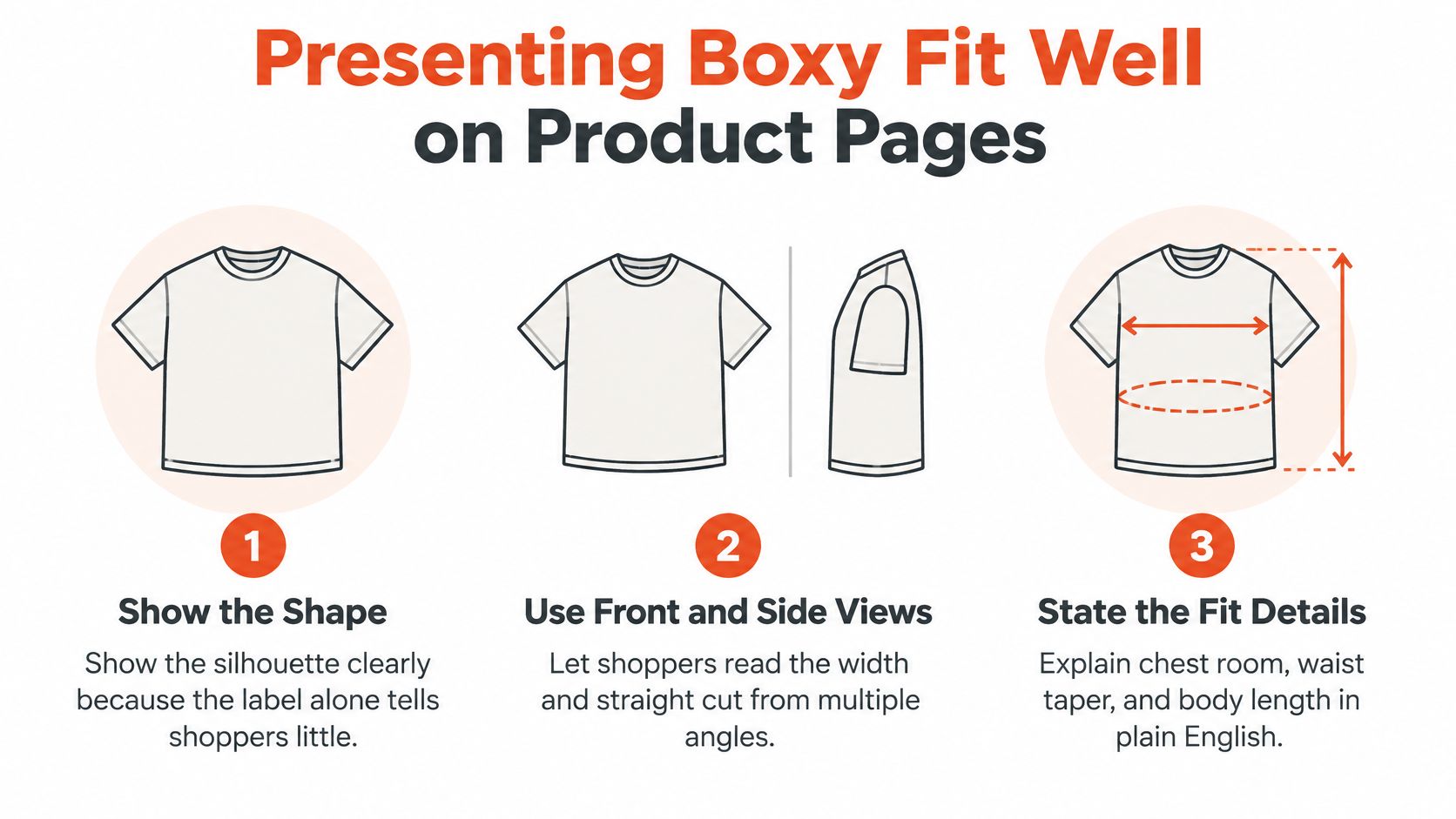
A boxy label tells shoppers too little on its own. Merchants need to show the outline, explain the intended wearing experience and supply enough information for a shopper to compare the product with clothing they own.
Place a short fit sentence near the product title. For example: Wide, straight torso with a shorter hem, designed to sit away from the waist. Add dropped shoulders only if the garment has them.
Product page elements for boxy fit
| Page element | What to include | Why it matters |
|---|---|---|
| Model photos | Different body proportions, front and back | Shows the boxy shape on real frames |
| Motion shot | Model sitting, reaching or walking | Reveals hem lift and sleeve drag |
| Fit note | Chest, shoulder drop, sleeve and length in cm and inches | Replaces the vague label boxy |
| Size recommendation | A garment-specific size with the reason | Reduces guesswork at checkout |
| Measurement chart | Flat measurements beside the size letter | Lets shoppers compare with their own shirt |
Keep each model in the same size across that model's views and disclose what they're wearing. Include side views so shoppers can inspect how the fabric stands away from the torso, not just how wide it looks head-on.
Photograph the garment untucked before showing styled variations. A front tuck, crossed arms or an open jacket can conceal exactly the information a shopper needs.
Explain recommendations and measurement methods
Don't write “size up for comfort” as a blanket instruction. Explain what changes and what trade-off the shopper should expect. A longer-torso shopper may want more coverage, but a larger size may also introduce unwanted width.
Use plain measurement labels and a small diagram showing the tape's path. Specify whether sleeve length starts at the shoulder seam or neckline, because those measurements aren't interchangeable.
A useful description combines intention with evidence: relaxed through the chest, straight at the waist, hem designed to sit near the waistband. Replace unsupported comparisons such as “shorter than regular” with actual product measurements unless you have a named reference garment.
Merchants improving how shoppers search for a shirt should keep category filters and product details consistent. Don't classify every dropped-shoulder garment as boxy.
Before publishing, ask colleagues or customers to describe the expected fit after reading the page. If one expects a long oversized shirt and another expects a cropped square, revise the wording or imagery until they're describing the same garment.
Confirm the Boxy Fit Before You Buy or List It
The answer to what does boxy fit mean becomes useful when you can translate the silhouette into a purchase decision. You're not trying to find the objectively correct amount of looseness. You're choosing a garment whose proportions match the look and coverage you want.
For shoppers, make the final decision with the product chart open beside your reference measurements. If the chest works but the length doesn't, keep looking rather than assuming a different letter will solve both.
Before you commit
- Shoppers: Confirm the hem clears your body comfortably, the sleeves reach where you want and the garment provides enough coverage in motion.
- Merchants: Audit the listing for finished garment measurements, a clear fit note and photos that reveal rather than conceal the outline.
- Merchandising teams: Keep the intended silhouette consistent across the title, filters, description and size guidance.
A recommendation tool can support that decision without replacing accurate product information. At Robosize, we give one precise size and fit recommendation for each specific garment, match products to the store's own size charts with unlimited chart uploads, and render a shopper's try-on from up to three angles in a single session.
The merchant's responsibility is still to describe what the shopper is choosing. A size recommendation answers which size to consider; clear imagery and fit notes help the shopper decide whether they want that cut at all.
Start your audit with the boxy products that have the highest return rates. Add missing flat measurements, rewrite vague fit descriptions and test the updated pages with real shoppers. Ask them where they expect the hem and shoulder seams to sit, then compare their answers with the garment's intended fit.
Robosize offers garment-specific size recommendations and virtual try-on to help shoppers assess a boxy silhouette before checkout. Visit Robosize to arrange a live demo using your store's sizing needs, and consider how clearer fit guidance could support your boxy product listings.