In 2024, 77.08% of in-store clothing shoppers believed physical stores offered higher quality, while only 53.85% of online clothing shoppers said the same about buying online, according to 2 Visions' 2024 survey of 2,411 U.S. shoppers. That 23-point confidence gap sits at the center of the virtual vs actual debate in apparel retail. Shoppers don't doubt whether ecommerce websites can display a sharp photo of a jacket or dress. They doubt whether the garment inside the shipping box will look, feel, and fit the way the screen promised.
Most product-page investments try to close that gap with prettier visuals. That instinct often misfires. A photorealistic render is an appearance preview, not a fit prediction, and treating the two as interchangeable can raise returns rather than lower them. When a render looks convincing enough to quiet a shopper's hesitation without backing up the image with garment-specific sizing and fabric-behavior data, the fitting room moves to the customer's bedroom after delivery.
Table of Contents
- The Short Answer on Virtual vs Actual Try-On
- Virtual and In-Person Try-On Side by Side
- What Return Rates Reveal About Fit Confidence
- How Reliable Size Recommendations Really Are
- What Virtual Try-On Still Cannot Show
- Privacy and Trust in the Virtual Fitting Room
- Which Fitting Experience to Use and When
The Short Answer on Virtual vs Actual Try-On
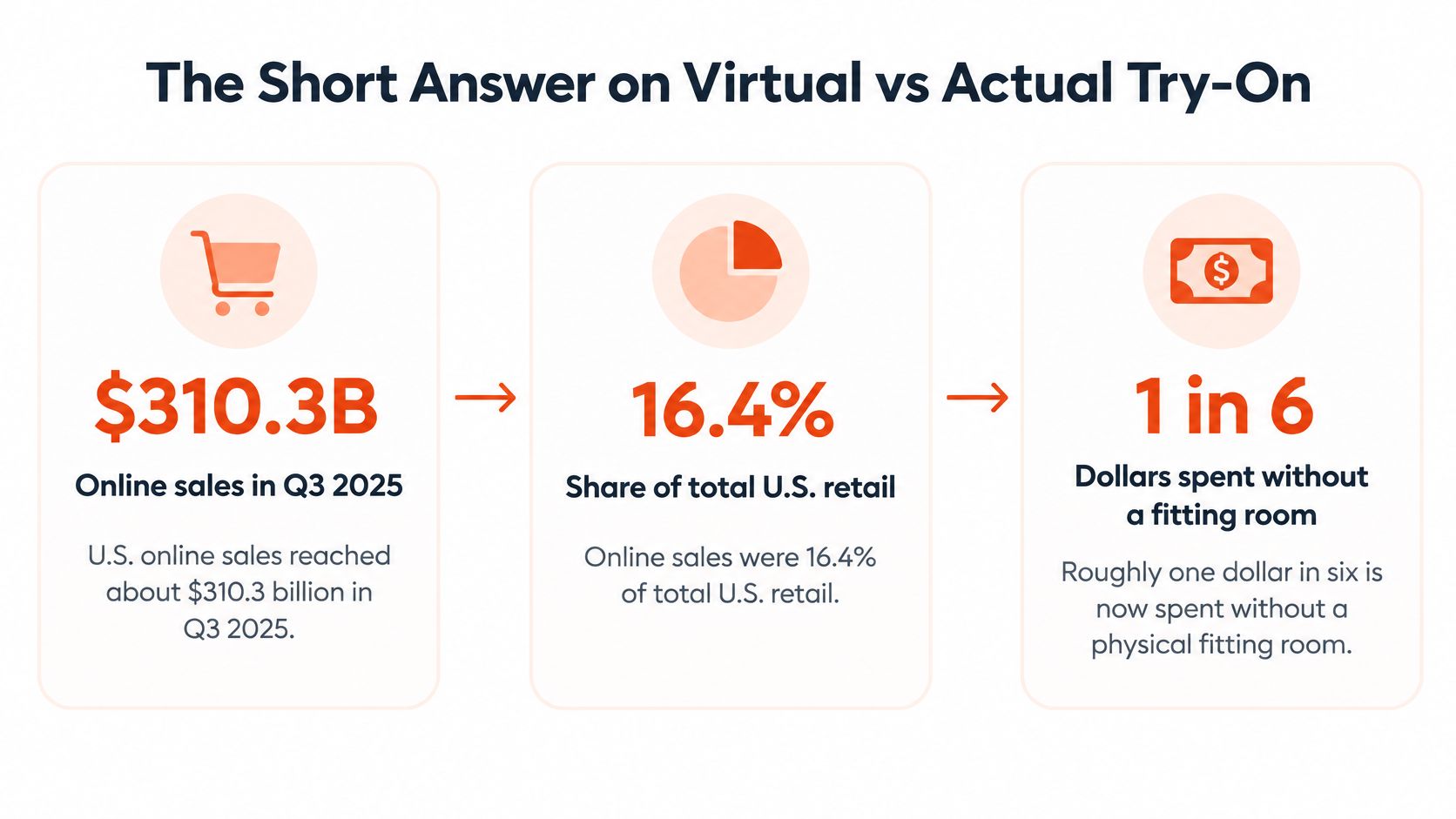
Virtual shopping is no longer a side channel for clothing brands. Official U.S. Census Bureau retail e-commerce figures show that online sales reached approximately $310.3 billion in the third quarter of 2025, representing 16.4% of total U.S. retail sales, up steadily from 16.1% in Q1 and 16.3% in Q2 of 2025. Roughly one dollar in every six spent by U.S. consumers now changes hands without a physical fitting room, turning digital fit confidence into an everyday margin question for apparel operators.
The short verdict on virtual vs actual try-on breaks cleanly into two halves. Virtual try-on is now reliable enough to replace an in-person try-on when you need to judge silhouette, color harmony, proportion, and probable size. It still can't replace a physical fitting room when fabric hand-feel, stretch under tension, localized pressure points, or movement comfort decide whether you keep the item.
Two Outputs Shoppers Should Never Confuse
Most frustration with online fitting rooms starts when buyers and merchandising teams lump two separate digital tools under one label. Evaluating a product page accurately requires keeping them apart:
- Appearance preview: A rendered image showing how a garment drapes visually over an approximated body shape, useful for judging hem length, neckline balance, and color contrast.
- Size recommendation: A garment-specific numeric or lettered size calculated from body dimensions and pattern specs, useful for picking between a Medium and a Large before checkout.
A crisp render doesn't prove a waistband won't pinch, and an accurate size tag doesn't prove you'll like where a blazer hits your hip. Because each garment category leans differently on silhouette versus physical tension, the right fitting method always depends on the piece in question. The side-by-side matrix below breaks down exactly where each experience holds the advantage.
Virtual and In-Person Try-On Side by Side
Comparing digital fitting rooms with brick-and-mortar cubicles works best across specific operational criteria rather than broad generalizations. Every row in the table reflects a real trade-off for either the buyer standing on the product page or the retailer absorbing the aftermath.
| Criterion | Virtual try-on | In-person fitting | Edge |
|---|---|---|---|
| Fit confidence | Garment-specific size recommendation with a confidence level; probabilistic | Size settled immediately by wearing the garment | In person, but narrowing |
| Fabric hand-feel and weight | Not rendered; must be inferred from product copy or fabric attributes | Direct touch and weight in hand | In person |
| Drape and movement | Static multi-angle render; posture and motion limited | Walk, sit, raise arms, see how it moves | In person |
| Stretch and pressure points | Not measured; depends on garment data supplied | Felt directly on the body | In person |
| Convenience and time | Seconds to a few minutes, no trip or queue | Travel, queue, fitting-room availability | Virtual |
| Privacy and data | Height, weight, age, shape and optional selfie collected | No body data retained by a system | In person |
| Shopper cost of being wrong | Return shipping, waiting, refund cycle | Exchange at the counter | In person |
| Retailer cost of being wrong | Return handling, restocking, inventory drag | Staff time, but item stays in stock | In person |
Three rows drive almost every real-world outcome in apparel commerce. Convenience belongs outright to the browser: checking proportions across five colors takes under a minute on a phone, with no parking lot or fitting-room line. Fabric behavior belongs outright to the store, because no screen communicates wool scratchiness, linen stiffness, or how tightly a denim thigh grips when you sit down.
The fit-confidence row is where analysts get fooled. A sharper render improves the appearance preview, and shoppers read that visual polish as fit proof. Confidence rises, conversion rises, and then the parcel arrives. If the size recommendation underneath the render is weak, the more convincing preview pushes more units into the returns pipeline, because buyers order with conviction instead of hesitation. The render earns the click. The size data earns the keep.
Core trade-off: Virtual try-on closes the appearance gap far faster than it closes the physical fit gap.
The cost-of-being-wrong rows explain why this matters commercially. Industry reporting consistently shows apparel ordered online coming back at a multiple of the in-store return rate, because fit evaluation shifts from before payment to after delivery. In a store, a wrong size costs an exchange at the counter. Online, the same mistake triggers reverse shipping on the shopper's side and inspection labor, restocking, and weeks of trapped inventory on the retailer's side.
A shopper who misses on size in a store hands the garment back to an associate; a shopper who misses online triggers reverse shipping, inspection labor, and weeks of trapped inventory.
Structured categories make the narrowing fit-confidence row concrete. Running numbers through a suit size calculator based on height and weight gets a buyer close on jacket chest and length in seconds, yet physical shoulder-pad structure still benefits from an in-person check. Don't read this table as a scoreboard where the higher tally wins. Pick the single row that governs your product category, whether that is drape for eveningwear or pressure points for fitted denim, and let that row make the call.
What Return Rates Reveal About Fit Confidence
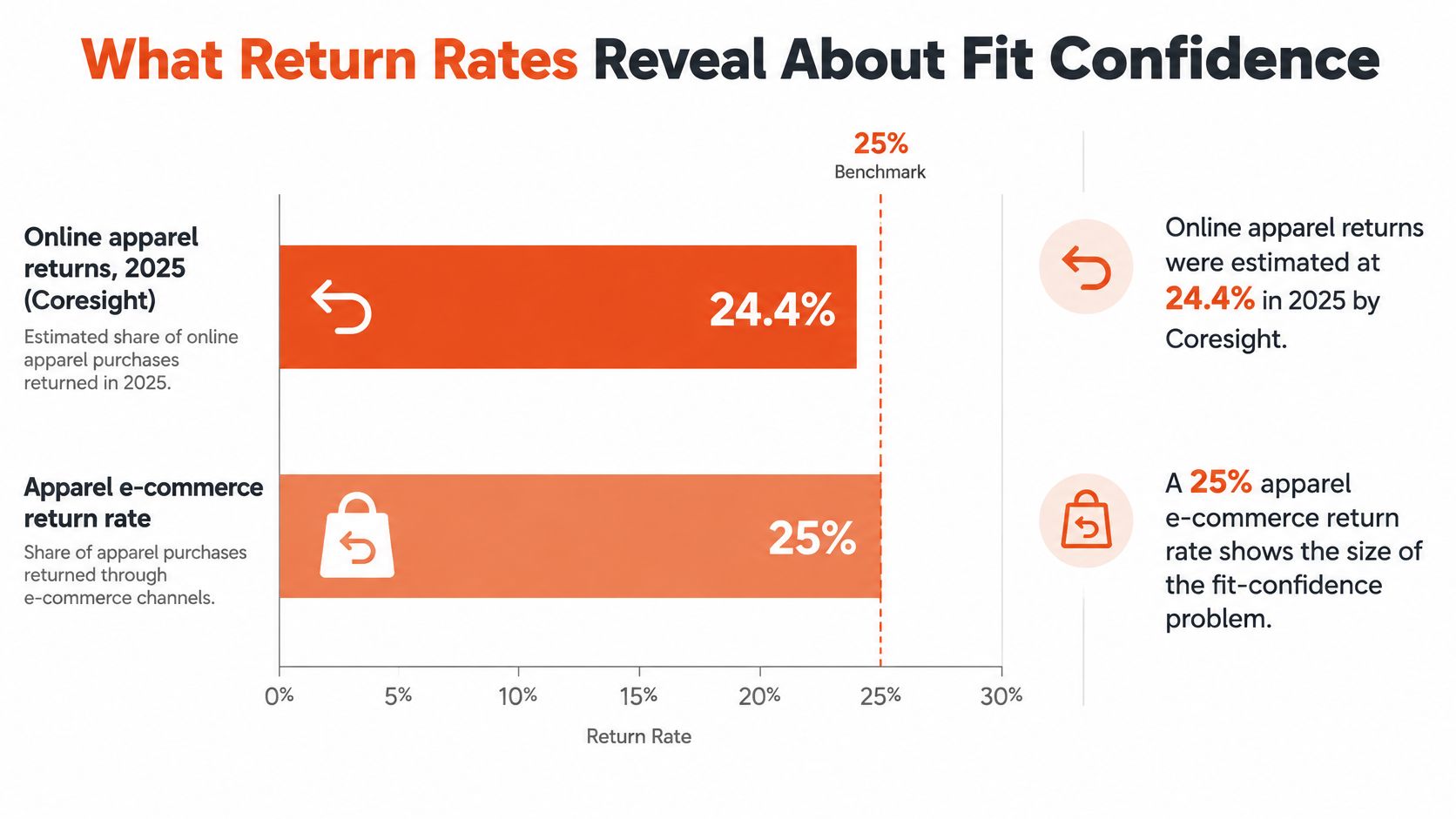
Channel-level return benchmarks reveal how expensive pre-purchase uncertainty becomes at scale. Across U.S. retail overall, 19.3% of online retail sales were expected to be returned in 2025, compared with 15.8% across all retail sales, according to National Retail Federation and Happy Returns estimates. Apparel sits well above those all-category averages because sizing varies widely across brands, cuts, and fabrics.
In 2025, U.S. online apparel returns were estimated at 24.4%, according to Coresight Research figures published by SizeMarker. That tracks closely with McKinsey's returns-management research, which reported a 25% return rate for apparel purchased through e-commerce channels versus 20% across retail overall. Put plainly, roughly one in every four garments ordered online comes back to the warehouse.
| Measure | Online | Comparison | Year | Source |
|---|---|---|---|---|
| Apparel return rate | 22% | 6.2% in stores | 2024 | ICSC |
| Apparel e-commerce return rate | 25% | 20% across all retail | Reported | McKinsey |
| U.S. online apparel returns | 24.4% | Online apparel only | 2025 | Coresight Research |
| U.S. online retail returns | 19.3% | 15.8% across all retail sales | 2025 | NRF and Happy Returns |
| Apparel returns caused by fit or style | ~70% | Remaining return causes | Reported | McKinsey |
Why Fit Dominates Reverse Logistics
The headline return percentage only tells half the story. In McKinsey's survey, respondents attributed approximately 70% of apparel returns to poor fit or style. That figure reframes the entire operational challenge for online clothing brands.
Shoppers aren't sending a quarter of their orders back because they hate fashion or regret clicking buy. They send items back because the product page didn't tell them how a specific cut would sit on their specific body before checkout. Written copy like "relaxed silhouette" and flat measurement charts leave too much guesswork, forcing buyers to order two sizes and treat the return label as a substitute fitting room.
Perception compounds the measurement problem. Shoppers already assume brick-and-mortar racks carry more reliable quality than digital catalogs, so any mismatch between expectation and reality feels worse when the parcel opens. That is why tools focused strictly on post-purchase logistics only treat the symptom. Reducing pre-purchase uncertainty attacks the dominant driver of apparel returns, while cosmetic visuals that leave fit questions unanswered rarely move the needle.
How Reliable Size Recommendations Really Are
Honest size-tech evaluation starts by looking at measurement error ceilings rather than vendor marketing claims. In a peer-reviewed 3D body-scan anthropometric study in Machine Vision and Applications, mean absolute errors ranged from 2.5 mm to 16.0 mm depending on the body dimension. Successful automated extraction rates varied even more sharply, spanning 28% to 93% for male subjects and 24% to 82% for female subjects.
Those spreads explain why virtual sizing feels remarkably accurate on some garments and inconsistent on others. Clear landmarks and circumferences, such as chest or waist on an upright torso, extract cleanly. Dimensions vulnerable to posture shifts, limb occlusion, clothing bulk, or ambiguous anatomical boundaries carry far more noise.
Why Fewer Inputs Often Outperform Larger Models
Adding more body variables doesn't automatically yield a sharper size pick. A Scientific Reports machine-learning sizing study found that a support-vector-machine (SVM) model trained on primary anthropometric measurements reached 89.66% accuracy, outperforming a principal-component-analysis SVM incorporating extra dimensions at 68.97%. Noisy secondary features dilute pattern matching rather than strengthening it.
Whether you're evaluating a sizing widget for your storefront or trusting one as a shopper, test it against three practical criteria:
- Prioritize pattern-driving dimensions. The recommender should weight the measurements that govern the garment's cut (chest, waist, hip, inseam, and shoulder breadth) rather than treating every estimated landmark equally. Understanding how garment measurements vs body measurements differ prevents a system from matching a 38-inch chest to a 38-inch shirt with zero wearing ease.
- Validate separately by brand, category, and size range. Grading rules never transfer cleanly across labels. Even commodity unisex tees vary enough by mill and cut that apparel decorators rely on dedicated guides for sizing blanks before DTF placement rather than trusting a generic Large tag across suppliers.
- Measure real purchase outcomes, not offline scores. Predicting a garment's labeled size in a lab dataset doesn't prove the piece felt comfortable on a living shopper. Strong validation tracks size-related return rates, exchange frequency, replacement sizes chosen, and post-purchase feedback on tightness or looseness.
What a Practical On-Page Flow Looks Like
Modern on-page fitting tools balance accuracy with low friction by pairing a brief questionnaire (height, weight, age, and body shape) with optional visual input. In our workflow, a real-time selfie from the shopper's phone or webcam completes their body model, or the shopper can pick a model, and Robosize gives one precise size and fit recommendation for each specific garment directly on the product page.
Even a well-calibrated model shouldn't pretend to be certain on every edge case. When a shopper sits directly between sizes, enters conflicting numbers, or views a rigid woven cut with tight tolerances, the interface should surface a clear confidence indicator and fall back to a tape-measured garment chart. Admitting borderline uncertainty keeps buyers from blaming the brand when a cuff runs snug.
What Virtual Try-On Still Cannot Show
A common assumption in ecommerce merchandising is that sharper graphics automatically slash return rates. Survey evidence points to a more complicated reality. According to 2025 reporting cited in Style3D's analysis of virtual try-on in activewear, size and fit ranked as the leading reason for online apparel returns for 53% of respondents, while 59% of online shoppers were dissatisfied when an item looked different on their body than expected.
Those two figures expose a counterintuitive trap. When a photorealistic render smooths away fabric tension, masks stiff collars, and holds a flattering static pose, it can generate false confidence. Shoppers read the clean image as proof of physical fit, buy without checking garment specs, and return the parcel the moment they pull the fabric over their shoulders. The preview did its job too well: it answered how the garment looks while the shopper assumed it answered how the garment fits. Those are separate questions, and only one of them is visual.
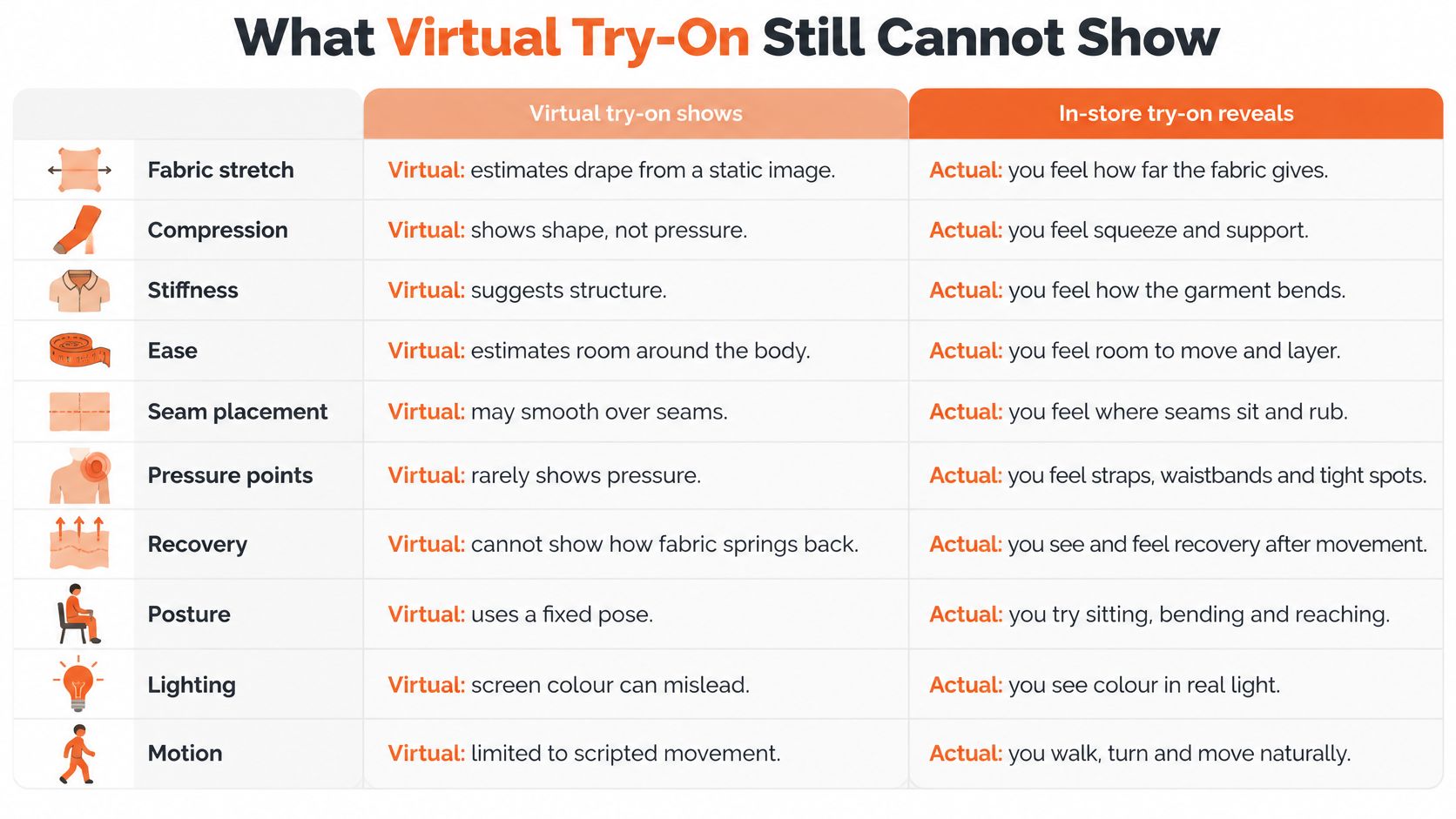
Before choosing between a virtual preview and a trip to the store, review the physical behaviors that screens still approximate rather than measure, category by category.
Where Category Physics Breaks the Render
Not every garment suffers equally from visual limits. A boxy cotton graphic tee behaves much closer to its digital silhouette than a high-support sports bra or raw selvedge jeans.
Activewear and compression pieces rely almost entirely on tension, elastane recovery, and support under motion. A render displays legging length and color-blocking cleanly, yet it can't tell you whether a waistband rolls down during squats or whether seams chafe across the shoulder blades.
Rigid denim lives or dies on stiffness, weave weight, and how much the cotton gives after three wears. Two pairs of jeans with identical hip outlines on screen feel completely different when one carries 14-ounce zero-stretch twill and the other blends elastane for seated ease.
Swimwear combines high stretch with wet-fabric behavior and coverage during movement. A static pose shows strap styling and cut height, while missing whether leg openings gape or dig in once you dive or walk.
Structured tailoring depends on internal canvas stiffness, armhole pitch, shoulder-seam placement, and intended ease across the upper back. Virtual rendering shows lapel proportion and jacket length well, yet only lifting your arms in person reveals whether the sleeves pull across the lats.
Knitwear adds a subtler twist: yarn weight and rib recovery determine how a crewneck holds its shape over a shirt collar and whether heavy sleeves drag downward by midday. Screens flatten that tactile weight into pixels.
The pattern across all five categories is the same. What breaks the render is never color, proportion, or length. It is force: how fabric pushes back against the body, recovers after stress, and shifts under motion. Appearance is a snapshot, while fit is a behavior over time.
The short clip below illustrates why textile physics, stretch, and lighting interact so differently on screen than on a moving body.
The question every product page should answer: "How closely will this preview match the physical garment, and what can it not predict?"
Answering that question transparently turns an appearance preview into a trustworthy decision aid, and it explains why a more realistic render can raise returns rather than lower them: realism amplifies whatever confidence the shopper already has, including confidence the data never earned. The corrective is pairing visual output with the measurements that carry fit. Retailers should present renders from multiple angles alongside explicit garment-behavior tags covering stretch rating, compression level, intended ease, model measurements, and likely pressure points, so the size recommendation and fabric data carry the weight that pixels alone cannot.
Privacy and Trust in the Virtual Fitting Room
Accuracy isn't the only hurdle keeping shoppers from clicking the virtual try-on button. Trust is just as decisive, and most retail teams treat privacy as a buried footer link instead of a core UX barrier.
As highlighted in Kodif's apparel and footwear returns report, AI virtual try-on asks for more sensitive personal details than standard online shopping, including body measurements, facial images, physical characteristics, clothing preferences, and behavioral data. That analysis also notes that deeper personalization heightens users' awareness of data collection and privacy risk.
This creates a real personalization paradox for ecommerce UX teams. The more customized and lifelike you make the fitting room, the more intrusive it can feel to a first-time visitor. Even when uploading a selfie is optional, shoppers know the widget is still constructing a body profile from their height, weight, age, and shape selections.
Five Disclosures That Earn Shopper Adoption
In-person fitting rooms hold one quiet structural advantage in the virtual vs actual contest: stepping behind a curtain with three pairs of trousers stores zero biometric data in any server. Virtual tools have to earn that trade-off with clear, upfront answers right next to the upload button.
- Storage scope and retention window: State plainly what data leaves the browser, whether photos stay only for the active session, and the exact timeline for automatic deletion.
- Model-training boundaries: Disclose upfront whether a shopper's selfie or body profile stays strictly tied to the current shopping session or gets reused to train future AI models.
- Visible deletion controls: Give users a simple, self-serve way to wipe their profile or image without hunting through a privacy policy or emailing customer support.
- A useful non-selfie path: Let camera-shy buyers preview garments on a representative body model driven by minimal questionnaire fields rather than gating the tool behind a face upload.
- Plain-English sizing logic: Explain briefly why the tool picked a specific size (for example, matching hip circumference to the garment's graded ease) so the output feels like a helpful fitter rather than an opaque black box.
Retailers who track drop-off rates between selfie prompts and model-selection paths quickly discover how much privacy friction costs conversion. Designing for minimal data collection and explicit consent before rendering builds far more durable shopper trust than chasing marginally sharper image realism alone.
Which Fitting Experience to Use and When
Neither channel wins across every wardrobe purchase. Treating virtual and physical try-on as complementary filters saves time for buyers and protects gross margin for brands.
When Shoppers Should Choose Virtual or In-Person
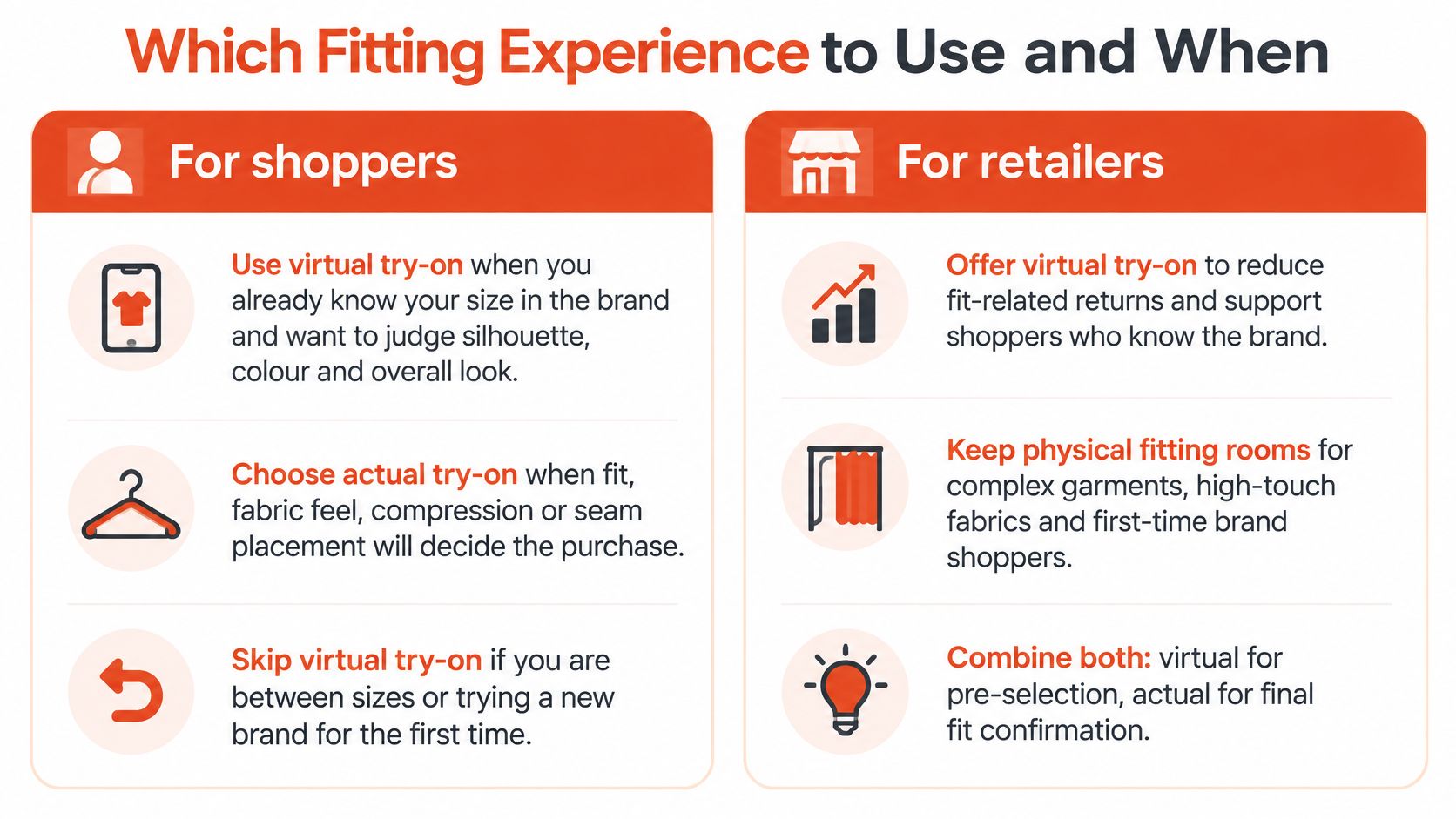
Use virtual try-on when you already know how a brand's sizing runs on your frame and want to test a new silhouette, colorway, or hemline without spending an afternoon at the mall. It also makes sense for relaxed-fit staples, knit basics, and repeat reorders where fabric stretch and drape are predictable.
Choose an actual store visit when the garment's comfort hinges on physical tension or hand-feel (compression activewear, swimwear, structured blazers, or heavy non-stretch denim). Walk into a fitting room as well whenever you're trying an unfamiliar brand for the first time, sitting squarely between two sizes, or buying a high-ticket piece where return shipping and refund delays create unnecessary hassle.
How Retailers Combine Both Outputs
For ecommerce operators, the strategic choice isn't virtual versus physical stores. The central question is which combination of outputs belongs on the product page to eliminate avoidable bracketing orders. Pair a garment-specific size recommendation with multi-angle visual try-on and clear fabric-behavior notes, then audit performance against actual size-related returns and exchange patterns rather than vanity click metrics. Teams weighing competing software approaches, such as comparing a Fit Hybrid review against dedicated AI fitting platforms, should look closely at how cleanly each tool links size charts to individual SKUs without slowing page load.
Roll out virtual fitting systematically instead of flipping it on across an entire catalog overnight:
- Audit your top return reasons by SKU. Separate fit-driven returns (too tight, too loose, wrong length) from style or quality complaints so you know where sizing friction hurts margin most.
- Select the highest-impact categories. Start with repeatable, high-volume product lines where shoppers struggle to picture proportion or pick between adjacent sizes.
- Run a controlled category trial. Deploy virtual try-on and per-garment sizing on those priority product pages alongside clear stretch and ease attributes.
- Measure against a clean control group. Track return rate, exchange size distribution, and conversion over a full return window before expanding catalog-wide.
Robosize is an AI virtual fitting room and virtual try-on for online clothing stores that installs via a one-click Shopify app or a lightweight JavaScript snippet for custom storefronts. Our Basic plan includes 50 try-on sessions per month and 1 try-on image per product, giving merchandising teams an accessible way to validate impact on priority SKUs before scaling. To get a demo, a store tells us about its catalog and we walk the team through a live demo of the Robosize fitting room on its own products.
Pairing garment-specific size recommendations with photorealistic multi-angle previews turns product pages into clearer decision tools without overpromising what a screen can measure. We build AI fitting rooms that adapt to your exact size charts, offer shoppers both selfie and model-based previews, and drop directly into Shopify or custom ecommerce stacks. Visit Robosize to see how our virtual fitting room performs on your own catalog.