The assumption that every body scanner online tool delivers the same outcome is the first buying mistake. Some products create a visual preview, some estimate measurements, some recommend a garment size from shopper and product data, and others support uniforms, manufacturing, or made-to-measure workflows. Those are different retail problems, with different inputs, implementation requirements, and accuracy dependencies.
The category has moved well beyond a novelty feature. One market estimate values virtual fitting rooms and online body scanners at USD 9.81 billion in 2026, with a projection of USD 23.94 billion by 2031. That growth matters, but market size doesn't tell a retailer which tool to choose. The useful comparison is operational: what must shoppers provide, how does the system produce a recommendation, what product data must the retailer maintain, how transparent is pricing, and what happens when devices, garments, or body shapes vary?
The list below separates photorealistic try-on, measurement capture, data-driven sizing, and enterprise outfitting. It also considers deployment effort, integration paths, privacy expectations, and the difference between a compelling preview and a reliable size recommendation. For more AI-assisted comparison formats, see generate listicles with AI.
Table of Contents
- 1. Robosize
- 2. 3DLOOK
- 3. Bold Metrics
- 4. True Fit
- 5. Naiz Fit
- 6. Sizer
- 7. MySizeID
- 8. Fit:match
- 9. Size Stream
- 10. Bodi.Me
- Top 10 Online Body Scanner Tools Comparison
- Choose by Capture Method, Fit Goal, and Rollout
1. Robosize
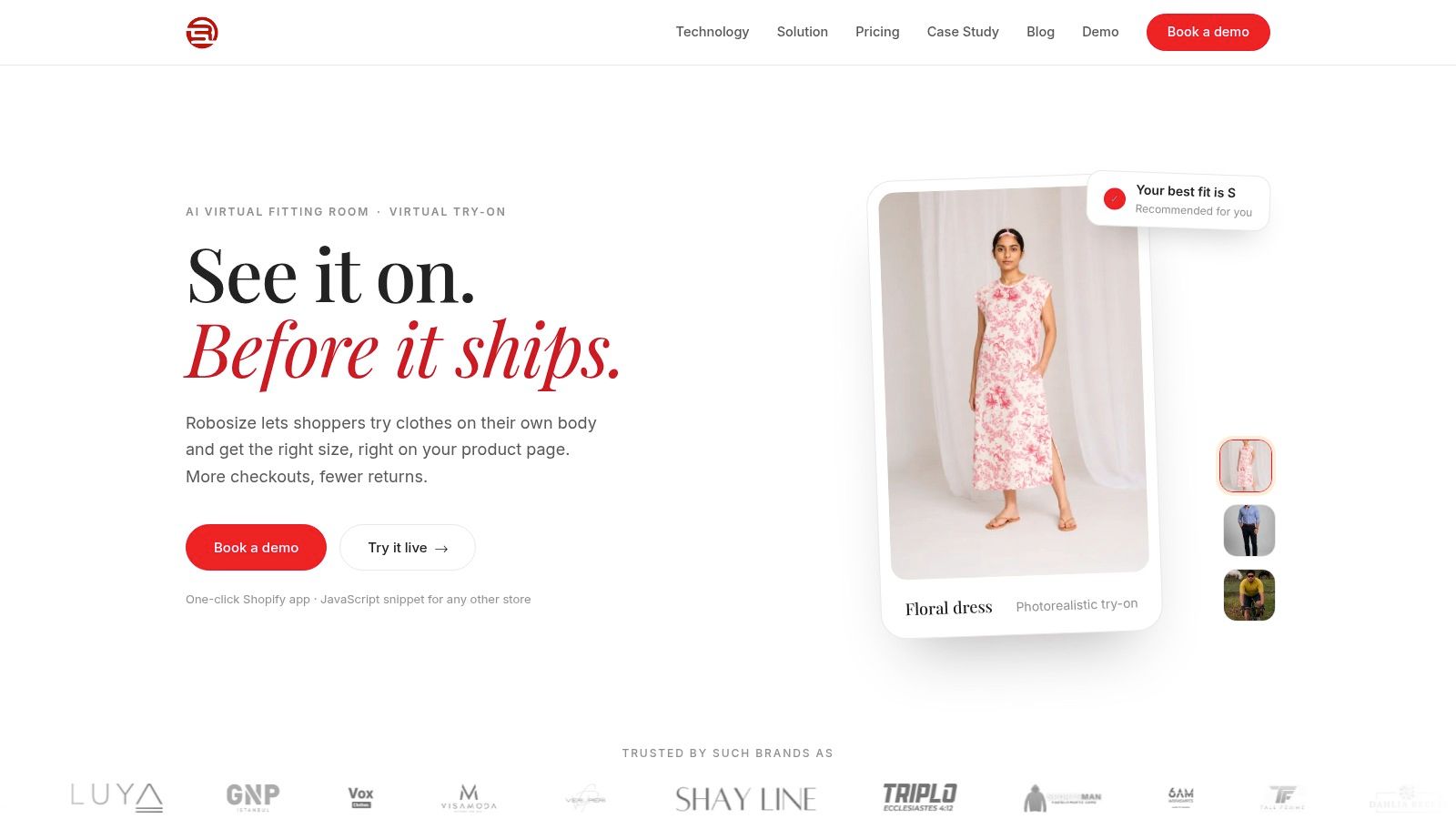
Robosize is the strongest option for apparel retailers that want to combine on-page visualization with garment-specific sizing. Rather than asking shoppers to interpret a static chart, the platform collects a short set of inputs such as height, weight, age, and body shape. Shoppers can also use an optional selfie or select a model, allowing Robosize to create a shopper-specific body model and render the garment on it.
That combination addresses two separate forms of uncertainty. The shopper can see how the item may look, while the retailer can show a recommended size for the specific product rather than offering a generic size label. Multi-angle rendering is available on supported plans, and the experience is designed for mobile shopping and phone-based camera input.
Why the operating model stands out
Robosize uses a low-friction storefront flow. Shopify merchants can install the app, while other ecommerce platforms can use a JavaScript snippet. Merchants can upload size charts, match them to products, handle metric and imperial units, and review fitting-room and recommendation analytics. Optional features include social proof for similar body profiles and recommendations for additional products likely to fit the shopper.
The platform's public materials include reported case-study outcomes of +17% conversion, +24% average order value, and -7% returns. Those are reported examples, not universal benchmarks, so retailers should validate them against their own categories, imagery, traffic, and return policies.
Practical rule: Treat the visualization and the size recommendation as separate outputs. A convincing render doesn't automatically prove that the recommended size is correct.
Accuracy depends on the quality of shopper input, the garment's size chart, and the available product imagery. A selfie-based experience may also require clear privacy communication, while model selection offers an alternative for shoppers who don't want to submit a photo. Pricing is plan-based, with session allowances, overage pricing, and configurable caps. Public flat-rate pricing isn't listed, so a buyer should confirm which plans include multi-angle rendering, customization, analytics, and usage controls.
Robosize is a practical fit for Shopify apparel brands, direct-to-consumer stores, sportswear retailers, and custom storefronts that want size guidance and visual reassurance in the same product-page flow. Visit Robosize for the platform details.
2. 3DLOOK
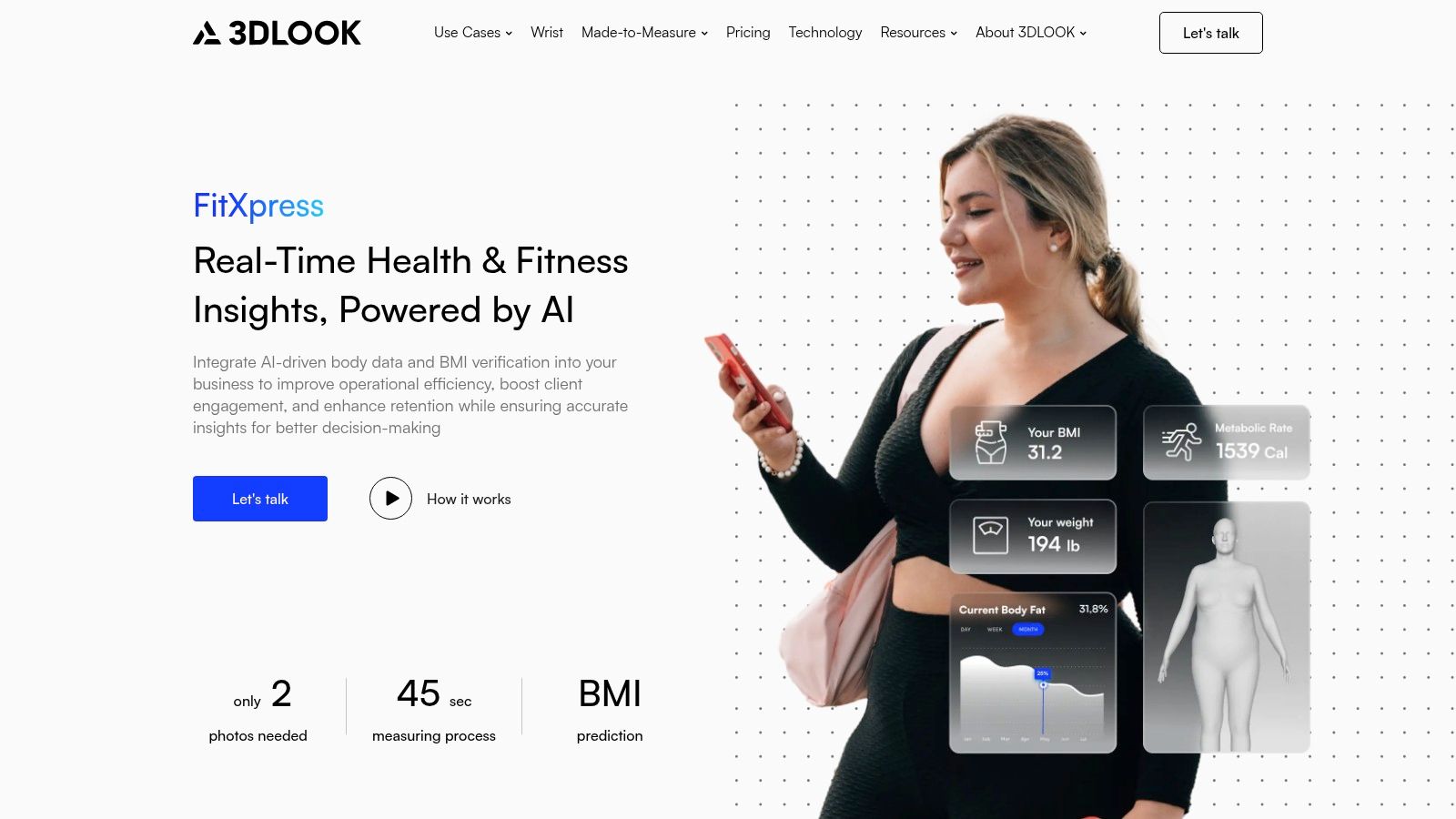
3DLOOK is a measurement-first body scanner online for retailers, uniform providers, and businesses that need a reusable digital body profile. Its mobile capture flow uses two photos to generate a broad set of body measurements, with optional body-composition outputs and a shareable three-dimensional body model. The system also supports web and mobile SDKs, API access, quality checks, pose validation, and an administrative dashboard.
That makes 3DLOOK materially different from a virtual try-on widget. The core asset is measurement data, not a photorealistic garment render. A retailer can use that data for size recommendations, made-to-measure workflows, uniforms, and outfitting, but generating garment-specific try-on assets can require additional production work.
Where it earns its implementation effort
The hosted scanning stack includes scan links delivered through email or SMS, a product-page widget, and tools for integrating the scanner into web or mobile experiences. Its value increases when the retailer has a clear downstream use for measurements, such as standardized uniform allocation or made-to-measure production.
The capture process is more demanding than a questionnaire. Shoppers generally need suitable clothing and must follow the pose and photography instructions. That creates an accuracy dependency that retailers should test with their real audience, especially when shoppers use older phones, inconsistent lighting, or a smaller screen.
For a deeper distinction between mobile capture and other sizing methods, consult this guide to mobile body scans.
3DLOOK publishes plan tiers and usage limits, which can make initial procurement easier than a fully sales-led platform. The vendor also presents accuracy and repeatability claims on its own materials, but retailers shouldn't treat those claims as a substitute for category-specific validation. The important question is whether the measurements remain useful for the garments, devices, and capture conditions in the intended rollout.
Choose 3DLOOK when measurement capture is the primary business requirement. Choose a visualization-led platform when shoppers mainly need to see a garment before buying and aren't likely to complete a more structured scan.
3. Bold Metrics
Bold Metrics Virtual Sizer approaches sizing from the retailer's product data rather than from a consumer-facing body scan. Shoppers provide simple information, and the system maps that information against garment technical data, size charts, fit models, and body-block information to produce a style-level recommendation.
This is an important distinction. A body scanner attempts to model the shopper. Bold Metrics focuses on the relationship between the shopper's inputs and the construction of the garment. For brands with strong technical packs and structured product data, that approach can deliver useful recommendations without asking customers to take photos or create a three-dimensional avatar.
The trade-off is data readiness
Bold Metrics is API-first and aimed at teams that can support a deeper integration. Its Virtual Sizer API is designed for fast responses without requiring the retailer to manage a scanning session. That can suit mid-market and enterprise brands with established engineering resources, multiple categories, and a product information environment that can supply garment-level data.
The system doesn't provide a consumer-facing three-dimensional avatar or photorealistic try-on in the described workflow. It solves the recommendation problem, not the visual reassurance problem. That may be an advantage for shoppers who don't want to upload a selfie, but it won't answer a question such as, “How might this silhouette look on me?”
A retailer should assess the consistency of its size charts and fit data before adopting this type of platform. If technical information is incomplete or inconsistent between product teams, the API can return a polished experience built on weak inputs. Pricing is sales-led, and public self-serve pricing isn't listed.
Bold Metrics is best for brands that want deep product-data integration and garment-specific recommendations. It isn't the natural choice for a retailer whose main objective is visual try-on.
4. True Fit
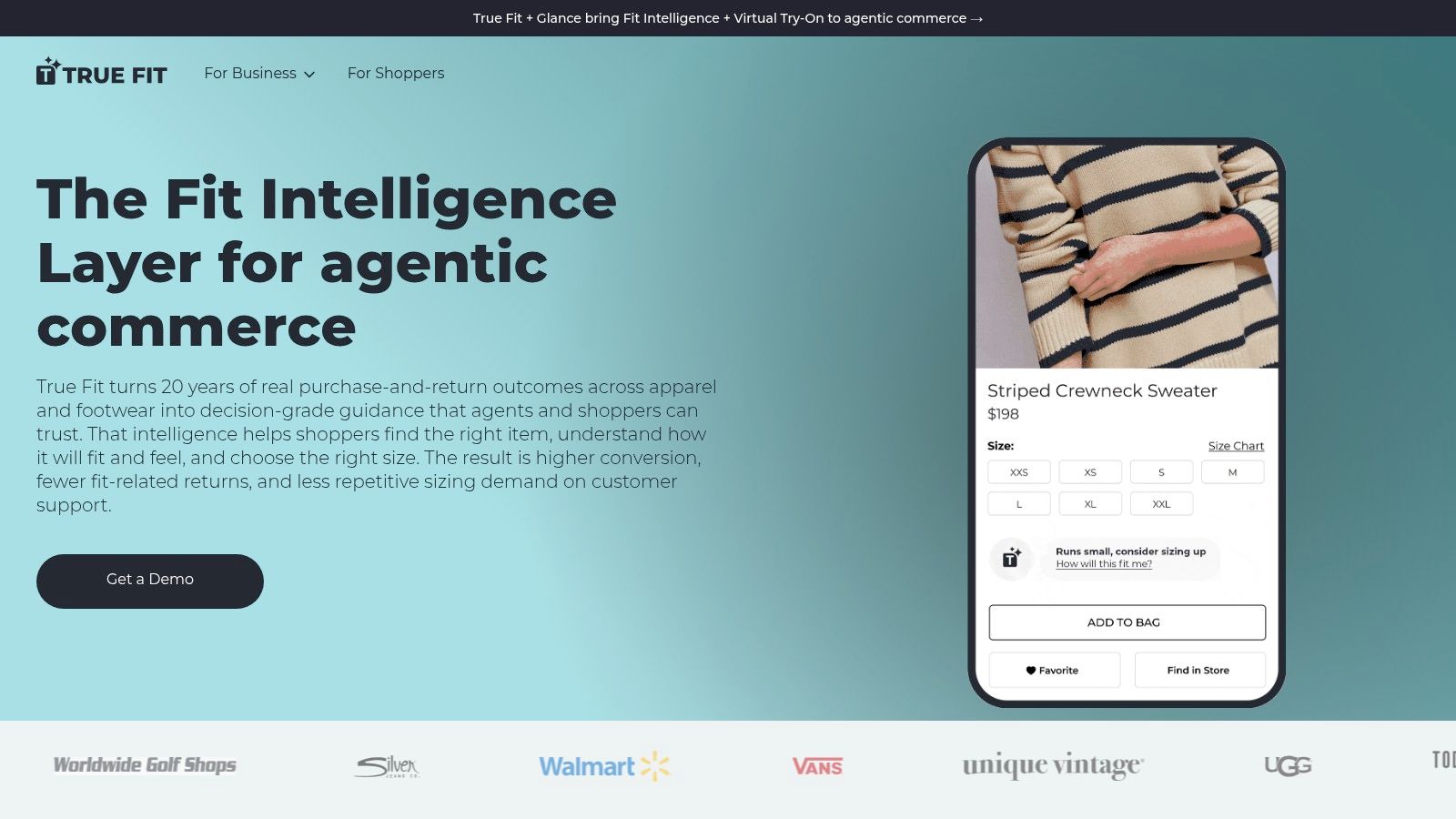
True Fit solves the fit problem with a data network rather than a camera. Its service gives shoppers one recommended size for a product using purchase and return information, brand data, and shopper preferences. The retailer can place the recommendation on the product page without requiring a selfie, body scan, or manual measurement session.
That makes the experience particularly attractive for stores where conversion friction is a bigger concern than visual preview. Shoppers answer questions or use existing information, then receive a direct size recommendation. The process is easier to explain than a full scan, and it avoids asking customers to photograph themselves in clothing or a specific pose.
Low friction, limited visualization
True Fit supports apparel and footwear and offers a Shopify app for faster rollout. Its analytics and merchant insights help retailers examine recommendation behavior, while its broader data approach can reduce the need to build a measurement model from scratch.
The limitation is equally clear. True Fit isn't a body scanner online in the literal sense, and it doesn't provide a three-dimensional avatar or photorealistic try-on. Its performance also depends on the quality and depth of brand-specific data. A new or highly differentiated label may need time to establish reliable product relationships.
That approach addresses a real ecommerce problem. In research on virtual dressing rooms, wrong size accounted for 51% of returns and wrong shape or fit accounted for 31%. The same Springer study cited online apparel returns at about 25% and found that 72% of participants preferred a physical fitting room over the webshop and virtual dressing room. A low-friction recommendation may therefore be more useful than a technically ambitious scan if shoppers won't complete the scan.
For retailers seeking a related view of fit technology, see this analysis of a clothing fit app. True Fit suits stores that prioritize fast recommendations with minimal shopper input.
5. Naiz Fit
Naiz Fit is a product-level size advisor built around fit intelligence and physical product testing. Instead of asking shoppers to create a body avatar, it uses information about the garment and its fit behavior to recommend a size on the ecommerce page. The widget can also support adding the recommended size directly to the cart.
This product-level orientation matters for categories where the same nominal size behaves differently across cuts, fabrics, and construction methods. A brand may have a standard chart, but individual styles can still fit differently. Testing the physical product gives the merchandising and product teams a route to encode that variation into the recommendation logic.
A tool for both ecommerce and product teams
Naiz Fit positions its Size and Fit Intelligence platform across ecommerce, product, retail, and strategy. That gives it a broader operational role than a widget that only appears at checkout. Product teams can use fit information during assortment and development work, while ecommerce teams use the shopper-facing recommendation.
The system isn't a consumer-facing scanner, and shoppers don't receive a photorealistic preview. Its success depends on the retailer supplying reliable product information and maintaining testing practices across the catalog. That makes implementation less about camera compatibility and more about product operations.
Pricing and access are sales-led, with no public pricing listed in the supplied product information. Buyers should ask how recommendations are maintained when garments change, how testing is documented, and which analytics are available to merchandising teams.
Naiz Fit is a strong candidate when fit consistency across individual products matters more than body visualization. It may be particularly useful for retailers with difficult categories, frequent style variation, or product teams that want fit intelligence to influence more than the product page.
6. Sizer
Sizer takes a measurement-first approach using smartphone capture. Its focus is to generate body measurements that can support size mapping for fashion, uniforms, workwear, and B2B outfitting. The platform also includes an ecommerce data module, so the measurement workflow can connect to online sizing rather than staying in a standalone app.
The product makes sense where a retailer needs consistent body information across many participants. Uniform programs, workwear providers, and distributed organizations often face a different problem from a direct-to-consumer fashion store. They may need to outfit groups, handle multiple locations, or connect measurements to standardized garment allocation.
Stronger for outfitting than visual merchandising
Sizer emphasizes user-friendly capture and measurement accuracy rather than photorealistic try-on. That keeps the product focused, but it also means it won't satisfy a retailer whose primary conversion issue is the absence of a visual preview. The shopper or employee is measured, then that information must be mapped to the organization's size system.
The operational burden sits in the capture process and rollout design. A retailer must decide how people receive instructions, which devices they can use, how measurements move into ecommerce or outfitting systems, and how exceptions are handled. The more standardized the workflow, the more valuable a measurement-first platform becomes.
The 2024 review of mobile 3D body-scanning applications concluded that consumer-facing adoption had not yet reached mass adoption. The review and related operator research also identified measurement inconsistency, mesh-quality issues, and weak interoperability as technical barriers. Those findings apply broadly to mobile scanning, so Sizer should be evaluated in a representative pilot rather than judged only from a demonstration.
Sizer is best suited to uniform, workwear, and multi-location measurement programs. Public self-serve pricing isn't listed, so enterprise buyers should request a deployment plan that covers devices, support, integration, and data handling.
7. MySizeID
MySizeID offers a camera-free alternative to the familiar selfie-based body scanner online. Its sensor-based workflow creates a shopper profile and size ID that can be reused across ecommerce and omnichannel touchpoints. The product includes a JavaScript widget, SDK, dashboard, size charts, analytics, and tools for connecting online and in-store experiences.
The absence of a camera changes the privacy and usability conversation. Some shoppers may be more comfortable with a sensor-based process than with uploading a photograph. Others may find any measurement flow too demanding, so the retailer still needs to test completion behavior with its own audience.
Reusable identity instead of one-time sizing
The size ID model is useful when a retailer wants the customer to avoid repeating the same process for every purchase. A dashboard can help merchants manage charts and analytics, while omnichannel tools can connect an online profile to store interactions.
MySizeID doesn't focus on photorealistic try-on or a three-dimensional avatar. Its job is measurement and recommendation. That makes it a better fit for retailers that value reusable sizing data and a camera-free capture path than for brands selling through visual storytelling.
The integration route is relatively direct through the widget and SDK, but pricing isn't publicly listed and a demo or sales conversation is required. Buyers should verify which devices support the sensor workflow, how the system handles incomplete captures, and how profile data is stored and reused.
Retailers comparing capture methods can also review this guide on how to take body measurements. MySizeID is worth considering when privacy-conscious capture and repeatable shopper profiles matter more than visual try-on.
8. Fit:match
Fit:match builds a digital twin from body scanning and uses shape-based matching to connect shoppers with products. It supports web capture, iOS LiDAR scanning, in-store kiosks, and concierge-style experiences. That range gives retailers more than one way to collect body data, from at-home discovery to an assisted physical retail interaction.
The product is therefore positioned between ecommerce personalization and store technology. A retailer can use a scan to recommend products online, while an in-store deployment can provide a more controlled capture environment. That flexibility is useful for brands operating both channels, but it also introduces device and deployment decisions that a lightweight size widget avoids.
Device support shapes the experience
The strongest mobile experience is tied to LiDAR-capable iPhones, while Android support varies. Retailers can't evaluate the product only on a flagship device. They need to understand what happens when shoppers use unsupported hardware, move between web and store capture, or decline a scan.
Fit:match has been associated with retail deployments and shape-based use cases such as bra fitting, but a retailer should still validate garment categories separately. A body model that supports shape matching may be valuable for one product class and less conclusive for another, especially where stretch, structure, and personal fit preference vary.
Pricing is typically enterprise-level and isn't publicly listed. The implementation conversation should cover kiosk hardware, web capture, supported devices, product data, and the handoff between in-store identity and ecommerce recommendations.
Choose Fit:match when you want digital-twin matching across physical and digital retail and can support enterprise deployment. It isn't the simplest route for a small store that only needs a product-page size recommendation.
9. Size Stream
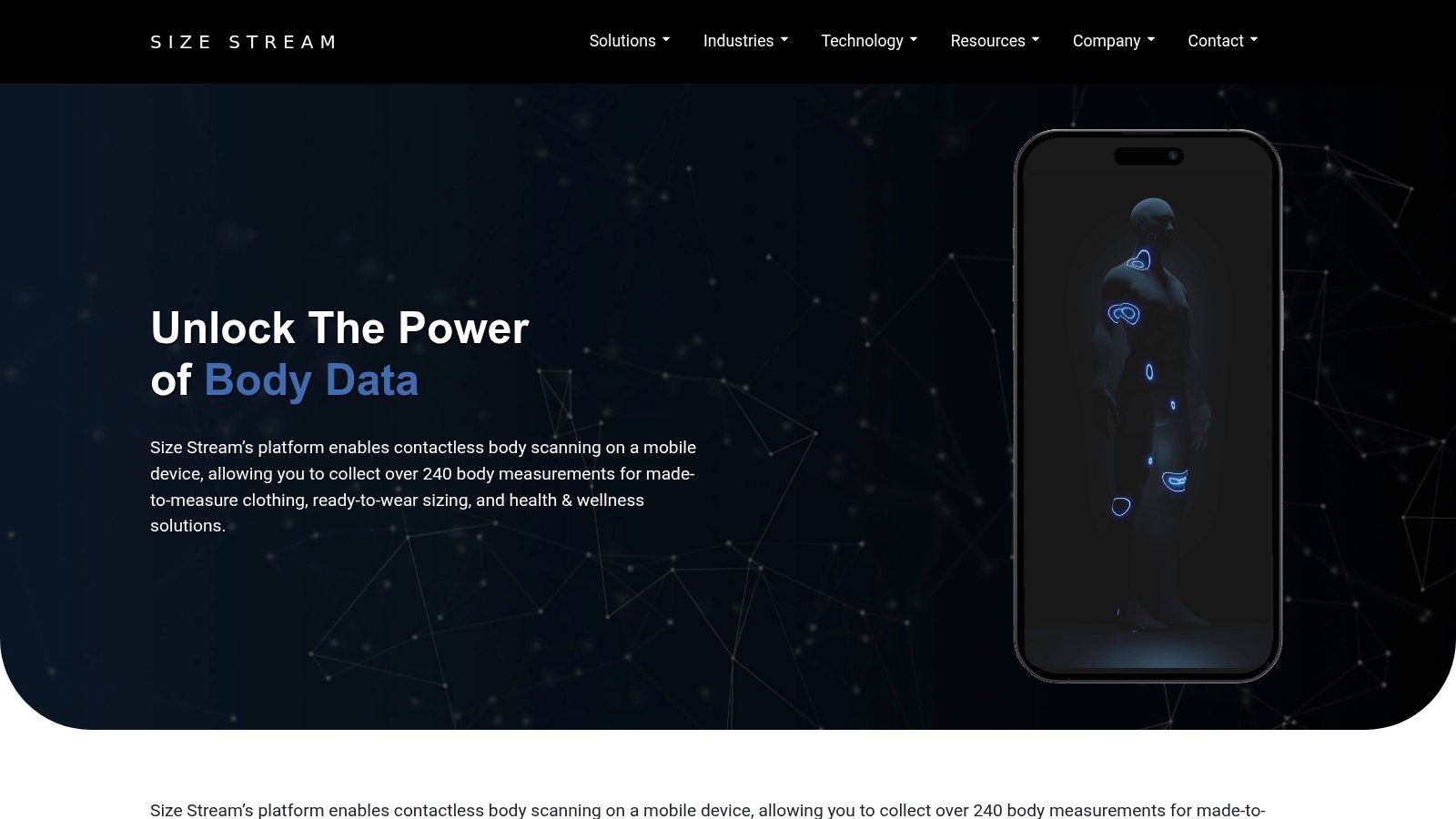
Size Stream is designed for organizations that need extensive measurement data and a direct connection to production or outfitting workflows. Its Mobile Fit app supports smartphone capture, while the broader platform also offers booth scanners, configurators, scan-to-factory processes, and private-label workflows.
That makes the product more relevant to apparel manufacturing, uniforms, made-to-measure services, and retailers with advanced production requirements than to a brand looking for a quick visual layer on a product detail page. The platform can support both at-home and on-premise capture, but the value comes from what the organization does with the resulting data.
Measurement depth requires workflow depth
Size Stream's documentation describes a detailed measurement set for fit and production use. That breadth can help pattern, manufacturing, and outfitting teams, but it also creates work. Product specifications, size systems, factory requirements, and data handoffs must be defined before the scan can produce operational value.
A retailer shouldn't choose this platform just because it returns more measurements. More data is useful only when a team has a clear decision or process attached to it. If the goal is to reduce hesitation on a product page, a shorter questionnaire or per-garment recommendation may be easier for shoppers and staff.
The right question isn't “How many measurements can the scanner return?” It's “Which measurements will change a purchasing, production, or allocation decision?”
Pricing and deployment are sales-led, with limited public detail. Buyers should ask about mobile and booth options, integration with factories or private-label systems, support for ready-to-wear and made-to-measure, and the operational cost of maintaining garment specifications.
Size Stream is the strongest fit for measurement-intensive enterprise workflows, particularly when scan-to-factory or outfitting is part of the business case.
10. Bodi.Me
Bodi.Me takes the opposite approach to a full body scanner. Its Size-Me platform uses a lightweight questionnaire to recommend garment-specific sizes, making it suitable for uniforms, workwear, corporate programs, and other rollouts where participation matters more than visual immersion.
The shopper or wearer provides a limited set of inputs, and the system returns a size recommendation through an ecommerce workflow. It doesn't create a three-dimensional body model or render garments photorealistically. That limitation is intentional. A low-friction questionnaire can be easier to deploy across a large group than a camera-based scan.
Designed for program management
Bodi.Me's value extends beyond individual recommendations. Uniform and workwear programs often need to plan size distributions, manage stock, and outfit many people without creating a lengthy measurement appointment for each participant. A questionnaire-based workflow can support that operational objective while keeping the user journey familiar.
The trade-off is that the system offers less visual reassurance than Robosize or a digital-twin platform. It also depends on the quality of the questions, the organization's size rules, and the garment information used to create the recommendation. A retailer with unusual body-shape requirements or highly visual fashion products may need a richer capture method.
Public pricing isn't listed, and engagement is sales-led. Before selecting Bodi.Me, confirm how recommendations are configured for each garment, how bulk programs are administered, what reporting is available for stock planning, and how exceptions are handled.
Bodi.Me is a sensible choice for high-volume uniform and workwear programs where low participation friction and stock planning matter more than try-on imagery.
Top 10 Online Body Scanner Tools Comparison
| Product | Core features ✨ | UX / Quality ★ | Value & Pricing 💰 | Target audience 👥 |
|---|---|---|---|---|
| 🏆 Robosize | ✨ Photorealistic virtual try‑on (selfie or model), per‑garment size rec, multi‑angle, Shopify app + JS | ★★★★★ Mobile‑first, realistic renders; proven case studies (+17% conv) | 💰 Plan‑based; session allowances, configurable caps; demo/quote | 👥 Online apparel retailers seeking on‑page try‑on & size accuracy |
| 3DLOOK (Mobile Tailor) | ✨ Two‑photo 3D scan → 80+ measurements, SDK/API, shareable 3D model | ★★★★☆ High accuracy claims; pose/quality checks required | 💰 Transparent tiers & usage caps | 👥 Brands needing precise body scans & measurement APIs |
| Bold Metrics (Virtual Sizer) | ✨ API‑first sizing, maps tech packs/fit models to per‑style recs | ★★★★ Developer/enterprise focus; deep fit modeling | 💰 Enterprise sales; no public pricing | 👥 Mid‑market & enterprise brands needing deep product integration |
| True Fit | ✨ Network-driven size recs from large purchase/return data; Shopify app | ★★★★☆ Low friction; proven at scale | 💰 App-based pricing; quick time‑to‑value | 👥 Merchants wanting low‑friction, data‑driven sizing |
| Naiz Fit (Size Advisor) | ✨ On‑PDP widget with add‑to‑cart, lab/product testing informed recs | ★★★★ Per‑product testing improves accuracy for hard categories | 💰 Sales‑led; value in per‑product testing insights | 👥 Retailers focused on product testing & merchandising insights |
| Sizer | ✨ Smartphone measurement, eCommerce module, measurement‑first approach | ★★★★ Strong for uniform/workwear rollouts; user‑friendly capture | 💰 Sales‑led; B2B references for rollouts | 👥 Uniform/workwear programs & large B2B outfitting |
| MySizeID (MySize) | ✨ Sensor‑based (camera‑free) measurements, JS widget & dashboard | ★★★☆ Privacy‑friendly; no photorealistic try‑on | 💰 Sales‑led; omnichannel dashboard | 👥 Privacy‑conscious retailers; omnichannel deployments |
| Fit:match | ✨ iOS LiDAR + web capture, digital twin shape matching, kiosk options | ★★★★ Fast scans; proven retail pilots but device‑dependent | 💰 Enterprise pricing; in‑store & online integrations | 👥 Retailers with LiDAR-capable deployments & in‑store pilots |
| Size Stream (Mobile Fit) | ✨ Mobile/booth scanning, 240+ measurements, scan‑to‑factory workflows | ★★★★ Enterprise-grade for made‑to‑measure & manufacturing | 💰 Sales‑led; deep deployment & configurators | 👥 Manufacturers, M2M brands & enterprise sizing teams |
| Bodi.Me (Size‑Me) | ✨ Lightweight questionnaire sizing, program/stock optimization | ★★★ Low‑friction for high‑volume deployments | 💰 Sales‑led; optimized for rollouts | 👥 Uniforms, corporate programs & large rollouts |
Choose by Capture Method, Fit Goal, and Rollout
The best body scanner online isn't the tool with the longest feature list. It's the one whose capture method matches the retail problem, whose output can be trusted for the relevant garments, and whose implementation fits the team's operational capacity.
Start with the shopper experience. If customers hesitate because they can't picture the garment on their body, prioritize photorealistic try-on. Robosize is especially relevant when the retailer wants optional selfie visualization, a model-based alternative, multi-angle rendering where supported, and a size recommendation on the same product page. Fit:match is more appropriate when digital-twin matching must connect at-home and in-store experiences.
If the business needs actual measurements, look at 3DLOOK, Sizer, MySizeID, or Size Stream. These tools aren't interchangeable. 3DLOOK suits hosted mobile scanning and reusable body models. Sizer fits measurement-led uniform and workwear rollouts. MySizeID offers a camera-free path with reusable shopper profiles. Size Stream is more suitable when measurements must feed manufacturing, made-to-measure, or scan-to-factory processes.
A second group avoids scanning altogether. True Fit, Naiz Fit, Bold Metrics, and Bodi.Me use shopper inputs, product data, testing, or network intelligence to produce recommendations. These tools can reduce capture friction, but their accuracy depends on the strength of the underlying data. A retailer with inconsistent size charts won't solve the problem by adding an API. A retailer with well-maintained product and fit information may not need a camera at all.
Validate the following before signing:
- Shopper inputs: Check whether the flow requires a selfie, two photos, LiDAR, sensor capture, a questionnaire, or a prior profile. Test completion with shoppers who use different devices and have different levels of comfort with measurement.
- Garment data: Confirm how the platform handles size charts, technical packs, fit blocks, physical product tests, stretch, cut, and product-specific variation. A body model can't compensate for incomplete garment data.
- Accuracy dependencies: Ask how pose, lighting, clothing, device capability, image angles, and body-shape variation affect results. The mobile scanning review describes a fragmented category in which outputs vary by use case rather than forming one universally trusted body model.
- Integration effort: Compare a one-click Shopify app, JavaScript widget, SDK, API, kiosk, and factory integration. The fastest storefront installation isn't necessarily the fastest enterprise rollout.
- Pricing visibility: Separate platform fees, session allowances, usage overages, implementation services, hardware, garment asset production, and support. Public pricing is clearer for some tools than others, so request a complete cost model.
- Privacy expectations: Explain whether the tool uses photos, sensors, body profiles, or reusable IDs. Give shoppers a clear alternative where possible, especially when a selfie isn't necessary for the business goal.
- Analytics: Confirm whether the retailer can see tool usage, recommendation outcomes, product-level behavior, and return patterns. A recommendation engine should support learning, not disappear into the product page.
- Pilot design: Test representative products and shoppers, including between-size decisions, different body shapes, brand inconsistencies, and the devices customers use. Don't approve a tool based only on ideal capture conditions.
The commercial case for fit tools is substantial because fit uncertainty is a major source of online apparel returns. Yet digital tools still face a trust gap compared with physical fitting rooms, so retailers should measure more than conversion. Track recommendation acceptance, scan or questionnaire completion, exchanges, fit-related returns, customer support questions, and repeat use.
For a retailer that wants a single on-page experience combining optional selfie visualization, per-garment size guidance, mobile-first deployment, and Shopify or JavaScript integration, Robosize is the most balanced choice in this comparison. A manufacturing business, uniform provider, or enterprise outfitter may reasonably choose Size Stream, Sizer, 3DLOOK, or Bodi.Me instead. The correct decision depends on whether the business needs a better preview, better measurements, better product-data logic, or a scalable outfitting workflow.
Robosize combines a short questionnaire, optional selfie or model selection, shopper-specific visualization, and garment-level size recommendations in one product-page experience. If your store needs to reduce fit uncertainty without forcing every shopper through a complex scan, visit Robosize to review its Shopify and JavaScript deployment options and request plan details.