More than 98% of respondents in a Nordic consumer survey said they'd experienced clothing-size variation, while fewer than 1% could always wear the same size, according to the apparel-sizing analysis. That's why a clothing size chart for women is most useful as a guide to measurements, not a promise that one label will fit the same way across brands.
To start, measure your bust, waist and hips, then compare those numbers with the chart below. The chart is a body-measurement reference. When a retailer provides a chart for a specific product, use that chart to make your final choice.
Table of Contents
- Women's Size Chart by Bust, Waist and Hip
- How to Measure Bust, Waist and Hip Correctly
- When Bust, Waist and Hip Point to Different Sizes
- Choosing Size by Garment Type
- Converting Labels and Why the Same Size Varies
- Reading a Product Size Chart
- Petite, Tall, Plus and Maternity Fit Types
- Confirm Your Size Before You Buy
Women's Size Chart by Bust, Waist and Hip
Start with the chart: match your bust, waist and hip measurements to a row, then use that row as a quick reference. These are approximate body-measurement ranges, not measurements of finished clothing.
| US size | Bust (in / cm) | Waist (in / cm) | Hip (in / cm) |
|---|---|---|---|
| 0 | 31–32 / 79–81 | 23–24 / 58–61 | 33–34 / 84–86 |
| 2 | 32–33 / 81–84 | 24–25 / 61–64 | 34–35 / 86–89 |
| 4 | 33–34 / 84–86 | 25–26 / 64–66 | 35–36 / 89–91 |
| 6 | 34–35 / 86–89 | 26–27 / 66–69 | 36–37 / 91–94 |
| 8 | 35–36 / 89–91 | 27–28 / 69–71 | 37–38 / 94–97 |
| 10 | 36–37 / 91–94 | 28–29 / 71–74 | 38–39 / 97–99 |
| 12 | 37–38 / 94–97 | 29–30 / 74–76 | 39–40 / 99–102 |
| 14 | 38–40 / 97–102 | 30–32 / 76–81 | 40–42 / 102–107 |
| 16 | 40–42 / 102–107 | 32–34 / 81–86 | 42–44 / 107–112 |
| 18 | 42–44 / 107–112 | 34–36 / 86–91 | 44–46 / 112–117 |
| 20 | 44–46 / 112–117 | 36–38 / 91–97 | 46–48 / 117–122 |
Use these as approximate reference ranges, not a universal standard. Retailers may place different measurement ranges under the same US size, partly because garments have different cuts and intended fits. The chart helps you find a likely starting point; it cannot guarantee how a particular item will fit.
How to use the rows
Find the range closest to your bust measurement, then check your waist and hips in that same row. When all three measurements fall within one row, that size is a straightforward starting point. If they point to different rows, your proportions may not match the chart's typical relationship among measurements. That is a fit question, not evidence that you measured incorrectly.
Which measurement matters most depends on the garment. Bust is often the main reference for tops and dresses, while trousers and skirts call for close attention to waist and hip. For full-body garments, height and length may also affect fit. Treat the chart like a map: it narrows the choices, while the garment's shape determines which route fits best.
Why a clothing label isn't a body measurement
A body chart describes the body a garment is intended to fit. A finished-garment chart gives the clothing's measurements, which can include added room for movement, layering or the intended silhouette. Those figures describe different things. For example, a finished garment may measure larger than the body range it is designed for because that extra room is built into its shape.
Women's sizing also reflects a history of grouping many body shapes into a limited set of labels. A U.S. anthropometric study conducted from 1939 to 1940 measured 14,698 women across seven states and recorded roughly 58 to 59 measurements per participant. Its findings included several distinct body-shape groups, while commercial sizing continued to rely largely on bust and an assumed relationship among bust, waist and hips, as described in this history of U.S. standard clothing sizes. That helps explain why one label cannot describe every figure or settle every fit question.
Keep your bust, waist and hip measurements handy when comparing a retailer's chart with this general guide. If the retailer provides measurements for the specific item, use those figures and check whether they describe the intended body or the finished garment.
How to Measure Bust, Waist and Hip Correctly
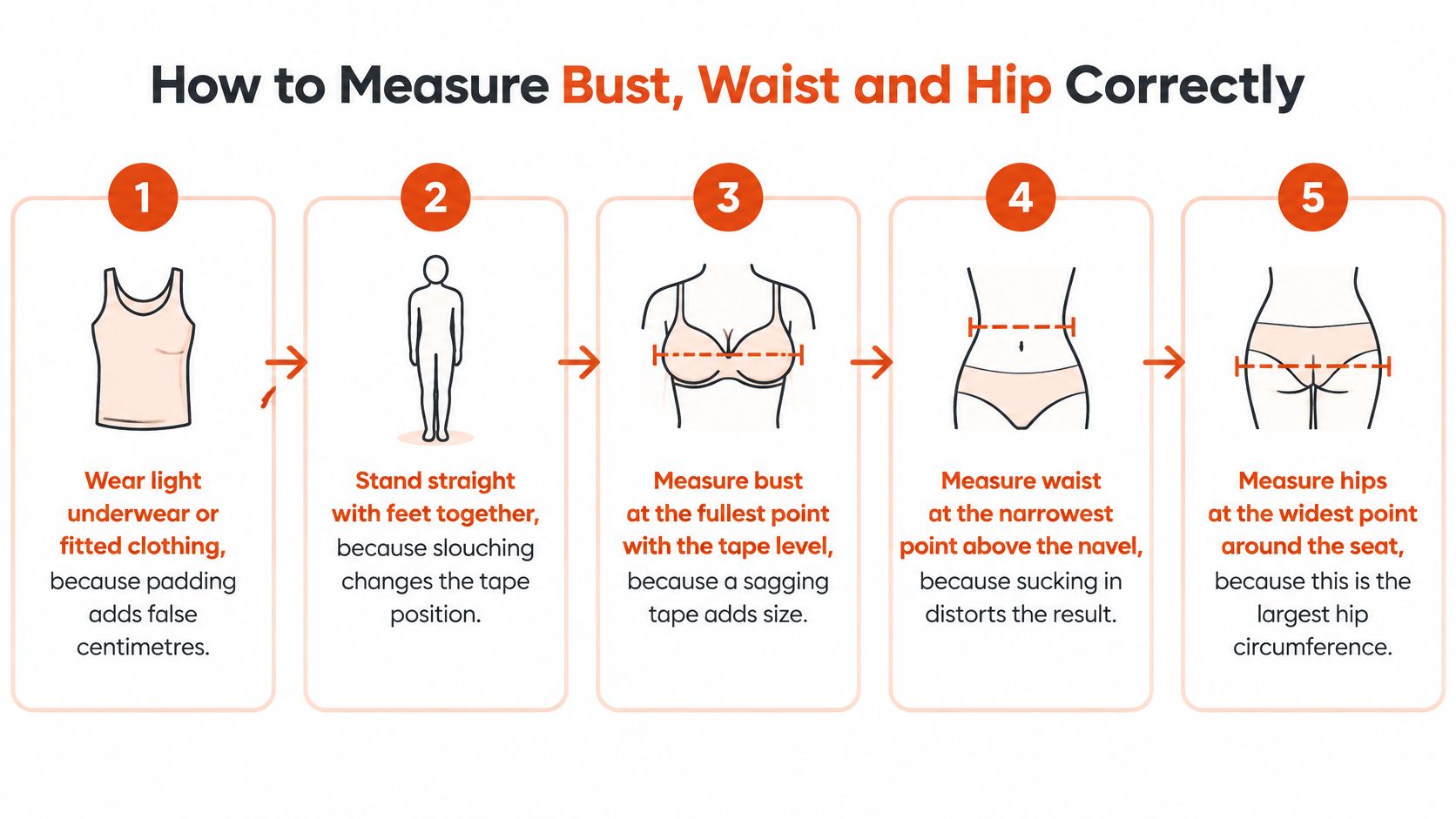
A useful chart starts with consistent measurements. Use a soft tape measure, stand naturally and keep the tape level. The EN 13402 measurement guidance defines bust girth around the fullest bust prominence, waist girth at the natural waist with the abdomen relaxed, and hip girth around the fullest part of the buttocks.
Take the measurements in order
- Wear light underwear or fitted clothing, because padding and thick layers can add false volume to your measurements.
- Stand upright with your feet together, arms relaxed and breathing normally, because slouching, holding your breath or pulling in your abdomen changes how the tape sits.
- Measure your bust at its fullest point, keeping the tape level across your back so a sagging section doesn't make the circumference read larger.
- Find your natural waist and measure around it with your abdomen relaxed, rather than sucking in or tightening your stomach.
- Measure your hips around the fullest part of your buttocks, checking that the tape stays level all the way around.
- Keep the tape snug without compressing your skin, because a tight tape underestimates your circumference while a loose one overestimates it.
- Record the measurement in centimetres first, then convert to inches if needed and round only at the end to avoid rounding drift.
- Take a second reading, and if it differs from the first by more than about a centimetre, take a third and use the average.
The tape should lie parallel to the floor. If you're measuring alone, use a mirror to check its position across your back and hips. You can also use a phone-based method as a supplement. For example, this guide to measuring your waist with a phone can help you explore a digital option, but check that any tool captures the natural waist rather than the waistband of your trousers.
Avoid three common mistakes: letting the tape sag at the back, measuring over bulky layers, and measuring just after a large meal when your waist may be temporarily fuller. If you sew, accurate body measurements are also a useful starting point when you find dressmaking patterns that fit, though the pattern's own sizing instructions still matter.
When Bust, Waist and Hip Point to Different Sizes
Two women can share the same bust measurement and still need different sizes. One may have fuller hips relative to her waist; another may have a longer torso or a fuller bust with narrower shoulders. A chart that assigns one size from a single number can't show how those proportions affect the garment. An international sizing analysis describes these proportion conflicts and notes that charts often don't explain which measurement should control when bust, waist and hip point to different rows.
| Body pattern | What the measurements show | Prioritize for tops | Prioritize for bottoms |
|---|---|---|---|
| Pear | Hip wider than bust and waist | Waist and bust | Hip |
| Apple | Bust and waist fuller than hip | Bust | Waist, with stretch or a higher rise |
| Hourglass | Bust and hip close, waist clearly smaller | Bust | Hip |
| Rectangle | Bust, waist and hip close together | Bust, then shoulder width | Waist |
| Full bust, narrow shoulders | Bust much larger than shoulder width | Bust, then check shoulders | Hip |
Let the garment's hardest fit point lead
For a fitted skirt or trousers, start with the hip, since a garment that's tight there can be difficult to fix without changing its shape. For a structured top or jacket, the bust is often the limiting measurement. The waist is usually easier to adjust with darts, elastic or a belt, so it may be possible to choose the size that fits the less-adjustable area and alter the waist.
Fabric and construction change how much room you have to work with. Stretch fabric can accommodate more movement and variation than a rigid woven fabric, while a close-fitting woven garment usually gives less. Shoulder width and body length are separate checks too: bust, waist and hip measurements won't tell you whether a shoulder seam sits correctly or a torso is long enough.
Practical rule: If your bust and hip measurements point to different rows, choose based on the area the garment can't easily accommodate. Then check whether the other area can be adjusted, and whether the likely alteration is worth the cost.
Choosing Size by Garment Type
The garment determines which measurements matter most. A chart for a blouse needs different priorities from a chart for trousers, and a one-piece jumpsuit may need a rise and inseam check as well as bust, waist and hip. The ISO 8559-2 sizing standard describes size designation through the intended wearer's body dimensions, with a primary measurement and optional secondary measurements. For clothing, the relevant dimensions depend on the garment category.
| Garment | Controlling measurement | Typical ease | Check also |
|---|---|---|---|
| Knit dress | Bust and hip | 0–5 cm | Stretch percentage and length |
| Woven blouse or shirt | Bust | 5–10 cm | Shoulder width and sleeve length |
| Stretch jeans or trousers | Waist and hip | 0–4 cm | Rise and inseam |
| Rigid denim or trousers | Waist and hip | 4–8 cm | Rise and inseam |
| Skirt | Waist and hip | 2–4 cm | Hem length |
| Structured jacket | Bust and shoulder width | 8–12 cm | Sleeve and back length |
| Coat over knitwear | Bust | 10–15 cm or more | Sleeve length and layering room |
| Activewear | Bust band and waist | 0–2 cm, compression | Compression level versus comfort |
| Overalls or jumpsuit | Bust, waist and hip | 3–6 cm | Rise, inseam and bib height |
Ease is the extra room built into a garment beyond the body measurement. A close fit leaves little room beyond the body; a relaxed fit leaves more. Stretch fabric and garment cut both affect how that room feels, so the same body measurements can suit different sizes in different styles.
For example, stretch denim can sit closer to the body than rigid denim. A rigid pair needs more allowance to let you sit and move comfortably. A jumpsuit or pair of overalls also needs enough length through the torso: check rise, inseam and bib height, not only waist and hip.
Product pages may list finished garment measurements rather than body ranges. Compare those figures with your body measurements plus the garment's intended ease, not directly with a body-size row. If you're shopping specifically for denim, this jeans size chart guide can help you focus on the measurements that affect the fit of jeans and trousers.
Converting Labels and Why the Same Size Varies
A US size 8 is often converted to a UK 12 or an EU 40. These are approximate label conversions, not a promise that the garments share the same measurements. Women's clothing labels are not globally uniform or legally standardized. The U.S. Department of Commerce withdrew its commercial women's clothing-size standard in 1983 after manufacturers diverged from it, as explained in this guide to clothing-size systems.
Historical bust-based formulas show why labels can mislead. Traditional conventions expressed US sizing as bust measurement in inches minus 28, and UK sizing as bust measurement in inches minus 24. Those formulas do not reliably describe how a current brand grades its clothing. For a market-specific reference, consult this UK clothing size chart.
Labels suggest a range, not a guaranteed fit
Letter sizes offer a rough starting point: XS is often associated with US 0–2, S with 4–6, M with 8–10, L with 12–14, XL with 16–18, and XXL with 20–22. These ranges vary between brands. An M at one retailer may fit differently from an M at another because the label alone does not show the intended body range, fabric stretch, cut, or ease.
Compare the garment's measurements when the label leaves questions. For example, two jackets marked size 12 might list finished bust measurements of 96 cm and 100 cm. The second provides more room across the bust, although both have the same label. That difference can be deliberate: one jacket may be cut closer to the body, while the other allows room for layering.
Size and fit are also common reasons for apparel returns. To choose between labels, compare the centimetres or inches on the product's own chart rather than relying on a conversion alone. The label is a starting point; the garment's measurements show how its cut may fit.
Reading a Product Size Chart
Before choosing a size, check what the product chart really describes. A number without a unit, measurement location or fit context can look precise while leaving out the information you need.
Use this checklist:
- Unit: Confirm whether the chart uses centimetres, inches or both.
- Measurement basis: Check whether the values describe the body the garment is designed to fit or the finished garment.
- Measurement location: Look for where the brand measures bust, waist and hip.
- Fit descriptor: Note whether the cut is slim, regular or relaxed, since ease changes how the same garment measurement feels.
- Range: Prefer a body range with minimum and maximum values over a bare number when choosing by body measurements.
- Fit type: Check whether the chart applies to misses, petite, tall or plus sizing.
If the page doesn't clarify these points, treat its size conversion as approximate rather than assuming the label has a fixed meaning.
You can also compare the product chart with a garment you already own that fits well. Lay it flat, measure the width across the bust or chest and waist, then double each width to estimate circumference. Compare those figures with the product's finished measurements, while keeping in mind that fabric stretch and cut affect how a garment wears. If the chart doesn't say whether it lists body or garment measurements, contact the retailer rather than guessing.
Petite, Tall, Plus and Maternity Fit Types
A shopper whose bust and hips match a standard size 10 but whose body is shorter may need petite trousers, not a larger size. A fit category changes the garment's proportions and length, so choosing the right category can be more useful than changing the size number.
| Fit type | How it differs | Values to compare | Example |
|---|---|---|---|
| Misses or standard | Regular body length and proportions | Bust, waist, hip and height | Standard size 10 chart |
| Petite | Shorter body length | Inseam, sleeve length and rise | Petite trouser inseam |
| Tall | Longer body length | Inseam, sleeve length and torso length | Tall jacket sleeve |
| Plus | Larger grading, usually from US 14 | Bust-to-waist and waist-to-hip ratios | Plus chart's bust, waist and hip ranges |
| Maternity | Added abdominal room | Waist and hip with panel length | Maternity panel depth |
Misses or standard sizing is intended for regular body length and proportions, so height helps you judge whether the garment's length is likely to work. Petite sizing adjusts lengths such as inseam, sleeve and rise; it isn't merely a smaller version of the same size. Tall sizing adds length where the garment needs it, including the torso and sleeves.
Plus charts may use different proportions as well as larger measurement ranges. The Vogue Business sizing survey reports that its respondents included 51% who were mid-sized, defined as US sizes 6–12; 25% who were plus-sized, defined as US size 14 or above; and 18% who were straight-sized, defined as US sizes 0–4. Those categories describe that survey's respondents, not a universal definition of fit.
Maternity clothing adds room for the abdomen, often through a panel. Check the panel depth and the garment's waist and hip guidance against the fit you need. Buying a larger standard size just to gain length can add unwanted room at the bust and waist without correcting the proportions. Check the product's listed height or length, then compare it with your own inseam or sleeve measurement.
Confirm Your Size Before You Buy
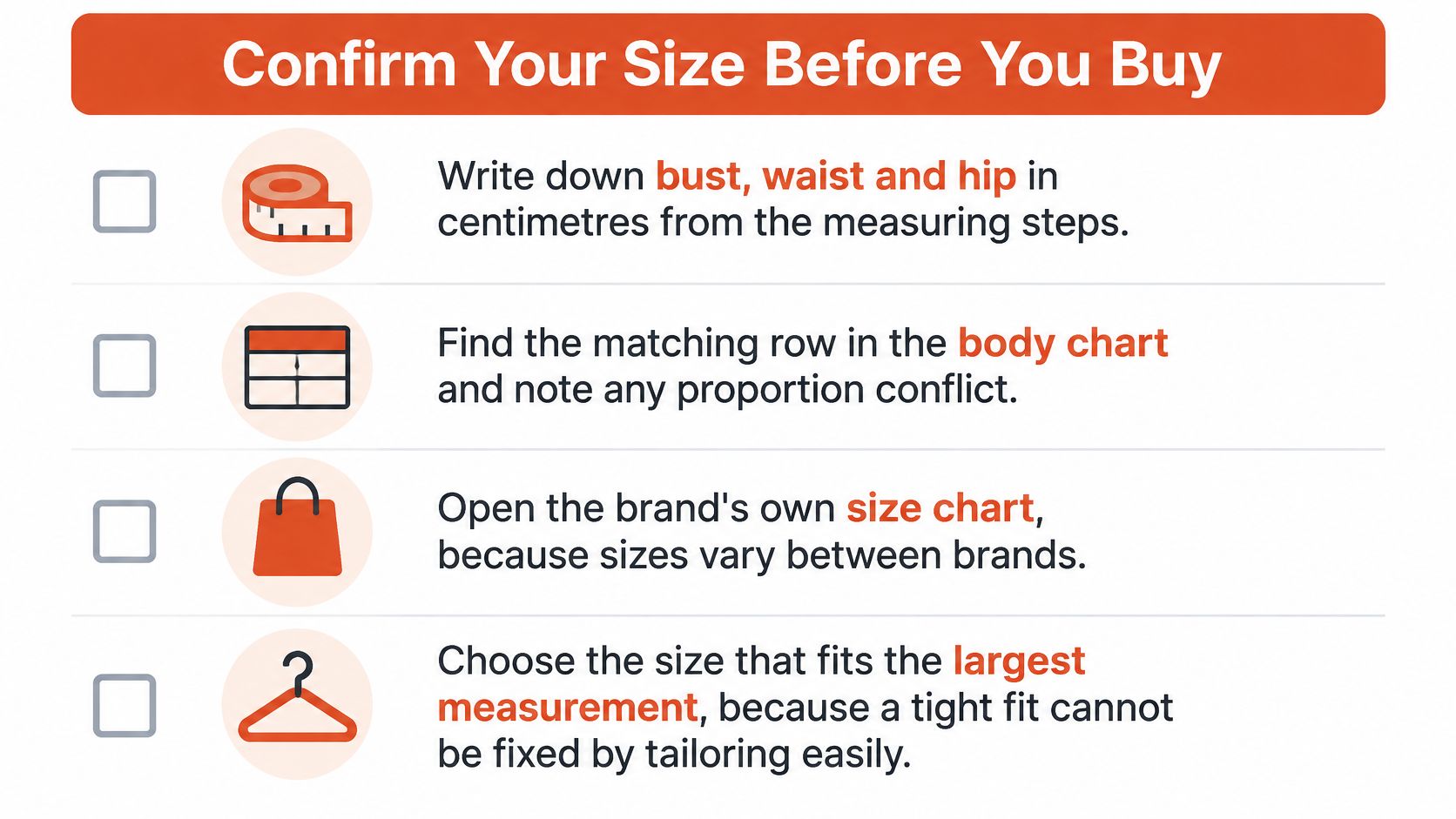
Use this sequence before placing an order:
- Write down your bust, waist and hip in centimetres.
- Find the closest body-chart row and note whether your measurements point to different sizes.
- Open the product's own chart and check the unit, measurement basis and measurement locations.
- Allow for the garment's fit and ease, including stretch, layering and cut.
- Choose for the measurement that controls that garment, then check length and fit type.
- Compare with a well-fitting item you own if the product chart gives finished measurements.
Remeasure when your body shape changes, when an order fits poorly, or when you're trying a brand with a different chart. Measurements from a previous purchase can still be useful, but they don't replace checking the current product's sizing information.
An on-page sizing tool can add another point of guidance. Robosize offers a size recommender for online apparel retailers that uses a short questionnaire and an optional selfie to generate a shopper-specific body model and recommend a size; treat that suggestion as support, not a substitute for checking the product chart.
Before you buy, check the retailer's return policy and consider whether any needed alteration is practical. A size that accommodates the hardest-to-fit measurement may still be the wrong purchase if the remaining adjustments would be costly or uncomfortable.
If you sell apparel online, Robosize offers product-page size recommendations and virtual try-on to help shoppers evaluate fit using their own measurements. Explore how it could complement your women's size charts and give customers another way to make an informed choice.