The familiar advice to find your usual clothing size and read straight across an international chart skips the most important question: what does that number measure? An inch converts exactly. A dress size, jacket label, or shoe number doesn't carry the same certainty.
A useful imperial sizes to metric chart separates physical measurements from retail labels. Start with the tape measure, identify the body point or garment dimension, and only then compare sizes. That's how a fitter turns a conversion into a sensible buying decision rather than a guess.
Table of Contents
- Exact Imperial to Metric Conversion Chart
- Apparel Categories That Need Separate Charts
- Body Measurements Versus Garment Measurements
- Women's Clothing Sizes in Inches and Centimeters
- Men's Chest Waist and Suit Conversions
- Shoe Hat and Ring Size Conversions
- How to Measure When You Fall Between Sizes
- Cross References for Labels That Share a Number
- Check the Garment Before You Order the Label
Exact Imperial to Metric Conversion Chart
Use the exact factors before choosing a clothing label. The NIST Guide to SI conversion factors gives 1 inch = 2.54 centimeters, 1 foot = 30.48 centimeters, 1 yard = 0.9144 meters, and 1 avoirdupois pound = 0.45359237 kilograms. The length and weight entries below are arithmetic conversions using those factors, not international clothing-size equivalents.
Exact imperial to metric factors for apparel
| Measure | Imperial | Metric | How to use it |
|---|---|---|---|
| Inch | 1 in | 2.54 cm | Base length factor, exact |
| Foot | 1 ft | 30.48 cm | Height, converted as a length |
| Yard | 1 yd | 0.9144 m | Garment or fabric length, exact |
| Pound | 1 lb | 0.45359237 kg | Body weight, exact |
| Waist 30 | 30 in | 76.2 cm | Compare with the specified waist point |
| Waist or hip 32 | 32 in | 81.28 cm | Length only, not automatically a size 32 |
| Waist or hip 34 | 34 in | 86.36 cm | Preserve precision before display rounding |
| Chest or hip 36 | 36 in | 91.44 cm | Identify the body point first |
| Chest 38 | 38 in | 96.52 cm | A chest circumference, not a universal label |
| Chest 40 | 40 in | 101.6 cm | Check whether the chart describes body or garment |
| Chest 42 | 42 in | 106.68 cm | Use the exact inch factor |
| Weight 150 | 150 lb | 68.0 kg | Rounded for display only |
Round the result, not the factor
Multiply inches by the exact centimeter factor, then round for display. Keeping a decimal place in recorded body measurements is a practical approach, provided you don't mistake a finely displayed result for a perfectly taken measurement.
Using a shortened factor creates an avoidable error. For example, multiplying a hypothetical chest measurement by a rounded-down inch factor would underestimate its circumference before you even open the brand's chart. A calculator or spreadsheet should retain the full factor internally.
Weight conversions serve a different purpose. A retailer may request weight as part of a sizing questionnaire, but weight alone doesn't tell you how a shirt will fit across the shoulders or abdomen.
Why the units agree but the systems don't always
The International Yard and Pound Agreement, effective July 1, 1959, established the exact yard and pound definitions across the United States, United Kingdom, Canada, Australia, New Zealand, and South Africa. That shared foundation makes apparel length conversions consistent.
Don't extend that assumption to every unit bearing a familiar name. U.S. customary and British imperial volume units aren't interchangeable, so a gallon comparison has no useful place in a clothing chart.
For a practical application, 2ndShotMVP's sizing guide for golf apparel is a useful companion when you're checking how a polo's listed dimensions relate to the fit you want. Convert the dimensions first, then judge the garment.
Apparel Categories That Need Separate Charts
A shoe number can't tell you your dress size, and a trouser label can't tell you your hat size. Each category starts from a different physical anchor. The international size guide from MySizeCharts distinguishes these category-specific measurements and cautions against treating nominal labels as universal body measurements.
The category map makes that separation clear.
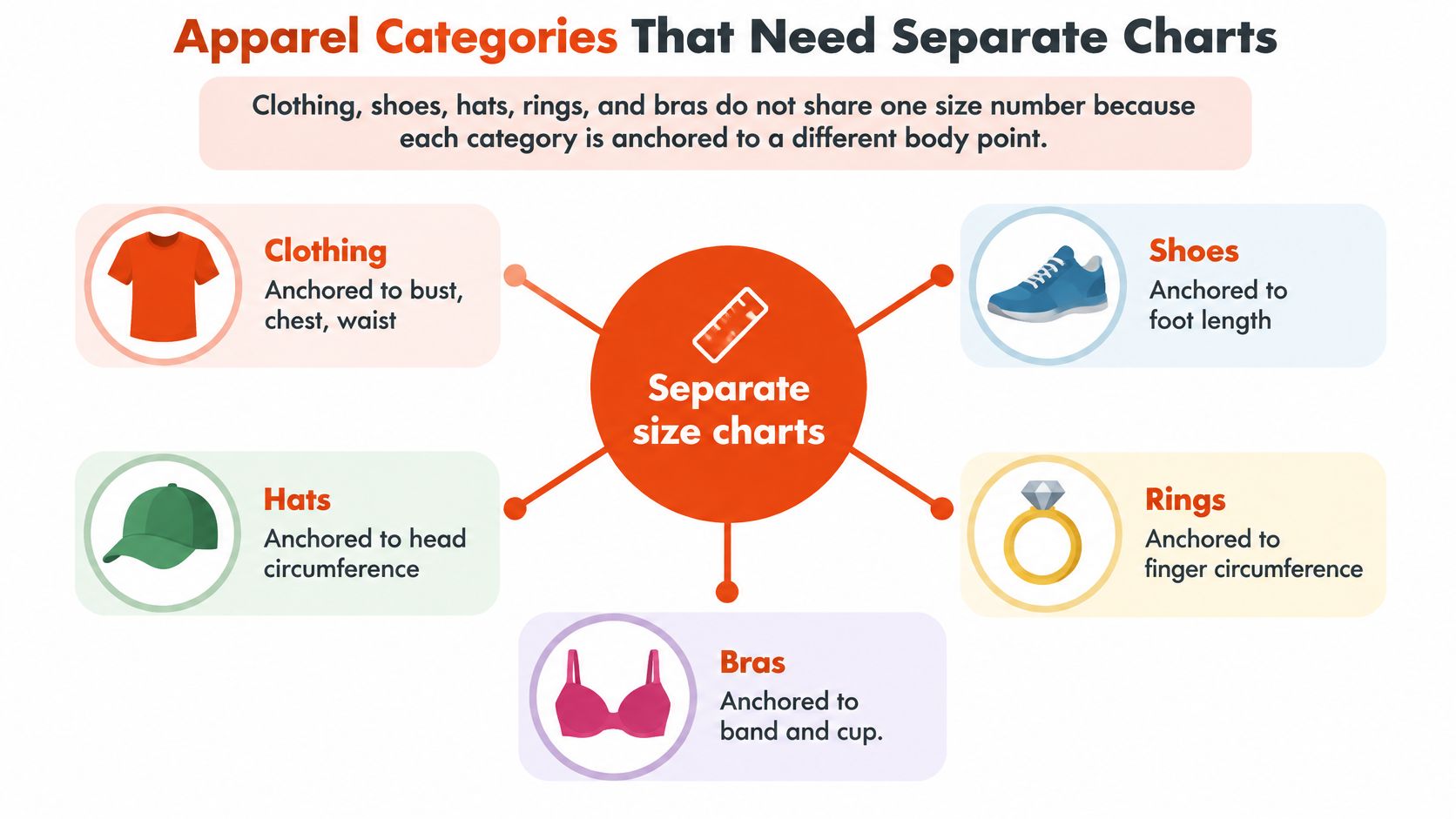
Match the category to its measuring point
| Category | Measurement to establish first | What to check afterward |
|---|---|---|
| Women's clothing | Bust, waist, and hip | Cut, length, and the brand's label |
| Men's clothing | Chest, waist, and relevant lengths | Jacket, trouser, or shirt system |
| Dress shirts | Neck and sleeve | Where the sleeve measurement begins |
| Shoes | Foot length | Width and the maker's chart |
| Hats | Head circumference | Adjustable or fitted construction |
| Rings | Finger circumference or ring inner diameter | The jeweler's sizing system |
| Bras | Underbust and full bust | Band and cup conventions |
| Children's clothing | Current body dimensions and height | The brand's growth and fit allowances |
Even within clothing, the garment changes which measurement controls the decision. A fitted dress needs enough room through the bust and hip. A jersey may need room for movement or an underlayer, which makes a category-specific soccer jersey size chart more useful than a generic letter-size comparison.
Treat the label as an address
A label directs you to a row in a particular chart. It doesn't describe every person who might wear that garment.
Letter sizes are especially easy to overinterpret. A medium in a close-fitting knit and a medium in a loose overshirt may serve different silhouettes, even when the same retailer sells both.
Accessories need their own logic, too. Converting a hat circumference changes the unit of length; assigning a hat label requires the seller's chart. Converting a ring's diameter is another length calculation, but choosing its nominal size requires a jewelry-specific reference.
The useful habit is simple: name the product before interpreting the number.
Body Measurements Versus Garment Measurements
A body chart describes the person the brand intends to fit. A garment chart describes the item itself. Those aren't interchangeable columns, even when both use centimeters.
For body measurements, position the tape at the brand's stated landmarks. Measure bust or chest around the fullest part, waist at the specified waistline, and hip around the fullest seat. Height is taken without shoes, while body inseam follows the inside leg toward the intended hem position.
This comparison shows why the measurement method matters as much as the unit.
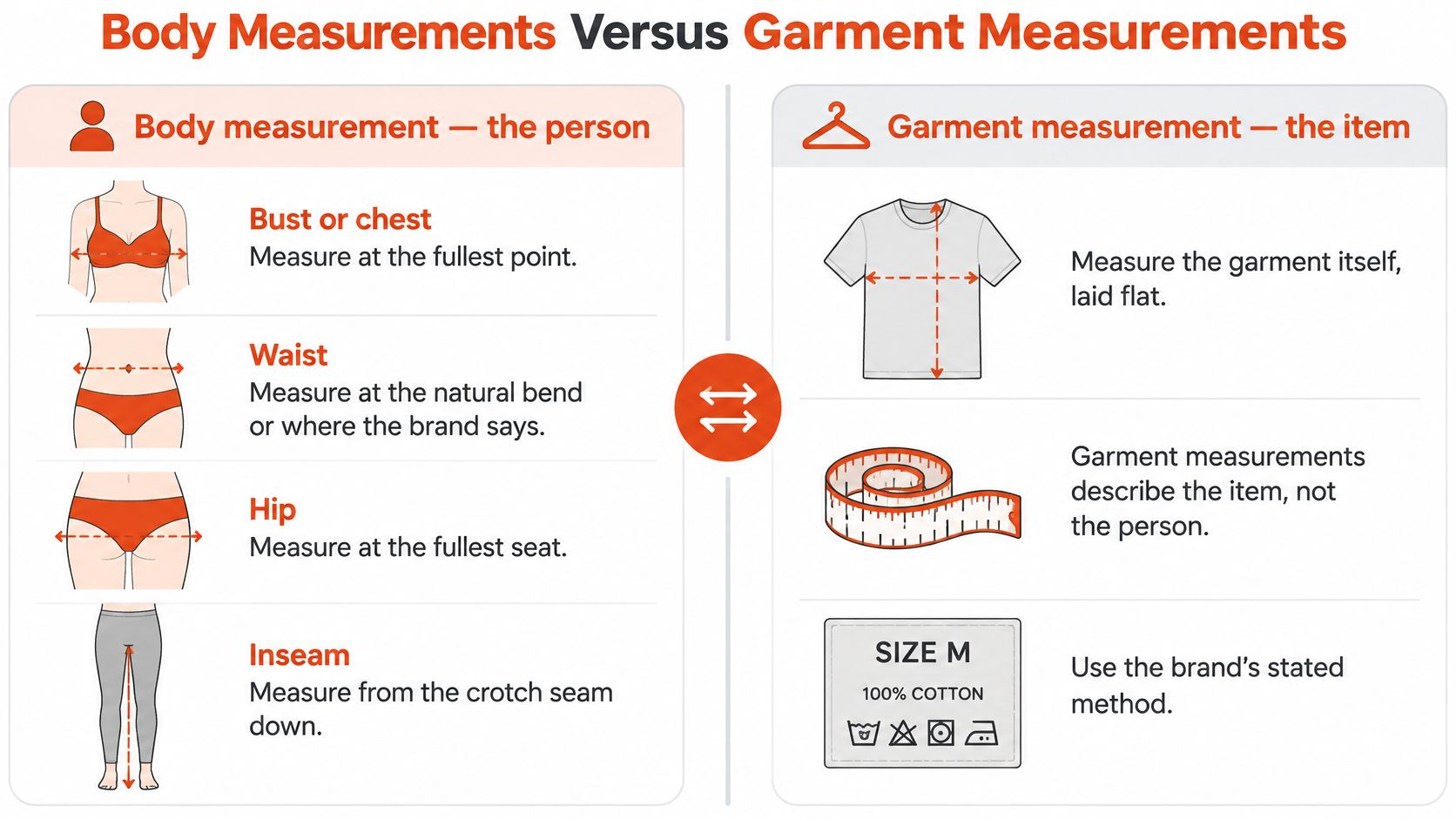
Read flat measurements carefully
A product specification might list chest width with the garment lying flat rather than a circumference around the body. It might also describe a waistband at rest, a stretched waistband, shoulder width, or back length.
Before comparing a product with your tape measurement, establish the method:
- Flat width: Check whether the seller measures straight across the item and whether the stated value needs doubling for a circumference comparison.
- Relaxed waistband: Measure without pulling the elastic or stretch fabric.
- Stretched waistband: Follow the seller's stated method rather than pulling as hard as possible.
- Garment length: Find the starting landmark, such as the shoulder or center back.
The guide to garment measurements versus body measurements helps resolve listings that use similar measurement names for different methods.
Understand the space inside the garment
Ease is the difference between a garment's dimensions and the body dimensions it accommodates. Positive ease provides extra room; negative ease means a stretchy garment is smaller than the corresponding body measurement and expands when worn.
Say you're comparing a jacket with your chest. If its finished circumference matches your body exactly, it may not leave the space you need to breathe comfortably, reach forward, or wear a layer underneath. A stretch top can behave differently because its fabric extends around the body.
Coats generally need layering room, while a fitted knit may rely on stretch. Don't assign either garment a fixed ease allowance without considering construction, lining, and intended silhouette.
Match like with like: Compare your body with a body chart, or compare a well-fitting garment with a finished-garment chart.
Centimeters don't repair a mismatch in method. A precise conversion of the wrong measurement still leads you toward the wrong size. When a listing doesn't identify its method, ask whether the dimensions describe the intended wearer or the finished item.
Women's Clothing Sizes in Inches and Centimeters
An inch converts exactly to centimeters, but a clothing label does not convert with the same certainty. International size codes are nominal labels, not measurements of your bust, waist, or hips. The Size and Spec women's clothing chart lists US 10 as UK 14 and EU 42. That is a label relationship shown by that chart, not a universal fit guarantee.
Typical women's US, UK, and EU label equivalents to confirm against the retailer's chart
| US | UK | EU |
|---|---|---|
| 4 | 8 | 36 |
| 6 | 10 | 38 |
| 8 | 12 | 40 |
| 10 | 14 | 42 |
| 12 | 16 | 44 |
| 14 | 18 | 46 |
| 16 | 20 | 48 |
Use the neighboring rows as a starting reference, then check the retailer's own chart. These are nominal labels, not body dimensions. A number in a size column cannot tell you your bust, waist, or hip measurement unless the brand provides those measurements separately.
Use bust, waist, and hip as separate checks
A dress chart may place your bust in one size and your waist or hips in another. That difference doesn't mean you measured incorrectly. It means the brand's proportions may not match yours evenly.
For a fitted woven dress, compare your current bust, waist, and hip measurements with the product's body chart. If the listing gives finished garment measurements instead, those describe the dress, not the body it is meant to fit. Account for the intended fit rather than matching the garment's numbers directly to your body.
Construction helps you decide which point needs closer attention:
- Fitted bodice: Check bust accommodation and shoulder placement before relying on the waist label.
- Straight skirt: Pay close attention to hip room, especially when the fabric has little stretch.
- Wrap construction: Check the maker's intended overlap and coverage. Don't assume every wrap dress adjusts without limit.
- Loose silhouette: Check the intended drape and length rather than automatically choosing a smaller size.
For a specific purchase, the Dress the Population size chart guide is more relevant than an unrelated retailer's chart. A brand's own measurements remain the useful comparison.
Don't force letter sizes into a fixed formula
Small, medium, large, and extended letter sizes follow each brand's system. Some brands group several numbered sizes under one letter; others use narrower ranges. A remembered medium is a clue about an earlier purchase, not a measurement. The fabric, cut, and fit preference may all have been different.
Stretch can also change how a garment wears without changing its printed label. A soft knit dress may accommodate proportions that a lined woven dress won't. Check the current product chart and construction: converting an international label can identify a likely equivalent, but it cannot promise the same fit.
Men's Chest Waist and Suit Conversions
An inch converts exactly, but a men's suit label does not always name a body measurement. Some labels refer to a chest circumference; others are regional size codes. The All-in-One Size and Measurement Conversion Guide identifies a men's size-40 jacket with a 40-inch chest. Treat that as a chest reference, not the finished jacket's circumference.
A regional label can map differently across garment types. Henry Bucks' men's sizing chart maps metric suit size 50 to imperial 40, while metric trouser size 50 maps to imperial waist 34. The same number therefore does not mean the same body measurement in both systems.
Men's jacket and trouser sizes in both systems
The example rows marked illustrative show a neighboring retail pattern, not a universal conversion. For trouser waists, the centimeter values below convert the stated inches; use the product's own chart to interpret the label.
| Body measure | Imperial | Common metric label |
|---|---|---|
| Chest | 36 in | Illustrative suit 46 |
| Chest | 38 in | Illustrative suit 48 |
| Chest | 40 in | Suit 50 in the Henry Bucks example |
| Chest | 42 in | Illustrative suit 52 |
| Chest | 44 in | Illustrative suit 54 |
| Chest | 46 in | Illustrative suit 56 |
| Trouser waist | 30 in | 76.2 cm |
| Trouser waist | 32 in | Illustrative trouser 48 |
| Trouser waist | 34 in | Trouser 50 in the Henry Bucks example |
| Trouser waist | 36 in | Illustrative trouser 52 |
| Trouser waist | 38 in | 96.5 cm |
| Neck and sleeve | 15.5 in neck, 34 in sleeve | Shirt measurements, not a suit label |
Separate the jacket from the trousers
A matched suit label does not mean the jacket and trousers describe the same body circumference. Read the jacket's chest reference and the trousers' waist reference separately, especially when buying separates.
Your proportions may call for different sizes in each piece. A broad chest and narrower waist can leave extra fabric through a conventional jacket's middle, even when the chest feels comfortable. Athletic cut describes a proportion, not a conversion factor. Check how the maker shapes the chest, waist, seat, and thigh instead of assuming every athletic garment uses the same pattern.
Shirts introduce another measuring system
A dress-shirt label may combine neck circumference with sleeve length. Neither gives the shirt's finished chest width, so check that dimension if you have a fuller chest or prefer a looser fit.
Sleeve measurements also depend on the starting point. A measurement taken from the center back is not interchangeable with one taken from the shoulder seam, even when both are called sleeve length.
For trousers, distinguish waist from inseam and rise. A waist that fits does not establish whether the crotch depth feels comfortable or the hem reaches the right place.
A tailoring label gives you a starting point. Chest, waist, seat, and length determine whether that size works for your proportions.
Shoe Hat and Ring Size Conversions
A shoe size is not a length conversion. The Measurement Units shoe-size chart pairs UK 7, EU 41, and a foot length of 25.4 centimeters. That length is 10 inches, but the UK and EU labels belong to sizing systems, not to a universal arithmetic formula.
Approximate adult shoe sizes by foot length
| UK | EU | Foot length | Inches |
|---|---|---|---|
| 5 | 38 | About 24.1 cm | About 9.5 in |
| 6 | 39.5 | About 24.8 cm | About 9.8 in |
| 7 | 41 | 25.4 cm | 10 in |
| 8 | 42 | About 26.2 cm | About 10.3 in |
| 9 | 43 | About 27.0 cm | About 10.6 in |
| 10 | 44.5 | About 27.9 cm | About 11.0 in |
| 11 | 46 | About 28.6 cm | About 11.3 in |
Read the foot-length column as a body measurement. It is not the length of the shoe's sole, and the converted measurement does not guarantee that a particular label will fit. Shoe brands can use different sizing charts, so treat these pairings as approximate and check the maker's chart before ordering.
Measure the foot before reading the label
Stand on paper with your weight distributed naturally. Mark the back of the heel and the end of the longest toe, keeping the pencil upright rather than angling it under the foot. Measure both feet, then use the longer measurement when following the maker's instructions.
Wear the type of socks you plan to use with the shoes. Check whether the chart asks for bare-foot length or another measurement, and enter the result in the units it requests. Don't add an arbitrary allowance: the chart may already account for fitting room.
Length is only one part of fit. Width, instep volume, toe-box shape, and the shoe's last can make shoes with similar stated lengths feel different. U.S., UK, and EU labels also need the correct adult, children's, or gender-specific chart. A length conversion can put you in the right part of a chart, but it cannot describe every dimension of the shoe.
Hats and rings remain separate length problems
For a hat, measure around the intended wearing line with a soft tape. Keep it level and comfortably snug, then compare the circumference with the hat maker's chart. An adjustable cap and a fitted hat allow different amounts of adjustment, so the label alone does not tell you how much room you will have.
For a ring, distinguish inner diameter from inner circumference. A ruler across the opening measures one dimension; a measurement around the inside measures another. Match your measurement to the field requested by the seller rather than treating the two as interchangeable.
Band design matters alongside size. If you're choosing a stamped silver band, compare the design with the seller's sizing instructions. For an important purchase, use a proper ring sizer or ask a jeweler to check the fit. A clothing chart cannot establish a ring size.
How to Measure When You Fall Between Sizes
Take fresh measurements before deciding that you need the larger or smaller label. Use a soft dressmaker's tape, a mirror, and the product chart. A helper makes shoulder, back, and sleeve measurements easier to keep aligned.
Follow the measuring sequence without pulling the tape tight enough to compress your body.
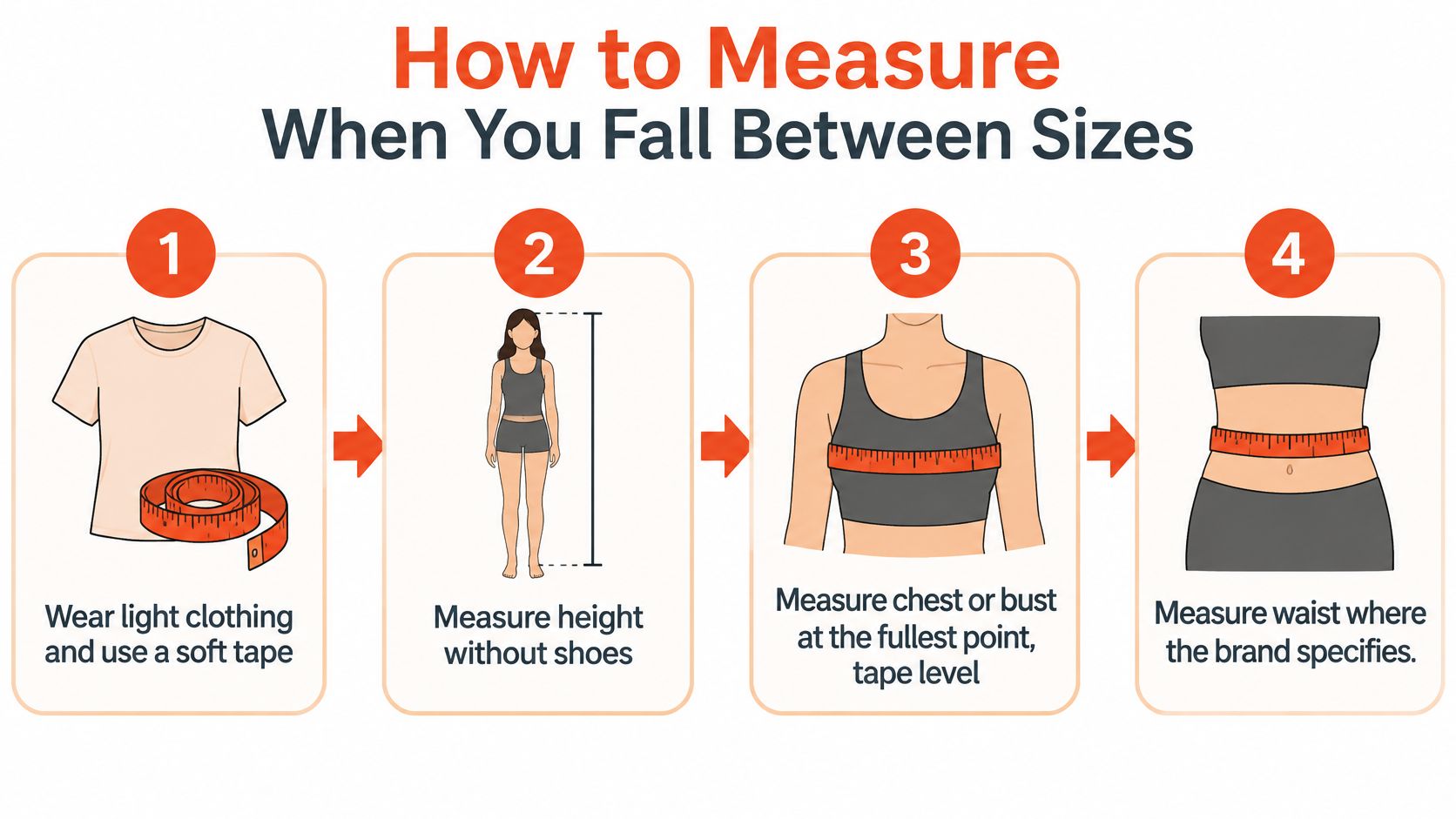
Record the measurements in order
- Prepare: Wear light clothing or the undergarments intended for the outfit. Check that the tape hasn't stretched or become damaged.
- Take height: Stand without shoes against a vertical surface, looking straight ahead.
- Measure chest or bust: Keep the tape level around the fullest part and breathe normally.
- Find the specified waist: Use the brand's landmark, which may differ between dresses and trousers.
- Measure hips: Pass the tape around the fullest seat, checking its position in a mirror.
- Check inseam: Follow the inside leg to your preferred hem position. For a garment chart, measure an existing pair using the seller's method.
- Convert consistently: Use the exact length factor and round only the recorded display value.
- Compare the correct columns: Keep body dimensions separate from finished-garment dimensions.
Choose for the hardest part to accommodate
When your measurements span chart rows, identify the garment's controlling fit point. For a structured jacket, shoulders and bust or chest can be harder to alter successfully than a loose waist. For fitted trousers, consider waist, seat, and thigh together rather than using waistband comfort alone.
Stretch can make a closer fit workable, but only if the garment is designed to stretch that way. A stretch lining, waistband, and outer fabric don't necessarily behave alike. For rigid fabric, choose enough room for the largest relevant measurement and consider alterations.
Current measurements matter especially after body change. A November 2025 Coresight survey found that 72% of U.S. GLP-1 users had dropped at least one clothing size, according to reporting on apparel sizing and retail returns. That finding concerns those surveyed users, but the practical measuring habit also suits postpartum shoppers, growing teenagers, and people changing their training routine.
Keep a dated measurement note rather than treating an old label as permanent. Remeasure when your clothes begin fitting differently.
Cross References for Labels That Share a Number
A bare number on a product page is incomplete information. You need the category, the sizing system, and the measurement description before it becomes useful.
The most confusing collisions happen when a genuine body measurement resembles a regional retail label. A chest-based jacket number, a European dress label, and a shoe label can look alike without describing anything comparable.
Use this checklist to identify the missing context.
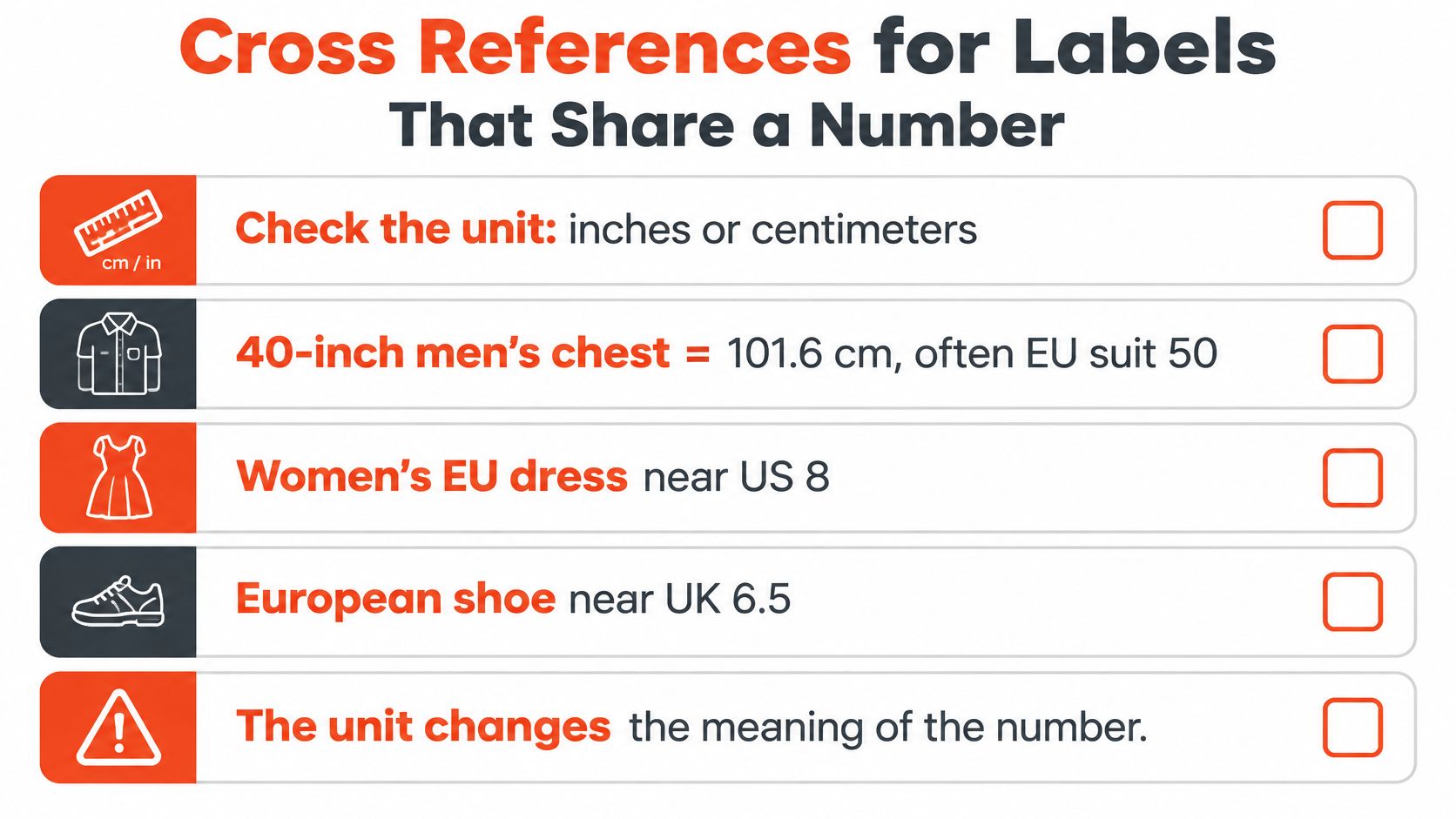
Resolve collisions by reading the heading
| What the listing shows | What you still need |
|---|---|
| A number followed by inches | The body point or garment dimension |
| A European clothing number | The garment category and brand chart |
| A metric suit label | The corresponding chest guidance |
| A metric trouser label | The waist and seat guidance |
| A shoe number | The regional system and foot-length chart |
| A letter size | The brand's actual measurement range |
Never infer a unit from the number's appearance. A trouser label that resembles a centimeter value may still be a nominal code. Likewise, a familiar jacket label doesn't establish the jacket's finished dimensions.
The practical reading order is:
- Name the category: Jacket, dress, trousers, shoe, or accessory.
- Identify the measurement type: Body guidance, finished garment, or nominal label.
- Read the unit: Inches, centimeters, millimeters, or no physical unit at all.
- Use the brand's mapping: Select the row that belongs to that exact product.
Keep neighboring dimensions separate
Inseam, rise, and trouser length are related, but they answer different questions. Inseam follows the inside leg; rise describes the crotch-to-waist dimension using the brand's method. An outside-leg measurement follows another path.
Dress length introduces another starting point, often at the shoulder or back neckline. You can't compare it directly with a trouser inseam just because both are lengths.
A number becomes useful only after you attach a product, a measuring point, and a unit.
Consider a listing with a regional size code and a waist specification. Read it as trouser guidance, not jacket guidance. If another item uses the same code beside a chest specification, treat it as a separate sizing decision.
For retailers, clear column names prevent this confusion before checkout. Label a field as body waist, relaxed garment waist, or finished chest circumference instead of publishing an unexplained measurement.
Check the Garment Before You Order the Label
Choose the size whose specification accommodates the garment's controlling fit point and intended silhouette. A successful conversion tells you what a measurement means in another unit; the product specification tells you whether the garment is suitable.
If your measurements fall between labels, consider fabric behavior and construction before choosing. Prefer a closer fit only when the brand's stretch and fit guidance supports it. For a rigid garment, make sure the relevant body points have enough room rather than hoping the fabric will give.
Buy when the evidence matches
- Clear body chart: Choose the row that accommodates your current measurements.
- Clear garment chart: Compare with a similar garment that already fits, using the same measuring method.
- Only a regional or letter label: Request the missing dimensions before ordering.
- Unclear measurement method: Remeasure or seek clarification rather than converting an ambiguous value.
Retailers can make this easier by maintaining a consistent measurement record, displaying both unit systems, and assigning each product its appropriate chart. The recommendation should belong to the item, not to a generic international label.
At Robosize, we let shoppers enter details in metric or imperial units and match each product to the store's own size chart. We provide a precise size and fit recommendation for each specific garment, so the shopper doesn't have to treat a converted label as the final answer.
Buy when the measurement, method, and intended fit agree. Otherwise, remeasure or request the missing specification before choosing.
We offer garment-specific size recommendations and virtual try-on, with shopper inputs in either metric or imperial units. Visit Robosize to see how you can connect your store's product charts to a fitting experience that shows shoppers an outfit with its size and fit recommendation.