No single number is right, and the ranges most survey teams settle on run from 1 to 5 questions for a short poll, 5 to 10 for a customer feedback form, 10 to 15 for an employee engagement survey, and 15 to 20 or more for a research survey, with a long academic instrument sitting at roughly 25 to 30. Those bands differ because each instrument carries a different amount of decision weight, not because one number is safer than another.
So here's the question that should come before those figures. Why does a twelve-question form sometimes lose more respondents than a twenty-question one? That reversal happens more often than teams expect, and it exposes the flaw in counting questions as if each were an equal unit of cost. A shopper answering on a phone in a lunch queue, a respondent who chose to take your survey, and a panelist paid per completion are not the same person, and the questions themselves are not the same amount of work.
Treat question count as a weak proxy. What predicts whether someone finishes are three things: how many decisions each question informs, how much effort that question demands, and the device it's answered on. The total is downstream of those, not the driver. Get those three right and the count usually lands near the right range on its own; get them wrong and no count saves you.
Table of Contents
- Recommended Question Counts by Survey Type
- Why Purpose and Effort Set the Right Length
- What Each Extra Question Costs in Responses
- Why a Raw Question Count Can Mislead
- How to Cut a Questionnaire Without Losing Accuracy
- Verify Your Question Count Before Launch
Recommended Question Counts by Survey Type
Start with the lookup, then read the caveat that keeps it honest. No single count fits every survey, but the published ranges by type are stable enough to plan from.
Short polls sit at 1 to 5 questions. BlockSurvey's 2024 guide to survey length recommends 1 to 5 questions for a quick poll, 5 to 10 for a customer feedback form, 10 to 15 for an employee engagement survey, and 15 to 20 or more for a research survey. Read the ladder and the logic appears: each step up buys depth and asks more of the person answering.
| Survey type | Question count | Reference point |
|---|---|---|
| Short poll | 1-5 | BlockSurvey 2024 range |
| Customer feedback form | 5-10 | BlockSurvey 2024 range |
| Employee engagement survey | 10-15 | BlockSurvey 2024 range |
| Research survey | 15-20 or more | BlockSurvey 2024 range |
| Long academic instrument | 25-30 | About 30 minutes to complete (2022 review benchmark) |
| Body-measurement or sizing intake | 5-8 required | 60-120 seconds on mobile (product benchmark to validate) |
The top rows belong to research. A long instrument commonly reaches 25 to 30 questions, and that row only holds if it can be finished in about 30 minutes. Cross that line and you're no longer buying insight, you're buying attrition.
Then the row that matters most in retail. A body measurement or sizing intake is defensible at 5 to 8 required questions completed in about 60 to 120 seconds on a phone. Call that a product benchmark rather than a scientific constant, and validate it against funnel data. Optional extras, a selfie, a model choice, a fit preference, stay outside the count and appear only when the core answers leave the size unclear.
Starting point, not a target: a range tells you where to begin counting, not where to stop thinking.
A test you can run today, before changing anything: count your required questions and your optional ones separately, time one real completion on a phone, and compare the result with the row that matches your survey's purpose. If the timing blows past the reference point, the count is already telling you something. The next question is why those rows differ so much, because the spread isn't arbitrary.
Why Purpose and Effort Set the Right Length
A questionnaire behaves like a supermarket checkout. Nobody abandons a queue because there are twelve people in it; they abandon it because the person at the till is arguing about a coupon. The number of items matters less than how long each one takes and how hard it is to scan.

The same twenty questions can feel short in one setting and long in another, which is exactly what the 2022 review of questionnaire-length research describes. It finds no universally correct number and locates the variation in four places: task complexity, respondent motivation, question difficulty, and completion context. The review also cites an experiment comparing 13, 25 and 75 question versions, where the shorter instruments produced higher response and completion rates while remaining reliable, and notes that stretching a mailed questionnaire from five pages to seven reduced response rates among women aged 70 and older, without necessarily hurting answer quality.
Two surveys, two ceilings
A customer feedback form about a single purchase works well at 5 to 8 questions. The decision it informs is narrow, and the buyer has just done the thing you're asking about, so recall is fresh and each answer costs little. That figure covers one narrow decision, which is why it sits inside the 5 to 10 band in the table above rather than contradicting it.
A workplace culture survey that will shape a leadership plan can justify 10 to 15 questions. Its results feed several decisions, respondents expect depth, and respondents answer it on work time rather than on a crowded bus. Same tool, different ceiling.
The rule that follows: decide which decisions the answers must support, then count the questions each decision requires. That reasoning survives a steering meeting. A target pulled from a blog post doesn't.
Audience motivation moves the ceiling as well. A customer who has bought from you four times tolerates more than a first-time visitor who arrived from an ad and has never seen your checkout.
Three things to answer before you count anything:
- Which decision does this feed? Name it, and name who acts on it.
- Who answers it? A loyal customer, a busy employee, an anonymous browser.
- Where and on what device? On a phone between meetings or at a desk with time to spare.
What Each Extra Question Costs in Responses
The cleanest way to see the cost is an experiment that changed nothing but length. In a 2020 mixed-mode survey of Gothenburg residents, researchers ran a shorter questionnaire of 149 questions across nine pages against a longer version of 205 questions across 12 pages. The longer version cut response rate by 2.7 percentage points, a statistically significant decline, and it happened where response rates were already high, as the University of Gothenburg's 2022 report on questionnaire length%20v2_1.pdf) sets out.
That's 56 additional questions, about 37.6% more items, and three extra pages, for a measurable loss of participation. The scale is the lesson: a moderate increase, nowhere near a doubling, was enough to move the number.
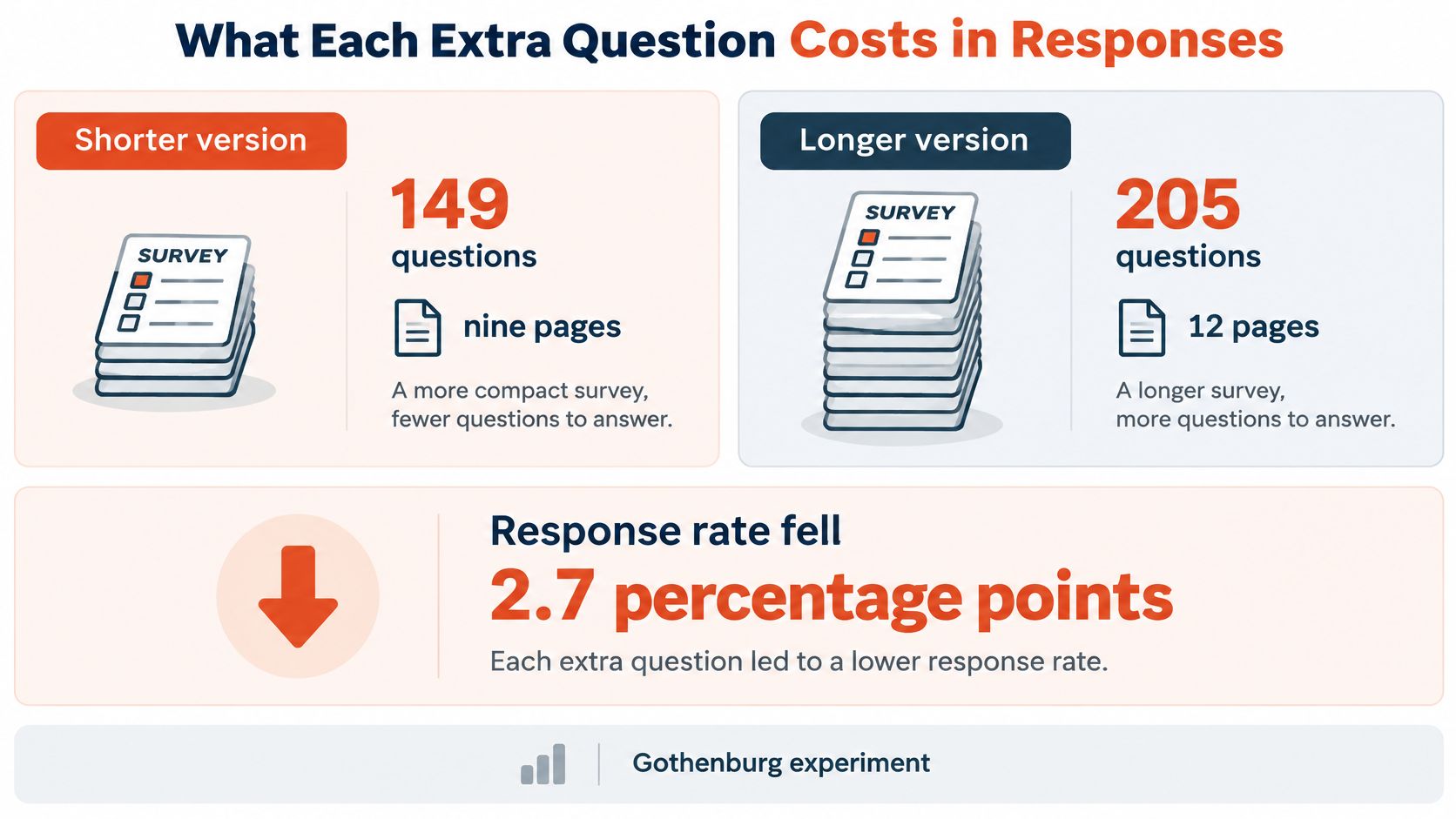
| Version | Questions | Pages | Response rate effect |
|---|---|---|---|
| Shorter version | 149 | 9 | Baseline |
| Longer version | 205 | 12 | 2.7 percentage points lower |
| Difference | +56 (about 37.6% more) | +3 | Statistically significant decline |
There's no clean per-question price, because burden accumulates rather than divides evenly across items. Directionally, the 56th added question hurts less than the 5th, since the people still answering are the motivated ones. The effect shows up as a slope, not a step.
A separate analysis of more than 25,000 real-world web surveys, cited in the same Gothenburg report, found completion rates declined as both the number of questions and the total words increased, and that more difficult questions pushed completion down further. So you have two levers, item count and item difficulty, and they pull in the same direction.
Context still decides how steep the slope gets. Mode, audience, incentives and respondent motivation all shift the size of the effect, which means any drop is a risk you measure on your own traffic rather than a fixed penalty you can budget for in advance.
Before launch: cut any question that wouldn't change the outcome, and make every difficult question earn its place twice, once for its value and once for the effort it costs.
For an online retail flow, that favors a compact core, clear early value, and progressive disclosure for everything optional. Keep the survey aimed at the information that materially improves a recommendation instead of drifting toward the upper limits normal in research work.
Why a Raw Question Count Can Mislead
The assumption worth challenging is that one number predicts quality: shorter is safer, longer is richer, and somewhere a correct count exists. Evidence keeps breaking that assumption. A 2025 experience-sampling study indexed in PubMed found that sampling frequency, not questionnaire length, predicted careless or insufficient-effort responding. Repeated prompts and interruptions did more damage than the size of any single instrument. The same work reports a questionnaire-length experiment in which shortening a self-completion survey produced no clear improvement in response rates, sample composition or data-quality indicators, even though long surveys can raise cumulative burden and invite satisficing near the end.
If length alone does not explain quality, what does? Three things do most of the work: how many decisions each question informs, how much effort each answer demands, and what device the person is holding.
Shorter but harder does worse
Effort and interface take over quickly. A 2025 study in the International Journal of Social Research Methodology found that higher perceived burden consistently reduced response quality, while question position had little effect, and it used responsive design to fit questionnaires to different screen sizes. Layouts built for smaller screens consistently lower the effort each question costs, which is why the device belongs in the count conversation at all.
Put those findings together and a contrast emerges. A six-question form with unclear body-shape terms, ambiguous units and no progress cue can perform worse than a nine-question flow in plain language with visual answer choices, unit conversion and a progress bar. Shorter but harder loses to longer but easier, especially on a phone. Six questions that each inform a real decision, such as which size chart applies or whether a fit preference changes the recommendation, can carry more weight than nine that inform nothing.
The real constraint: a shopper's patience runs on perceived effort, not on item count.
Global audiences sharpen the point. The same count feels heavier to someone who thinks in inches when the form asks for centimetres, to someone who has never measured their own waist, or to a reader who doesn't expect a clothing retailer to ask their age.
So count the wrong thing and you optimize the wrong thing. The question to design against is how many high-friction actions a person will complete before trust and conversion decline, and that number is smaller than many assume. It also shifts with the device, the audience and the effort each item demands, which is exactly why a raw total cannot stand in for any of them.
How to Cut a Questionnaire Without Losing Accuracy
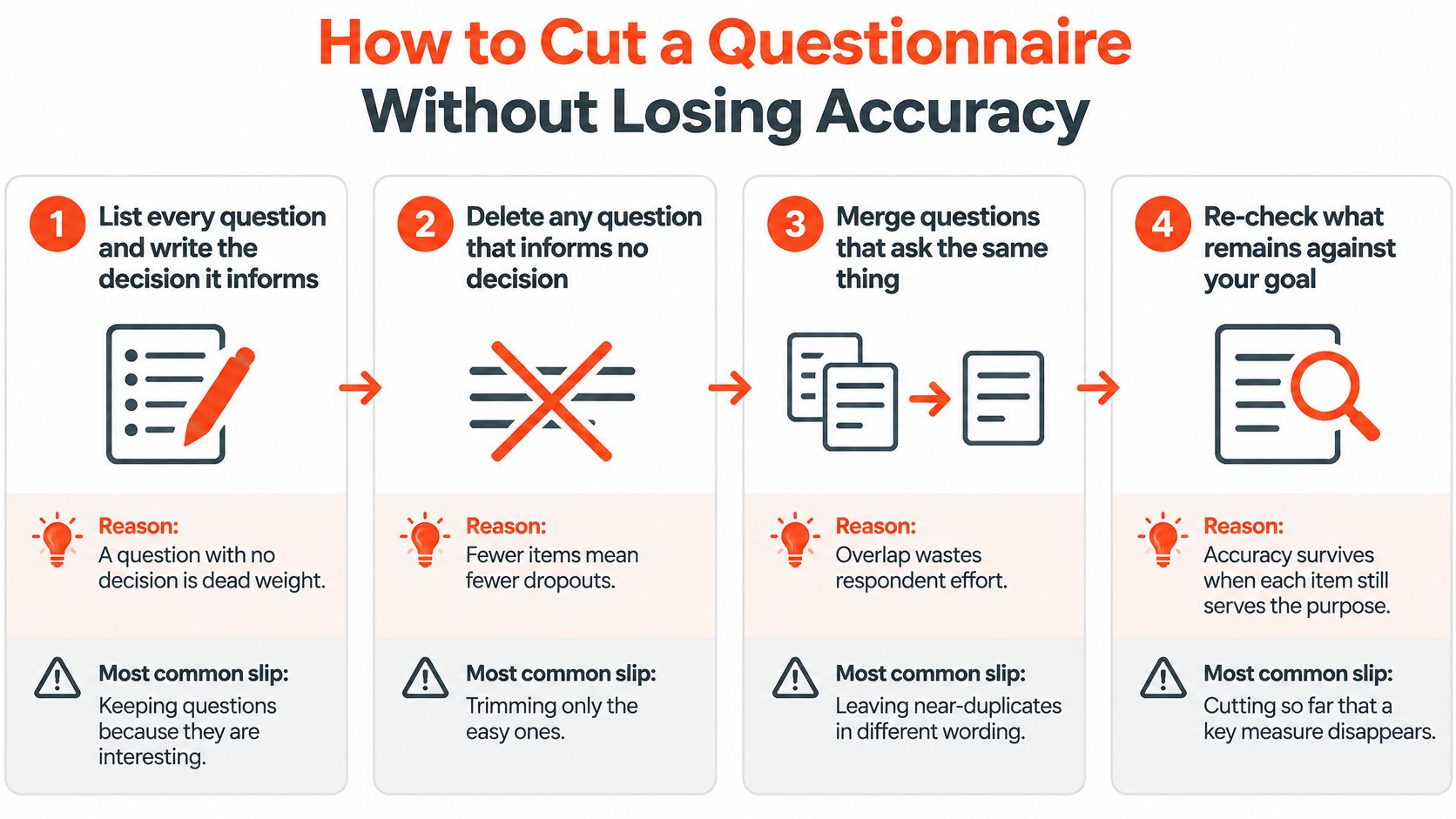
Cutting is a procedure, not a mood. Work through it in order, and stop as soon as the next cut would cost accuracy rather than effort.
The order matters. Early steps remove questions that carry nothing, so they cost no accuracy at all. Later steps trade a little precision for a lot less effort, which is why they come after the free wins and before the risky ones.
- List every question and write the decision it informs. One line per question, naming the decision and the person who acts on it. A question with no decision behind it is dead weight, and the usual slip is keeping it because the answer is interesting. "Interesting" is not a decision.
- Delete the questions that inform nothing. Fewer items mean fewer places to drop out, and this is the cheapest cut available. The slip here is trimming only the awkward questions and leaving the comfortable filler, the items nobody uses but everybody is used to seeing.
- Merge questions that measure the same thing. Keep the one input that carries the signal, such as height and weight, and drop the overlapping items that predict the same outcome with less precision. Two differently worded versions of the same question don't double your accuracy. They double the effort. Leaving those near-duplicates in is the mistake to watch for.
- Replace manual entry with estimation or selection where accuracy holds. Choosing a body shape often does the work of several tape measurements, and it lets you skip detailed manual entry entirely when height, weight, shape and an optional photo already pin down the inference. The slip here runs the other way: cutting a question the decision needs just because it's inconvenient to ask.
- Check the wording, not only the count. The study of 426 replicated survey questions in Sociological Methods & Research found that longer wording can improve comprehension in some cases while also adding cognitive burden and confusion that produces measurement error. A U.S. Bureau of Labor Statistics study cited there found that objectively longer surveys raised perceived respondent burden, and burden lowers effort and increases attrition. Sometimes the fix is a clearer sentence, not a shorter questionnaire.
- Test the short version against the long one. Compare response rate, completion and the accuracy of the downstream decision, then keep the shortest version that still clears your confidence threshold. The failure mode is measuring completion alone and shipping a flow that finishes fast but no longer recommends the right size.
Progressive disclosure is the thread running through all six. Begin with the minimum viable profile, calculate an initial recommendation, and ask one more high-information question only when the model can't separate two adjacent sizes. A shopper whose measurements sit clearly inside one size never sees the extra question. A shopper on the boundary gets the precision they need. Same accuracy, different effort, allocated only where it pays.
Notice what this procedure never uses: a target number. Each cut is justified by a decision, an overlap or a test result, not by a count someone published for a different audience and a different device. What you should hold at the end is a list of kept questions, each tied to a named decision. If a question's decision can't be written in a single line, it's either two questions or none. And if the list still feels long, compare it against your accuracy target rather than against a number someone else published.
Verify Your Question Count Before Launch
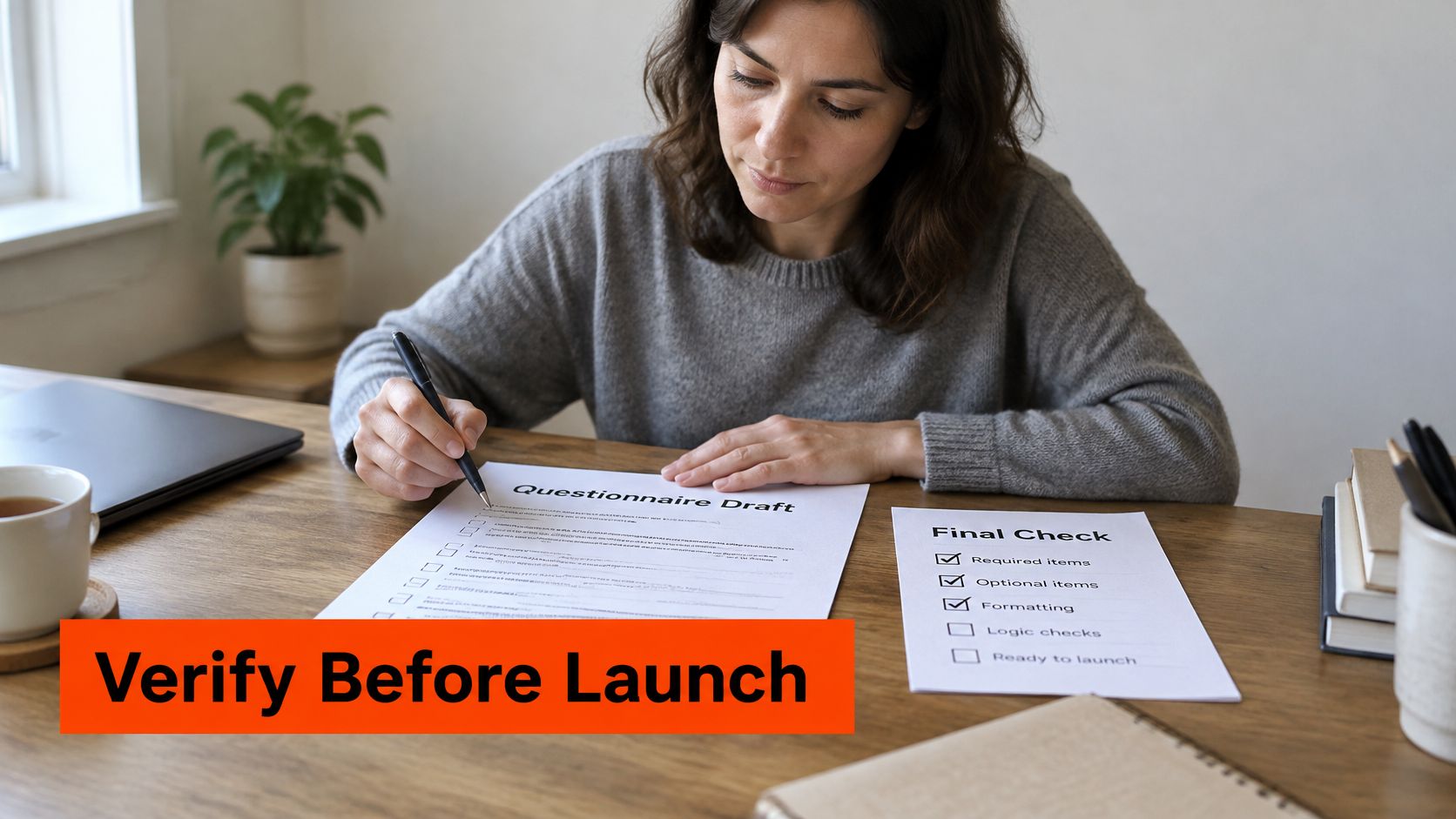
The draft is cut. Now prove it before real traffic does the proving for you.
- Count required and optional separately. Optional items must stay out of the core path, or they aren't optional.
- Time a real run on a phone. Not a desktop preview and not your own second attempt. Compare the result with the reference point for your survey type, and re-time after any wording change.
- Run the new version against a shorter or staged alternative. Track start-to-completion rate, question-level abandonment, missing answers and correction rates by version, segmented by device.
- Keep the version that reaches the needed accuracy with the least friction. Then review it once a full cycle of responses is in, because the questions people skip tell you more than the ones they answer.
A worked example. A sizing intake carries six required questions and two optional follow-ups shown only when adjacent sizes are in play. The phone run takes about 90 seconds, so the core path sits inside the window and the follow-ups stay outside the count. If abandonment spikes on the fourth question, rephrase it or cut it before you add anything else.
Judge every proposed addition by whether it changes the recommendation, never by whether it seems useful. A question that would give the same size answer either way is a toll on the shopper paid for nothing. The decision rule that sums this up: the right number is the fewest questions that reach the decision the survey exists to support.
The intake you just trimmed is the front door of a fitting experience, and the best route through it is the one a shopper finishes. Robosize builds that as a short body and fit questionnaire, turns the answers into a shopper-specific body model, and puts a garment-specific size recommendation on the product page, matching every item to your store's own size chart with unlimited charts on any plan. See how few questions it takes at Robosize.