You're on a clothing product page, comparing your measurements with a size chart that seems to describe nobody in particular. You don't own a tape measure, the garment's cut is hard to judge from photos, and the safest choice feels like ordering two sizes and returning one. A human body scanner changes that decision by turning a shopper's body into usable measurement data, but the technology only helps when retailers understand what it measures, how reliably it measures it, and how those measurements become a size recommendation.
The important distinction is easy to miss. A convincing digital avatar is evidence of good reconstruction, not proof of good sizing. A retailer needs to validate both.
Table of Contents
- Why Shoppers Still Guess Their Size Online
- The Three Main Ways a Human Body Scanner Captures You
- Comparing Capture Methods for Apparel Use
- What Accuracy Actually Means When the Body Becomes a Size
- From Body Scan to Virtual Try-On and Size Recommendation
- Privacy, Biometric Data, and the Selfie Question
- Evaluating a Body Scanner Vendor for Your Store
- What Body Scanning Solves Today and What It Still Cannot
Why Shoppers Still Guess Their Size Online
A shopper may know that a shirt feels tight across the chest, a pair of trousers sits differently at the waist, or one brand's medium fits like another brand's small. A flat size chart rarely captures those details. It lists garment or body dimensions, but it doesn't show how a particular cut, fabric, or ease allowance will behave on an individual body.
The usual workaround is a guessing exercise. The shopper searches for a tape measure, estimates from a previous purchase, or compares their body with a model whose proportions may be very different. If the decision remains uncertain, they hedge at checkout by choosing a familiar size, adding multiple sizes, or abandoning the purchase. This is why the problem is not a lack of product photography. Better images can show color, texture, and silhouette, but they can't directly answer, “Which size is most likely to fit me?”
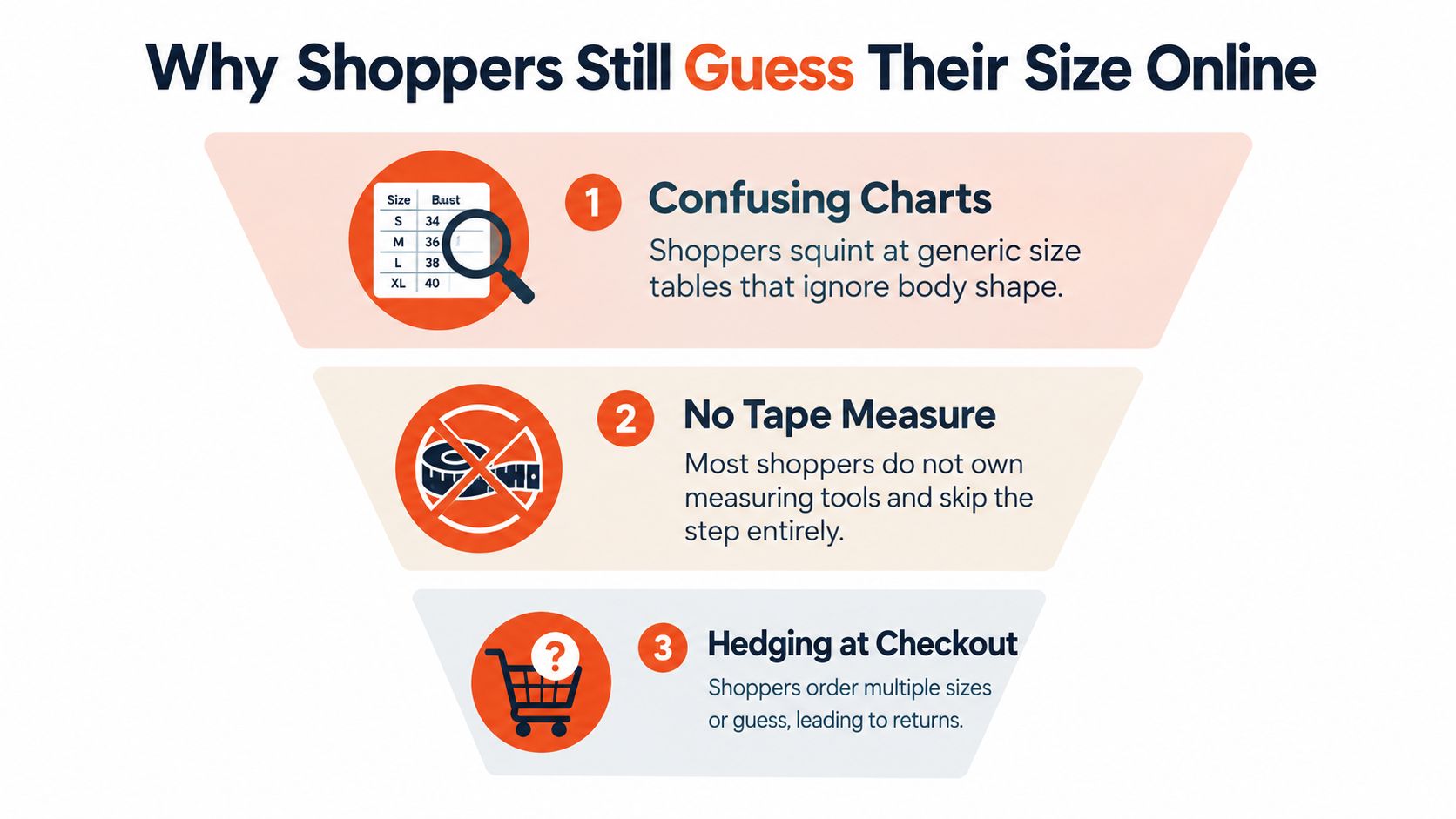
A size chart is a reference, not a fitting decision
A size chart gives shoppers a set of boundaries. A sizing tool has to make a decision under uncertainty. It needs to interpret body measurements, match them to a retailer's chart, account for garment construction, and communicate how confident the recommendation is.
That distinction explains why size-related returns remain difficult to eliminate. The retailer may have accurate product data, yet the shopper still lacks a reliable bridge between their body and the product. The bridge might be a fixed scanning booth, a phone-based capture flow, or a questionnaire that estimates body shape. Each approach reduces some friction while introducing different sources of error.
For a useful overview of the wider online sizing problem, see Robosize's analysis of why online shopping creates fit uncertainty. The core lesson is practical: measurement-based sizing is a different category of solution from adding more photographs to a product page.
The Three Main Ways a Human Body Scanner Captures You
A retail body-scanning experience usually belongs to one of three families. The shopper may stand in front of dedicated hardware, take several guided photographs, or answer questions with an optional selfie. The output can look similar, but the capture process determines what the system can observe and what it has to infer.
Dedicated 3D scanning
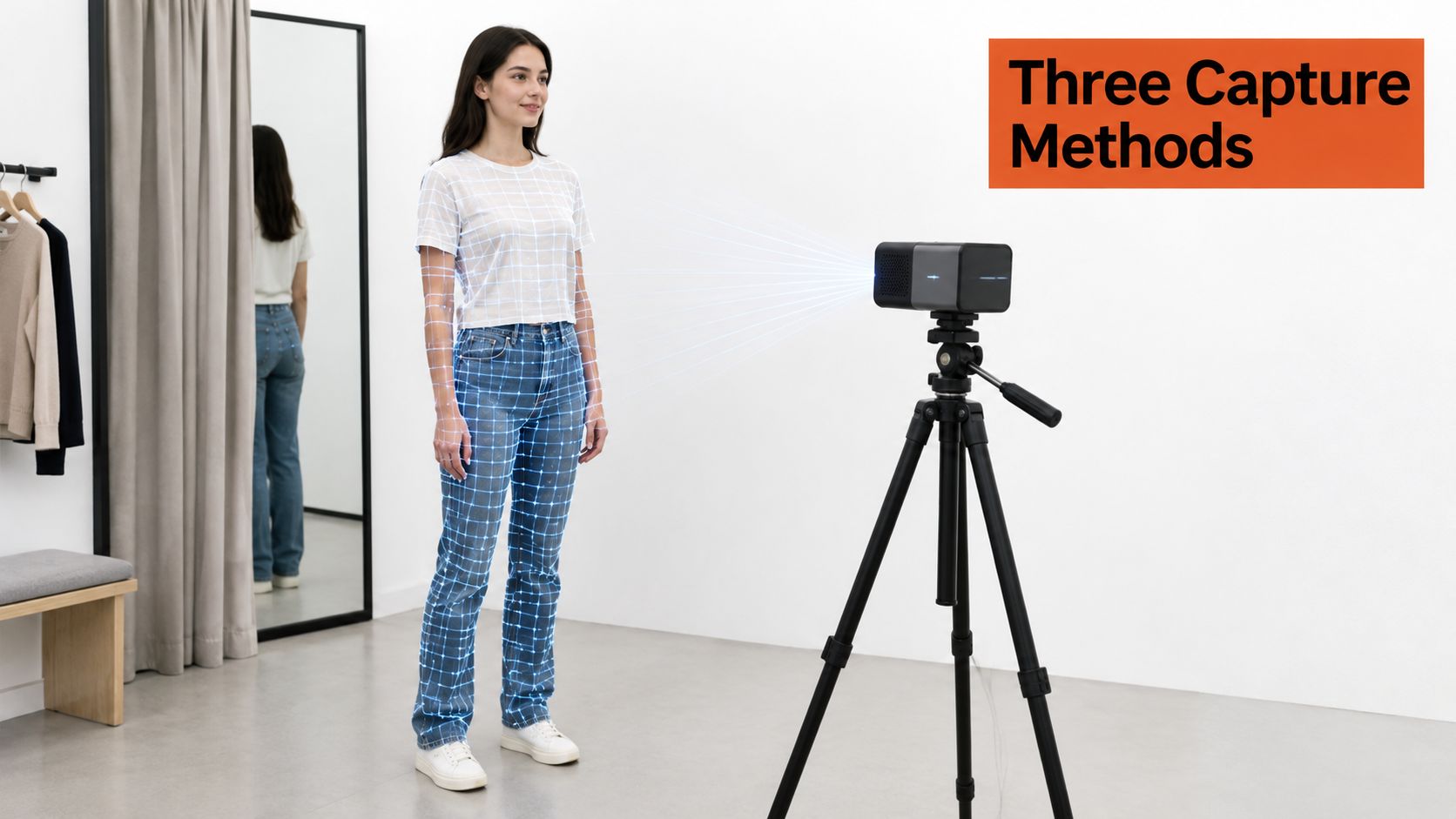
Structured-light and depth-sensor systems work like a light-based mold. The device projects or reads patterns across the body, observes the surface from a controlled viewpoint, and assembles a three-dimensional representation. A fixed retail booth can control distance, lighting, pose, and background, which makes the capture environment more predictable.
This method suits a flagship store, sizing studio, or other setting where the retailer controls the equipment. The tradeoff is operational. The shopper has to reach the scanner, follow instructions, and accept a more visible capture process. Hardware, maintenance, calibration, and staff training also become part of the deployment.
Photogrammetry
Photogrammetry works more like a photo mosaic. The system combines multiple images from different angles and uses visual features to estimate depth and shape. A guided phone flow can make this accessible without dedicated scanning hardware, but the result depends heavily on framing, lighting, clothing, camera position, and movement.
Photogrammetry can fit an online journey better than a fixed booth because shoppers already have a phone. It still asks them to cooperate with the camera. If one side of the body is hidden, the clothing is loose, or the pose changes between images, the system may have to fill in missing information.
Questionnaire and optional selfie
A questionnaire-plus-selfie flow behaves like a short interview. The shopper supplies inputs such as height, weight, age, or body shape, while the selfie can add visual information for a body model or virtual try-on. If the shopper doesn't want to provide an image, the questionnaire can remain the sizing path.
This approach usually has the lowest hardware requirement and can sit directly on a product page. It also relies more on estimation. The retailer should explain what the system needs, what it stores, and when it will request another input.
You can often identify the method from the experience itself:
- A fixed booth: Dedicated 3D scanning, designed for controlled environments.
- Guided phone images: Photogrammetry or camera-based reconstruction.
- Questions with an optional image: A hybrid sizing and visualization flow.
A practical free body scanner guide from Robosize can help teams compare these experiences before choosing an implementation.
Comparing Capture Methods for Apparel Use
No capture method wins every retail requirement. A dedicated scanner may provide a more controlled measurement environment, but a phone flow may reach more shoppers. A questionnaire can remove camera hesitation, while a selfie may produce a more personal visual result. The right decision depends on where the interaction happens and what the retailer needs the output to do.
Capture Methods Compared for Apparel Retail
| Method | Typical Accuracy | Shopper Friction | Hardware Required | Best Fit |
|---|---|---|---|---|
| Structured-light or depth-sensor 3D scanning | Strong potential in a controlled environment, provided the system is calibrated and validated by body dimension | Higher, because the shopper must visit or use dedicated equipment | Scanner, controlled space, calibration process | Store-based fitting, research, controlled sizing sessions |
| Photogrammetry | Variable, because image quality, pose, clothing, lighting, and occlusion affect reconstruction | Moderate, with guided photos and positioning instructions | Smartphone camera or image capture setup | Online flows that need a richer body model without a booth |
| Questionnaire with optional selfie | Measurement quality depends on the inputs and estimation model; a selfie can add visual context | Low to moderate, especially when the image is optional | Smartphone or browser, no dedicated scanner | Product-page sizing, mobile shopping, shoppers who prefer not to scan |
The table describes operational tradeoffs, not a universal ranking. A retailer should ask which error matters most. If the goal is a controlled anthropometric study, hardware and repeatable capture may justify the friction. If the goal is to help a mobile shopper choose between two adjacent sizes, a shorter flow with a clear fallback may produce more completed recommendations.
The product page changes the calculation
A scan that feels acceptable in a store can feel excessive on a product page. Online shoppers may be browsing quickly, using a small screen, or deciding whether to share a photo. The flow needs a clear reason for every question and a visible result at the point of purchase.
The lowest-friction option isn't automatically the least accurate. A questionnaire may avoid poor lighting and awkward camera angles, while a selfie may introduce occlusion or uncertainty. Conversely, a highly detailed scan isn't automatically useful if the retailer hasn't modeled garment stretch, cut, or ease.
Practical rule: Choose the capture method by the decision it must support, not by the visual sophistication of the avatar.
A retailer should also test the complete path, not just the capture step. Measure how many shoppers start, finish, receive a recommendation, understand it, and proceed to purchase. Accuracy matters, but so do completion, clarity, and integration with the size chart.
What Accuracy Actually Means When the Body Becomes a Size
A shopper can receive a convincing digital body and still get the wrong size. A small error in a circumference or landmark may place that shopper on the other side of a garment-size boundary. Reconstruction accuracy describes how faithfully the avatar represents the body. Sizing accuracy describes whether the recommended size matches the garment and the shopper's fit needs. Those measures overlap, but they are not interchangeable.
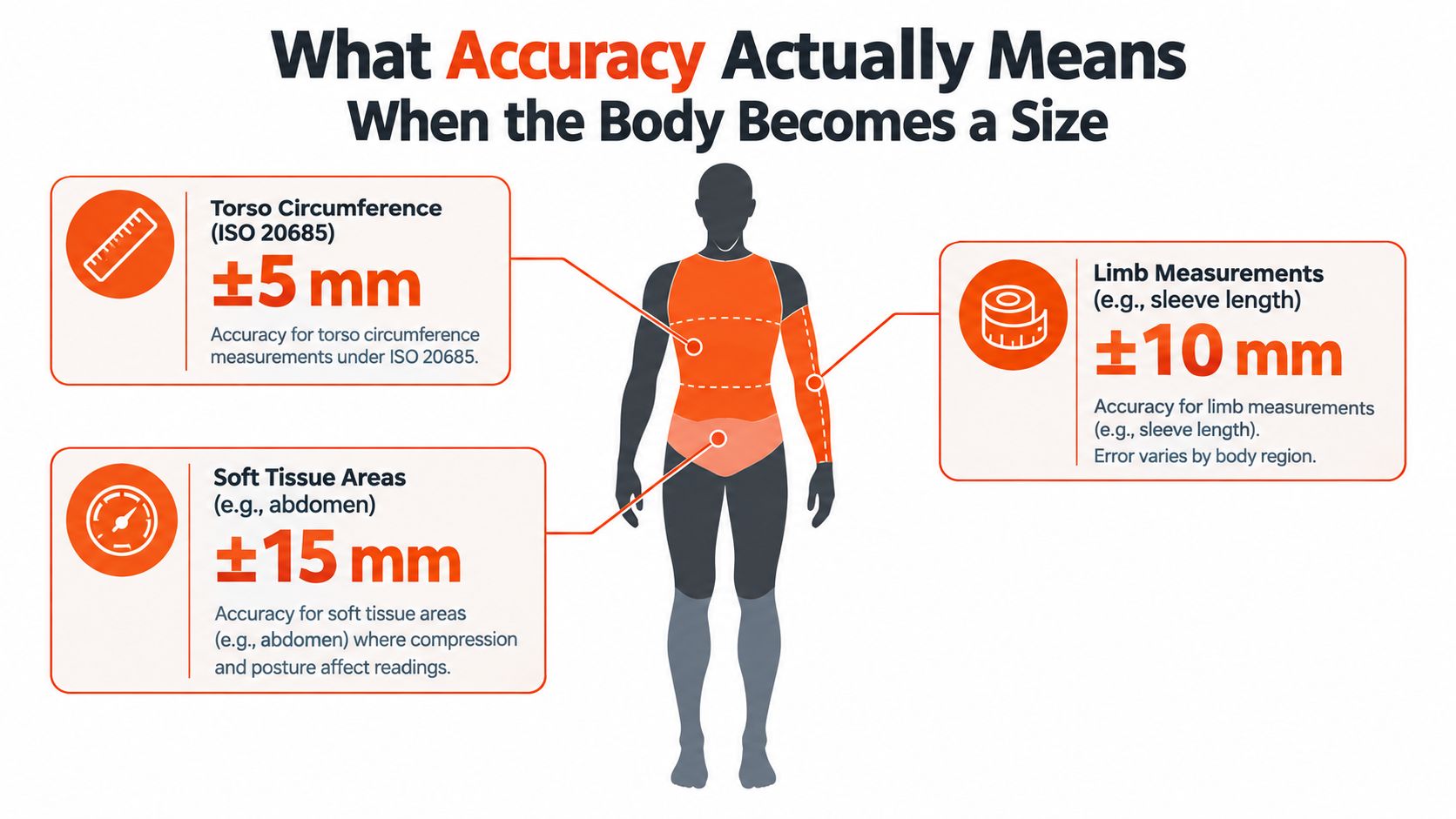
ISO 20685-2:2023 treats 3D surface-scanning validation as a testing problem that extends beyond sensor resolution. Operator technique, participant movement, rotation during capture, landmark placement, and scanner performance all add to total error. The relevant question is therefore not whether a scan looks detailed, but whether it measures the dimensions driving a decision, such as height, bust or chest, waist, hip, and inseam.
Why one number hides the useful information
Error changes by body region and capture condition. Clear landmarks may be easier to reproduce than soft-tissue areas. Hair, loose clothing, lighting, posture, and movement can interfere with the surface being interpreted. A polished mesh may still contain uncertainty around the abdomen, bust, shoulder, or crotch.
Ask vendors for validation results by size-driving dimension, not one overall accuracy score. A useful test uses a fixed pose, controlled clothing, repeat scans, and a calibrated reference object. ISO 20685-1 also provides a comparison with measurements taken by an experienced anthropometrist using ISO 7250 methods. That comparison gives a stronger basis for evaluation than placing two attractive renders side by side.
For how estimated inputs become a body model, see Robosize's height-and-weight body modeling explanation.
Repeatability is not the same as accuracy
A system may produce the same answer repeatedly while disagreeing with a calibrated reference. In a peer-reviewed study of a single-camera Styku S100 whole-body scanner used with athletes, test-retest reliability was nearly perfect, with a mean intraclass correlation coefficient of 0.98 and a mean standardized random error of 0.14. The authors concluded that one scan was sufficient for reliably collecting most circumferences, surface areas, and volumes in research and professional contexts.
That result supports a low-friction capture flow, while reference agreement still needs separate validation. A sizing system should identify measurements near a size boundary and apply an uncertainty rule, rather than presenting every recommendation with the same confidence.
From Body Scan to Virtual Try-On and Size Recommendation
The shopper usually sees two outputs: a visual try-on and a size recommendation. They may appear together, but they solve different problems. The try-on is a presentation layer that shows how a garment might look on a generated body. The recommendation is a measurement and garment-modeling decision.
A photorealistic render can still be wrong about size. It may smooth the body toward a generic shape, conceal a fit issue through image generation, or display a garment without correctly modeling the product's size chart and ease. The reverse can also happen. A sizing engine may produce a useful recommendation even when the avatar is visually simple.
A study of a single-camera whole-body scanner illustrates why repeatability is operationally valuable, but a retailer still needs a guardrail around uncertainty. The system should account for garment-specific ease, product measurements, fabric stretch, and the difference between a close-fitting sports top and a relaxed outer layer.
The recommendation needs a fallback
A serious sizing flow doesn't force every capture into a confident answer. It can request a second capture, reduce confidence, or fall back to questionnaire-based estimation when the shopper's pose, clothing, occlusion, or motion quality is poor. The fallback should be visible and understandable, not an unexplained error message.
A retailer should also separate three tests:
- Body reconstruction: Does the generated body resemble the shopper?
- Measurement extraction: Do the waist, bust, hip, inseam, and other values agree with a trusted reference?
- Garment recommendation: Does the system select the right size after applying the product chart and fit rules?
Teams planning a broader visual commerce experience may also benefit from this guide to AR product demos on Shopify, especially when deciding how a try-on component should fit into an existing storefront.
The video below shows how a virtual fitting experience can sit alongside the product decision. The visual result is useful, but it should support, not replace, the sizing logic.
Privacy, Biometric Data, and the Selfie Question
“Biometric” and “body measurement” aren't interchangeable terms. Under the EU GDPR, biometric data receives special protection when technical processing is used to uniquely identify a person. A dataset containing height, waist, hip, or other body measurements isn't automatically biometric merely because it describes someone's body.
The risk changes when the system captures or retains information that can identify the person. A face image, a unique identifier linked to the body model, or technical processing intended to recognize an individual calls for a different privacy analysis. Retailers shouldn't describe all body scanning as one category, because the actual data flow matters.
Questions a retailer should answer
A responsible implementation should make the capture and storage model legible before the shopper starts. The privacy notice should explain:
- What is captured: Measurements, photos, video, a face, or a generated body model.
- Why it is captured: Size recommendation, virtual try-on, account personalization, or another purpose.
- What is retained: Raw images, extracted measurements, derived models, or only the recommendation.
- Where processing occurs: On the device, in the browser, or in a cloud service.
- How deletion works: Whether shoppers can delete the data and how the retailer handles account removal.
- Whether consent is optional: Especially when a selfie improves visualization but isn't necessary for sizing.
A scanner that discards a face image after extracting measurements presents a different design question from one that stores the original image and links it to an account. The retailer should document that difference in plain language.
No scanner doesn't mean no privacy risk
A phone-based questionnaire can expose body-related personal information even without a camera. An optional selfie adds another layer of sensitivity, but removing the scanner doesn't remove the responsibility to minimize collection, control retention, and explain the purpose.
The practical approach is privacy by design. Collect only what the sizing or visualization decision needs, avoid retaining raw imagery when derived measurements are sufficient, restrict access, and give shoppers a meaningful choice. Privacy isn't a reason to reject every body model. It is a reason to inspect what the system captures rather than relying on reassuring labels.
Evaluating a Body Scanner Vendor for Your Store
A polished demo can hide weak sizing performance. Ask vendors to show dimension-level validation, the reference method used, clothing and pose conditions, and what happens when a capture falls below its quality threshold.
A working checklist
- Request dimension-level results: Look for separate findings for bust or chest, waist, hip, inseam, and other measurements that affect your products. One overall accuracy statement cannot show where fit decisions succeed or fail.
- Test boundary cases: Ask how the system handles a shopper near a size threshold. Confidence rules should guide the recommendation, with uncertainty exposed rather than concealed.
- Inspect the fallback: Confirm whether shoppers can complete a questionnaire, retry the capture, or continue without a selfie.
- Map the size charts: Check support for product-to-chart matching, garment-specific rules, and the retailer's metric or imperial units.
- Review implementation: A Shopify app may reduce setup work, while a JavaScript snippet may fit a custom storefront. Confirm where the component appears and how product data reaches it.
- Clarify usage controls: Ask how sessions are counted, how overages are priced, and whether the retailer can limit additional try-ons.
- Measure by catalog segment: Track recommendation acceptance, conversion, fitting-room use, and size-related returns across categories. A single catalog-wide result can hide weak performance in a specific garment group.
- Review the visuals: If virtual try-on matters, inspect multi-angle rendering and performance across product images, colors, and garment types.
Ask about repeatability directly. The Styku research cited earlier found strong test-retest reliability, but each vendor should show how its own capture process performs with its intended shoppers and clothing conditions. A model that reconstructs the body attractively is not automatically a model that selects the right size. Request both avatar-quality evidence and sizing-outcome evidence.
Reported case-study outcomes for AI virtual try-on deployments include higher conversions of about 17 percent, greater average order value of about 24 percent, and lower return rates of about 7 percent, with results varying by catalog and traffic mix (case-study overview). Use these figures as directional benchmarks, not promises. Catalog structure, traffic, garment construction, and implementation quality all affect the result.
One option for retailers is Robosize's questionnaire-and-optional-selfie flow, which creates a shopper-specific body model, supports virtual apparel try-on and garment-level size recommendations, and offers Shopify and JavaScript integration paths. The evaluation should focus on whether its capture method, recommendation logic, privacy controls, and reporting match the store's operating model. A vendor should explain what the system captures, what it derives from that input, and which parts are retained.
What Body Scanning Solves Today and What It Still Cannot
A modern human body scanner can reduce manual measurement friction, give shoppers a more consistent size decision, and provide a more personal way to inspect a garment online. It can turn a static chart into an interactive recommendation, provided the retailer has connected body measurements to accurate product and fit data.
It still can't guarantee that every relevant garment dimension is captured from one pose. It can't fully replace the feel of fabric, account for every preference in ease, or compensate for a poor size chart. A technically strong body reconstruction may still produce a poor recommendation if the retailer hasn't modeled stretch, cut, and garment-specific tolerances.
The useful mental model is simple: reconstruction accuracy and sizing accuracy are separate engineering problems. Privacy is also a data-design problem, not a choice between “scanner” and “no scanner.” A deliberate system may retain less information while still producing a detailed enough model for the decision at hand.
Retailers should treat body scanning as one input in a broader fit strategy. Validate the measurements, expose uncertainty, offer a fallback, and judge success by the shopper's actual size decision rather than the avatar's visual polish.
If you're evaluating a sizing or virtual try-on flow, visit Robosize to see how a questionnaire, optional selfie, shopper-specific body model, and garment-level recommendation can fit into a Shopify or custom apparel storefront. Use the product-page experience as a test case, then compare its validation, privacy controls, integration path, and measurement outcomes with your store's requirements.