“Choose your usual UK size, then convert it to EU or US” sounds like simple shopping advice. But a UK size number isn't a reliable promise about how a garment will fit. It's a label chosen by a retailer, and the useful information is the product's measurements, the garment's design and how those details compare with your body.
A clothing size chart UK shoppers can trust should help answer a more specific question: which size in this particular garment is most likely to fit? That means choosing the right chart for the garment, checking body measurements rather than relying on a label, and deciding what to do when bust, waist and hip measurements point to different sizes.
Table of Contents
- Why the Clothing Size Chart UK Is Not Universal
- Clothing Size Chart Categories by Garment
- Women's UK Clothing Size Chart in Detail
- Men's and Children's UK Size Charts
- UK, EU and US Size Cross References
- How to Measure Before You Trust a Chart
- Quick Reference When You Fall Between Sizes
- Choosing a Fit Tool Over a Static Chart
- What to Do Next with Your Measurements
Why the Clothing Size Chart UK Is Not Universal
A UK 10 doesn't describe one fixed set of body measurements across every shop. The UK has no universally enforced clothing-size chart, so retailers can assign different measurements to the same number. British Standard BS 3666:1982 attempted to standardise women's numbered sizes, traditionally from 8 through 32, but retailers weren't legally required to follow it. It also focused mainly on bust and hip, rather than describing a person's full proportions. (Background on British clothing sizes and standards)
A later European standard, EN 13402, moved toward labels based on body measurements in centimetres. That approach is more informative than relying only on a number, but measurement-based labels haven't been adopted consistently across UK retail. As a result, a size number is a broad retail convention, not a precise measurement specification.
A label doesn't tell the whole fit story
Even if two garments share a label, their fit can differ. A retailer chooses how much room to build into a garment, how it's shaped, which fabrics to use and what kind of fit the design is meant to provide. A stretch top and a structured jacket may therefore fit the same body differently, even within one brand.
This is why a static chart marked “UK 8,” “UK 10” or “UK 12” can only be a starting point. The garment's measurements, the shopper's body dimensions, the fabric and the construction all matter. A chart also needs to make clear whether it describes the intended wearer's body or the garment itself. Those are different sets of measurements.
Practical rule: Treat the number as a way to find a row in a brand's chart, not as evidence that the same number will fit at another retailer.
Cross-references can still help you recognise which regional label a product uses. They can't guarantee that a garment will fit like a UK high-street equivalent. For that, you need product-specific information, starting with a chart designed for the type of garment you're considering.
Clothing Size Chart Categories by Garment
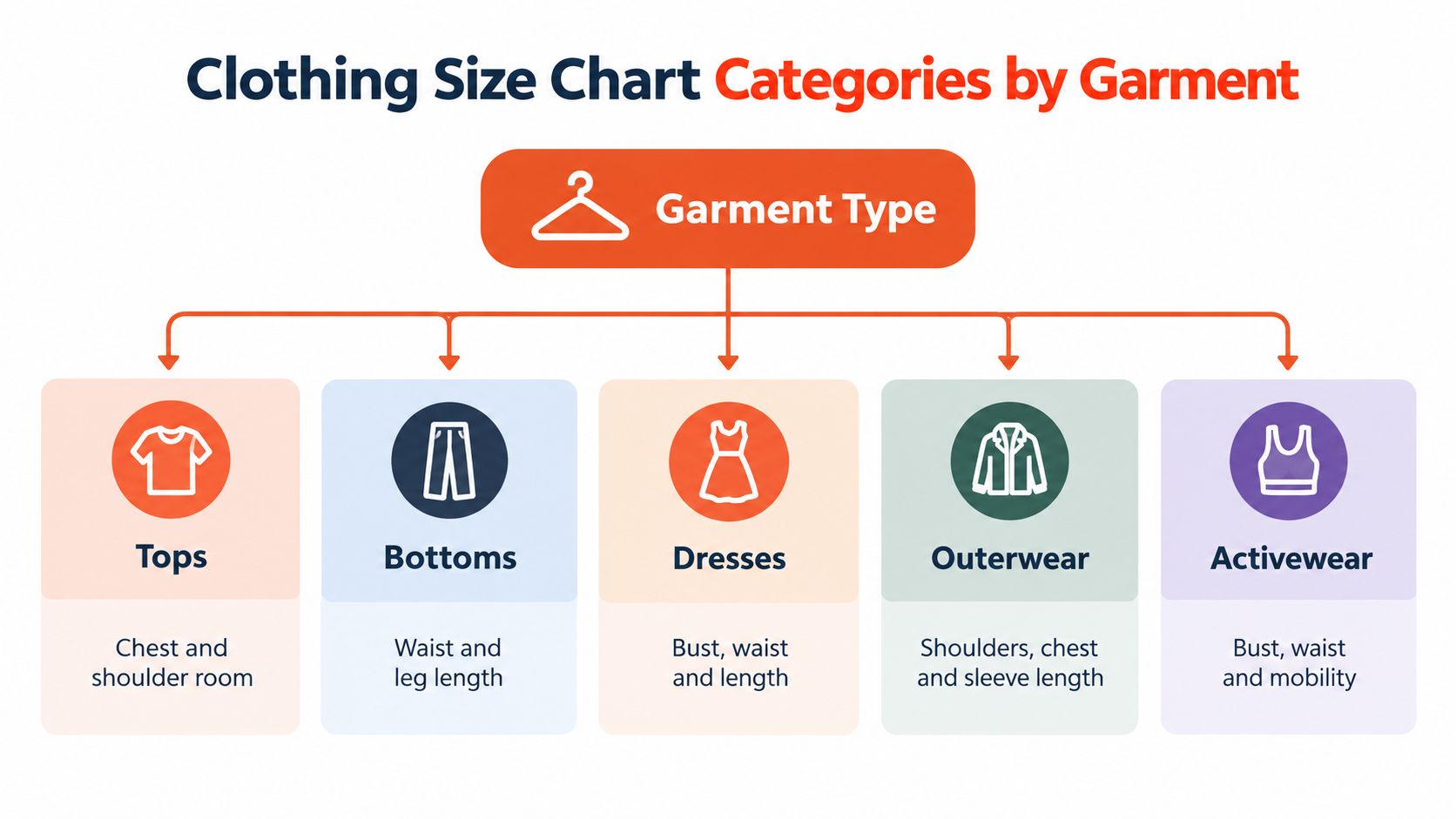
The first question isn't “Which number should I pick?” It's “What part of this garment needs to fit?” A shirt, a pair of trousers and a jumpsuit place different demands on the body, so their charts shouldn't rely on the same primary measurement.
Match the chart to the garment
ISO-aligned sizing uses a primary dimension to define the main size, then adds secondary dimensions to refine fit. The primary dimension depends on what the garment needs to accommodate. Bust or chest is often central for upper-body clothing; waist and hip matter for bottoms; a full-body garment may need height, and trousers can also need inside-leg information. (ISO guidance on body-measurement tables and size intervals)
Use that logic when you open a chart:
- Tops and shirts: Start with bust or chest, then check shoulder room or any additional fit notes.
- Bottoms: Compare both waist and hip. For trousers, check inside leg as well.
- Dresses and jumpsuits: Look for the dimensions that affect the bodice and lower body, and check height when the garment's overall length depends on it.
- Outerwear and activewear: Pay attention to the intended fit. A close-fitting layer and a relaxed coat may need different ease even when they share a primary measurement.
Women's, men's, boys', girls' and infant charts should also be treated as different population tables, not as one adult scale extended by age or label. A child's age, for example, doesn't tell you their height or chest measurement.
For shoppers, the practical step is to open the chart for the garment category you're buying and look for body measurements in centimetres. For retailers, that means storing each chart as measurement intervals for the relevant dimensions, rather than relying on a single label such as UK 10, M or 32. If a shopper's waist and hip fall in different rows, those ranges will be more useful than a lone size name.
Women's UK Clothing Size Chart in Detail
A women's UK size chart should describe the body measurements intended for a size, not the width of a garment laid flat. On a product page, read the UK number as the row label. Then check the measurements in that row, especially the dimension most relevant to the garment. Bust or chest often leads for a top or dress; waist and hip can help show whether that same row will work for the lower body.
The traditional numbered run from 8 through 32 is a range of labels associated with older British practice, not a guarantee that a particular number corresponds to today's body measurements. The SizeUK national survey, conducted in 2001–2002, was the first nationwide UK body-measurement survey since 1951 and the first to include men as well as women. Researchers scanned more than 11,000 people aged 16 to 95 across three UK regions, collecting approximately 1.5 million measurements. (UCL's account of SizeUK and changes in clothing fit)
Why the history matters to today's chart
Compared with the 1951 survey, the average female waist measurement had increased by about 16.5 centimetres, while the average woman was approximately 4 centimetres taller. Historical comparisons also report a change from roughly a 27.5-inch waist in 1951 to about 34 inches in the later survey. UCL reported that more than 60% of UK shoppers had difficulty finding clothes that fit. These figures help explain why a chart based on older body data may not describe contemporary shoppers well.
SizeUK measurements were later used to develop brand-specific charts for more than 25 UK retailers. That illustrates why a chart built around a retailer's own product data is more useful than a copied table based on an old standard. A UK 12 at one shop isn't evidence that a UK 12 at another shop will fit the same way.
When a product chart lists bust, waist and hip, compare each measurement rather than stopping at the first match. A dress may fit at the bust but feel restrictive at the waist, or suit the waist while having extra room at the hip. The garment's shape and fabric determine how important those differences are, so check the product's fit notes alongside the chart. If you want help working out your measurements before comparing them, use this women's clothing size calculator.
Men's and Children's UK Size Charts
A men's medium at one retailer can describe a different body than a men's medium somewhere else. The letter tells you the size category. It says nothing about the chest interval the brand assigned to it. Men's charts work better when you read them as measurement ranges: chest for tops and jackets, waist and inside leg for trousers, and neck for shirts that button at the collar.
For a men's shirt, match your neck measurement first if the shirt fastens at the top, then check the chest band and any fit note such as slim, regular or relaxed. For trousers, compare waist and inside leg together, because a correct waist paired with the wrong leg length still fails. Height appears on some men's charts as well, mainly for tall or short ranges, so treat it as a secondary check rather than the deciding number.
For children, use measurements before age
Children's charts should be separated for infants, girls and boys, since each group has its own measurement ranges. Age works like a rough postcode: it gets you to the right neighbourhood, not the right house. Two children of the same age can differ widely in height, chest and waist, so when a product page lists centimetre ranges, check height and the relevant girth measurement first and use age only to orient yourself.
Research on UK children's size charts found that their average measurements ran smaller than the body data recorded in the national Shape GB survey. A child can match a chart's height band yet still find the chest or waist too close, depending on how the brand graded the garment.
Two common cases show why the numbers beat the label:
- Trousers: Check waist and inside leg together. A correct leg length does not guarantee enough room at the waist.
- A jersey or school top: Compare chest and height. The age label alone will not tell you whether the top has enough width across the body or enough length to stay tucked.
When a product page gives measurement ranges, read those before reaching for an age or letter label. That habit keeps the comparison tied to the wearer's body rather than to a number the brand happened to print on the tag.
UK, EU and US Size Cross References
A conversion table works like a phrasebook: it can tell you which language you're looking at, and that's where its usefulness ends. Cross-reference charts do one job well, identifying whether a product page uses UK, EU or US labels. They can't confirm that a garment carrying one of those labels has the same measurements as a garment carrying another.
As noted earlier, reporting on UK high-street sizing found that garments sharing the same label can measure differently across retailers, with uneven grading between sizes too. If brands inside one country's system already disagree on what a size means, mapping that label onto a second system adds guesswork rather than removing it. An EU or US equivalent may point you toward the right part of a site. It can't tell you whether the garment there was cut for your measurements.
| Sizing System | What the Label Means | Safe Use | Main Limitation |
|---|---|---|---|
| UK numbered or letter label | A retailer's size name, such as a number or a letter category | Find the matching row on that retailer's chart | Retailers don't have to assign the same body measurements to the same label |
| EU measurement-led labelling | Sizing communicated through body measurements in centimetres | Use the stated measurements when the product page provides them | Measurement-led labelling isn't applied consistently across UK retail |
| US numeric or letter label | A size name used for a US product or chart | Treat it as a starting clue, then check the brand's own chart | A US label doesn't guarantee a stable one-to-one match with a UK or EU label |
Follow a foreign label only as far as the brand's own chart. Once you've found the likely row, compare the body measurement range for the garment's primary dimension, then the secondary ones. If a conversion guide gives you a starting point, use it to locate that row. Locating a row is different from proving a fit.
The same limit applies when your bust, waist and hip fall into different columns. A conversion table translates label names, nothing more. It can't tell you which of those three measurements should drive the decision for a fitted dress versus a loose blouse.
So "What UK size am I?" only becomes answerable with context: which brand, which garment, which cut and which measurements. A product-specific chart can work with those details. A universal UK-to-EU-to-US table can't.
How to Measure Before You Trust a Chart
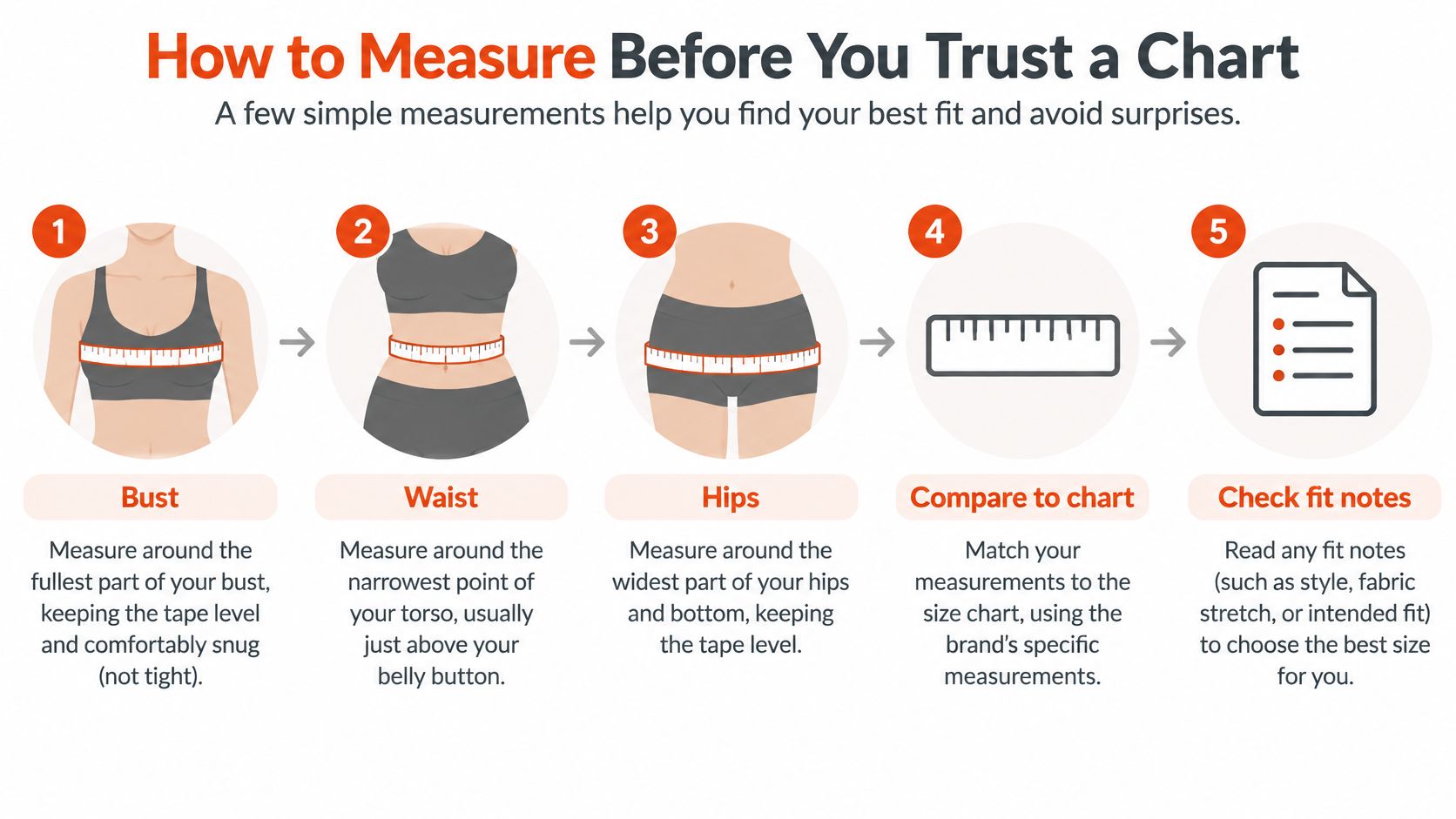
Measure your body, not a favourite jumper or pair of jeans. A garment has its own construction and amount of ease, so its dimensions don't directly tell you which body measurements a brand intends it to fit. For a consistent reference, take body measurements in centimetres, then convert to inches only when you need to read a chart that uses them.
Take the measurements the garment needs
Use a flexible tape measure and note the measurement point clearly. Bust or chest is measured at the fullest part; waist at the natural waist; hip at the fullest part of the hips. Height helps with full-body garments, while inside leg is useful for trousers. The key is consistency: a measurement is only useful if you compare it with the same defined body point on the chart.
ISO 8559-2 describes size designations based on the intended wearer's body measurements, with a primary dimension defining the main size and optional secondary dimensions refining the fit. Measurements are expressed in centimetres. ISO 8559-1 provides terminology and procedures for taking measurements, helping shoppers and retailers use the same definitions. (ISO information on body dimensions and size designations)
A useful product record should keep four things separate:
- Body interval: The range of body measurements the size is intended to fit.
- Garment measurement: The product's own measurement, when available.
- Fit profile: Whether the cut is slim, regular or relaxed.
- Definitions and units: The point being measured and whether the figure is in centimetres or inches.
For a dress, compare your bust to the chart's primary upper-body range, then check waist and hip against the secondary ranges. For jeans, compare waist and hip, then check inside leg for length. The most important number depends on the garment, so don't assume one measurement answers every fit question.
If you're buying a kilt, the measurement points and method can differ from those for everyday trousers. This guide on how to measure for a kilt with Kilts4Less gives garment-specific instructions. If taking a waist measurement is difficult, this guide to measuring your waist with a phone offers another point of reference.
Quick Reference When You Fall Between Sizes
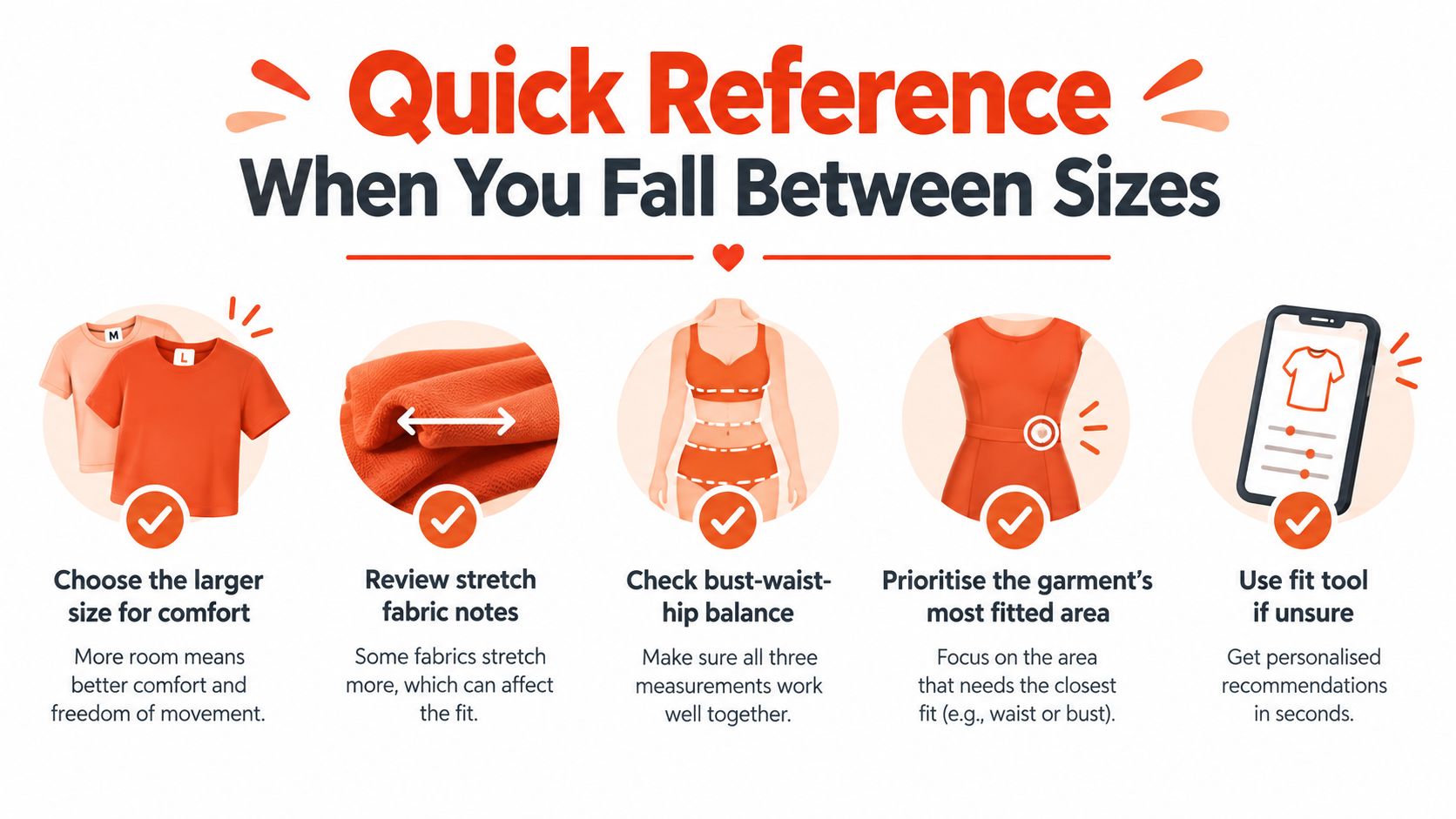
Your bust, waist and hip may not line up in one chart column. That doesn't mean your body is wrong or that one measurement must be ignored. It means you need to decide which part of the garment is most restrictive, then account for the fabric and the fit the designer intended.
Research on women's sports compression garments found that participants differed from the hourglass shape assumed in UK sizing standards; 44.44% fell between available sizes for at least one measurement across three brands. (Research on body shape and sizing in sports compression garments) This helps explain why a chart based on a single set of proportions may not give a clear answer for every body.
Make a decision based on the garment
Start with the largest restrictive dimension. For fitted trousers, that may be the hip or waist, depending on the cut. For a structured bodice, the chest or bust may be decisive. Then check the fabric and how much ease the product is meant to have. If you choose a size to accommodate one area, be clear about where you may have extra room elsewhere.
A blanket “size up” rule can mislead. Stretch fabric may tolerate a closer measurement match differently from a non-stretch or structured garment. A relaxed cut has different expectations again. Use the product's fit description rather than assuming that the same choice works for every style.
On the product page, check:
- Primary dimension: Which body measurement controls the fit for this garment?
- Secondary dimensions: Do your other measurements fit the same size range?
- Fabric behaviour: Does the product describe stretch or a more structured feel?
- Fit intention: Is the cut close, regular or relaxed?
- Chart match: Is this chart for the specific garment or just a general brand guide?
A UK label on an overseas brand doesn't prove the garment uses the same pattern block as a UK high-street retailer. The useful outcome isn't a falsely precise size number; it's a decision that names the trade-off, such as choosing enough room at the hip while expecting a looser waist.
Choosing a Fit Tool Over a Static Chart
A generic population chart, a retailer's own chart and an on-page fitting tool answer different questions. A generic chart can provide orientation, but it can't represent a particular product's design. A brand chart is more useful because it can describe that retailer's intended body measurements. A fitting tool can use those product details alongside a shopper's information to make a garment-level recommendation.
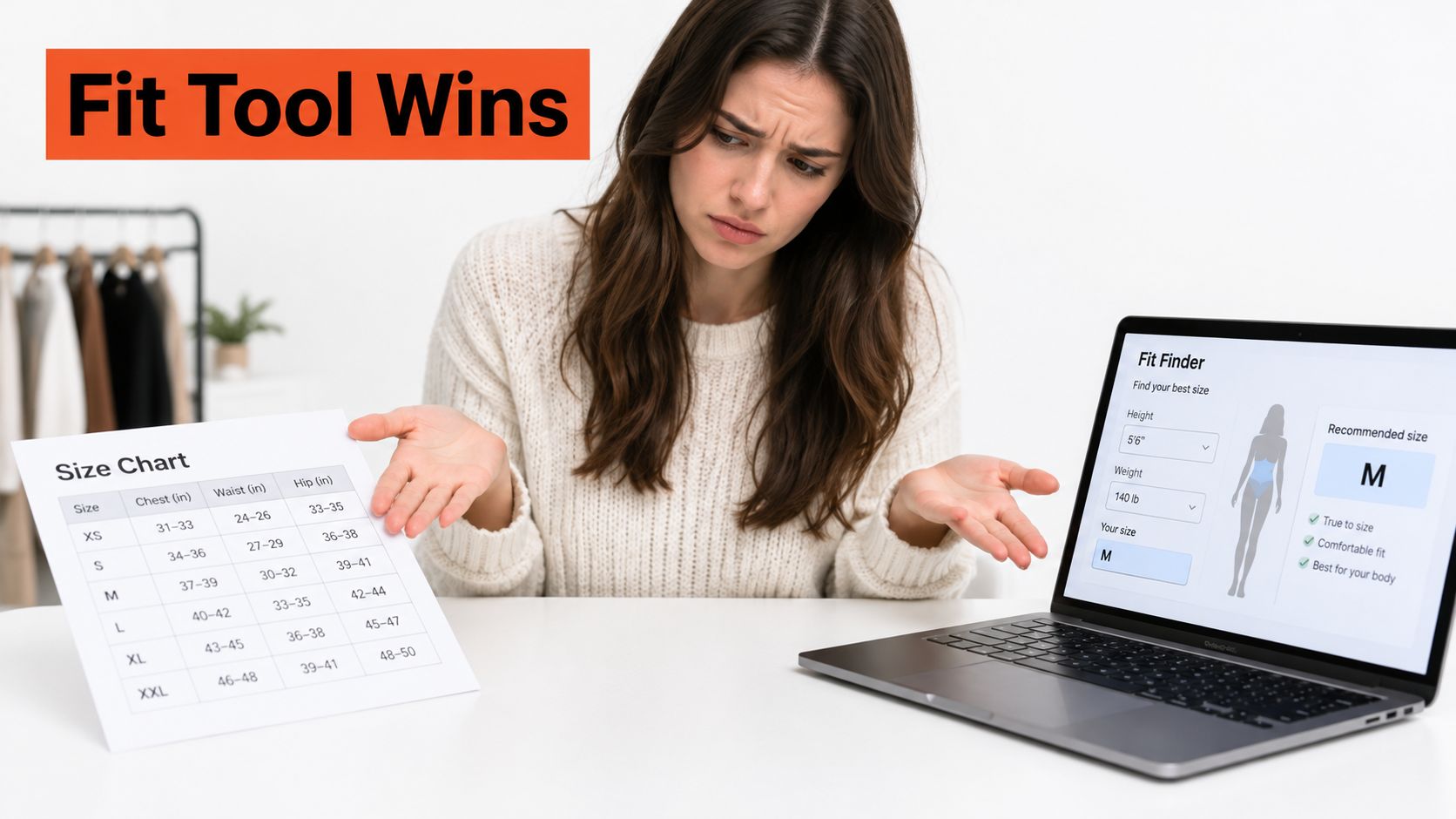
A static chart works when the brand provides clear body intervals and the shopper is comfortable comparing their measurements. It's also useful when the product has a straightforward fit and the relevant dimensions are easy to identify. But if measurements point to different rows, or the page doesn't explain the garment's fit, the chart may leave a shopper unsure which trade-off to accept.
What a product-page fitting room adds
Robosize is an AI virtual fitting room for apparel retailers. It uses a short questionnaire, with inputs such as height, weight, age and body shape, to create a shopper-specific body model; the shopper can also choose an optional selfie or an alternative model. The tool can render the product on that model, show a per-garment size recommendation on the product page and provide multiple viewpoints where the plan allows.
Retailers can upload size charts and match them to products, while shoppers can use metric or imperial units. The fitting room can be added through a Shopify app or a JavaScript snippet on other platforms. Optional features include social proof for similar body profiles, product recommendations, usage analytics, appearance styling and session controls. It doesn't replace the retailer's chart. It applies the available chart information to a particular shopper and garment.
If you're comparing virtual fitting options, consider whether the page makes the garment's fit easier to judge, not just whether it displays a size. A multi-angle preview may help you assess drape; a per-product recommendation can make the size choice more specific. A height and weight visualizer can also help shoppers understand how a visual model relates to those inputs.
The video below shows the product experience in context.
What to Do Next with Your Measurements
If you're shopping for one garment today, write down the measurements that matter for that category in centimetres. Open the brand's product chart, not a generic converter, and compare your body with the ranges for the garment's primary and secondary dimensions. If those measurements point to different rows, use the garment's construction, fabric and fit notes to decide which area needs the most room.
When the retailer offers an on-page fitting room, use the questionnaire and any available visualisation option to get a recommendation tied to the product. Check the preview and fit information before checkout, especially if you're balancing room in one area against a closer fit in another. The label is still useful, but it comes after the product details, not before them.
Retailers and ecommerce teams can take a parallel step: make sure each product has its own relevant body intervals, identify the primary dimension for that garment, and distinguish body ranges from garment measurements. A single sitewide chart shouldn't be presented as though every product block has the same fit. Clear chart-to-product matching gives shoppers a better basis for choosing than a label alone.
For a Shopify store, the Robosize app offers one installation route; retailers using other platforms can add the JavaScript snippet. Once the charts are matched to products, the fitting room can connect shopper inputs with garment-level recommendations and provide analytics on how shoppers use it.
Robosize provides apparel retailers with an AI virtual fitting room that combines shopper inputs, optional selfie-based visualisation and product-level size recommendations. If you're ready to make a clothing size chart UK shoppers can use with more confidence, explore Robosize for your store.